
Capability Academy • Keysi Fighting Method • Applied Awareness
Predator Alert
Training the eyes to stay online under pressure, so the protective structure does not become a visual prison.
It is one thing to move through everyday life with a reasonable level of awareness. It is another thing entirely to keep that awareness when someone is trying to punch you in the head.
Pressure changes the human machine. The field of vision can narrow. Attention can lock onto the most immediate threat. Breathing changes, muscles tighten, decision-making accelerates, and information that would normally be obvious can disappear from conscious recognition. The eyes may still be open, but that does not necessarily mean we are seeing.
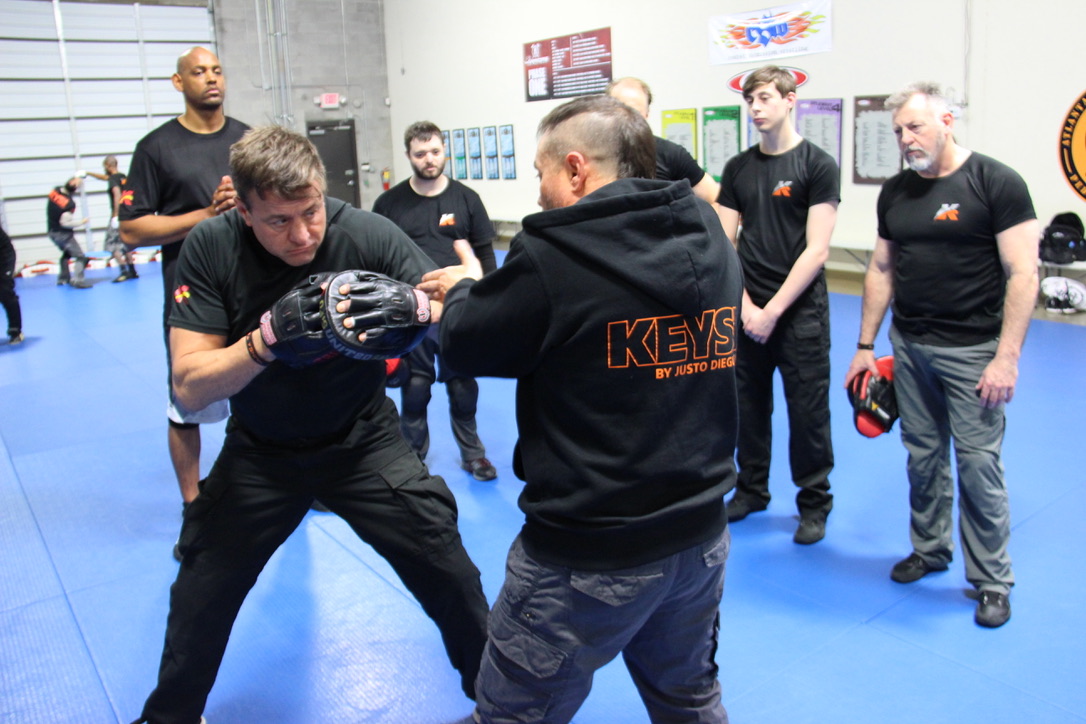
Inside Keysi Fighting Method, this is why building the Pensador and learning to articulate its shielding positions is only part of the work. The next task is training the practitioner to remain visually intelligent from inside that protective structure. We have to protect the head without allowing the shield to disconnect us from the environment.
The Protective Structure Is Only the Beginning
A beginning student can often learn the broad shape of a shield relatively quickly. The hands come to the head, the elbows find useful lines, the spine and shoulders help reinforce the structure, and the student begins to understand how the Pensador can receive and redirect pressure. That is important. It gives the nervous system a place to go when an exchange becomes chaotic.
But a structurally sound shield can still fail tactically if the practitioner cannot gather information through it. A person may cover correctly and yet lose track of the other hand, the second attacker, the wall behind them, the open exit, or the change in the opponent’s body that signals another line of force.
The Pensador is not meant to be a bunker. It is a mobile, articulated platform from which we protect, strike, manipulate, move, and continue making decisions. If the structure saves the head but shuts down the eyes, it has solved only part of the problem.
Eyes Open Is Not the Same as Information Received
When we tell a student to keep the eyes open, we are giving useful but incomplete advice. Vision is not simply a camera recording everything in front of us. What we consciously perceive is shaped by attention. Under stress, attention tends to be pulled toward the object that appears most dangerous. That response can be useful for surviving the immediate moment, but it can also cause the practitioner to miss information that changes the entire tactical picture.
A fist coming toward the face is designed to command attention. So is a loud aggressor, a sudden collision, or a body driving into close range. The problem is not that the practitioner notices the danger. The problem begins when the immediate danger consumes the whole visual field and erases everything else.
Awareness before contact is valuable. Awareness that survives contact has to be trained.
Research in sport, policing, and other high-pressure performance domains repeatedly shows that anxiety can change visual search behavior. Performers may fixate differently, scan less effectively, or allocate attention in ways that reduce the information available for action. We should be cautious about transferring laboratory findings directly into a violent encounter, but the practical direction is consistent with what instructors observe on the floor: pressure changes how people look, what they notice, and what they fail to notice.
Predator Alert Is Not Hypervigilance
In our Keysi training, I use the phrase Predator Alert to describe an active, disciplined visual state. It is not fear-based scanning, nervous head movement, or a theatrical attempt to look dangerous. It is the ability to remain connected to the larger environment while dealing with the problem directly in front of you.
The name points toward purposeful observation. A predator does not stare blindly at one detail. It reads movement, distance, direction, opportunity, obstruction, and changes in the surrounding field. In training, Predator Alert means developing the habit of reopening the picture whenever pressure tries to close it.
The objective is not to look at everything. No one can process every detail in a chaotic environment. The objective is to avoid becoming blind to everything except the problem directly in front of you.
Why the Four-Man Box Is an Ideal Training Environment
The Four-Man Box gives us a controlled environment in which to make this problem visible. The practitioner works inside a small field surrounded by multiple training partners. Depending on the phase of the drill, partners can provide touch, pressure, strikes, changes of angle, directional cues, verbal information, or limited tactical choices.
The value of the box is not simply that several people are present. Its value is that it exposes the natural tendency to disappear into a single exchange. A student receives pressure from one partner and begins solving that problem as though nothing else exists. The body turns, the eyes lock, and the other people in the environment vanish from the student’s working awareness. The box makes that loss observable.
This is why the drill should be treated as a laboratory rather than a contest. We are not trying to create a chaotic pile of people or prove that the person in the middle can endure punishment. We are using a structured problem to study where vision collapses, when attention becomes sticky, and what training cues help the practitioner reopen the field.
Done properly, the Four-Man Box lets us adjust one variable at a time. We can slow the pace, limit the available attacks, reduce physical force, establish visual markers, or ask the student to identify information while maintaining the Pensador. Then we can gradually increase complexity without abandoning the learning objective.
Learning to Look From Inside the Pensador
The Pensador is not a single shield position. It is a family of connected structures that can articulate around the head and body. That articulation creates windows. Some are obvious, some are peripheral, and some appear only when the body turns or the arms change relationship.
A student has to learn those windows. Where can the eyes see without weakening the shield? How can the chin, forehead, shoulder, forearm, and hand work together without covering both eyes unnecessarily? Can the student rotate the torso and use the shield to redirect pressure while keeping useful visual contact? Can the student change from one shielding relationship to another without losing the room?
Early in training, the head often hides behind the arms because the student is trying to feel safe. That response is understandable. It also gives the instructor a clear developmental task. We do not ask the student to abandon protection. We teach them to organize it more intelligently, to find the visual lanes that already exist, and to move the structure so that protection and perception support one another.
Seeing While Acting
The difficult part is not looking around while nothing is happening. The difficult part is continuing to see while the body is busy. The student may be receiving impact, striking, changing level, turning, controlling an arm, moving around an obstacle, or trying to recover position. Each task competes for attention.
This is where visual skill has to become integrated with movement rather than added on top of it. If a student stops working every time they scan, the visual action has not yet become part of the method. If they can move the Pensador, strike from the structure, and briefly widen the picture without losing balance or protection, the pieces are beginning to connect.
This relates directly to the Nucleus. Individual movements are like notes and chords. The deeper skill is learning to play the music in the moment. Predator Alert is part of that music. It keeps the practitioner connected to timing, space, pressure, and emerging information while the body expresses the method.
La Mano Negra: The Blind Spot Becomes Information
One useful training device is what we call La Mano Negra, the Black Hand. A training partner presents an unexpected hand, touch, or cue from outside the student’s primary focus. The task is not to chase every movement. The task is to notice that the field has changed and respond without surrendering structure.
At first, the cue should be clear and the pressure modest. The student can be asked to identify the hand, touch it, orient toward it, move away from it, or use an appropriate shield. As competence grows, the cue can appear at less predictable moments and from more difficult angles. The black hand becomes a simple way to reveal whether the student is truly collecting information or merely staring through the drill.
This work should not become a game of catching the student unaware. If the partner is rewarded for winning the surprise, the drill quickly turns into cheap shots and noise. The purpose is to create a learnable signal that improves the practitioner’s ability to detect change.
The Optics Must Survive Positional Change
Standing is only one position of the human machine. In the Keysi “Around the World” framework, we train concepts while standing, kneeling, seated, and on the ground. Each position changes the visual problem.
When standing, footwork can reopen angles and create space. While kneeling, mobility is reduced and the horizon changes. While seated, the chair, vehicle, wall, or furniture can block movement and vision. On the ground, the practitioner may be looking upward through limbs while another person’s body fills most of the available field.
Predator Alert has to survive those transitions. A practitioner who sees well while standing may lose the environment when taken to a knee. A student who scans effectively in open space may become visually trapped when backed against a wall. Training across positions prevents us from confusing success in one favorable arrangement with a transferable skill.
What Is Not Trained Begins to Deteriorate
I have seen this in my own training and in students over many years. When visual awareness under pressure is trained consistently, the body begins to keep more of the environment online. The student does not become immune to stress, but the contraction is less severe and recovery is faster. When the work disappears from training, the skill begins to lessen.
This is important because Predator Alert is not a trick that can be learned once and permanently stored. It is a relationship between perception, movement, and nervous-system regulation. That relationship has to be refreshed. The good news is that the training does not always require maximum intensity. Short, focused rounds with a clear visual objective can maintain the skill far better than occasional uncontrolled chaos.
A Progressive Method for Training Predator Alert
The progression below is not a rigid curriculum. It is a practical framework instructors and serious students can adapt. The central rule is simple: do not add so much pressure that the behavior you are trying to develop disappears completely.
- Establish visual windows. From a stable Pensador, identify where the student can see without separating the hands from the protective structure. Explore small changes of arm, shoulder, head, and torso position.
- Add directional references. Place partners or markers at known points. Ask the student to orient briefly toward a called direction while keeping the structure organized.
- Protect and identify. Introduce light, predictable contact. The student shields while naming a hand, number, color, or movement shown elsewhere in the field.
- Act without losing the picture. Add a strike, frame, control, turn, or exit. The student completes the action and immediately reopens the visual field.
- Introduce the Black Hand. Present a secondary cue outside the main exchange. Keep it slow enough that recognition is possible, then vary timing and angle.
- Change position or environment. Repeat the work standing, kneeling, seated, and grounded. Add a wall, chair, doorway, or training vehicle only when it serves the lesson.
- Add limited choice. Give partners two or three defined options so the student has to read and decide rather than repeat a memorized answer.
- Add progressive pressure. Increase pace, contact, uncertainty, and consequence in measured steps. If the student becomes visually absent, reduce one variable and rebuild.
What the Instructor Should Observe
Head and Eye Behavior
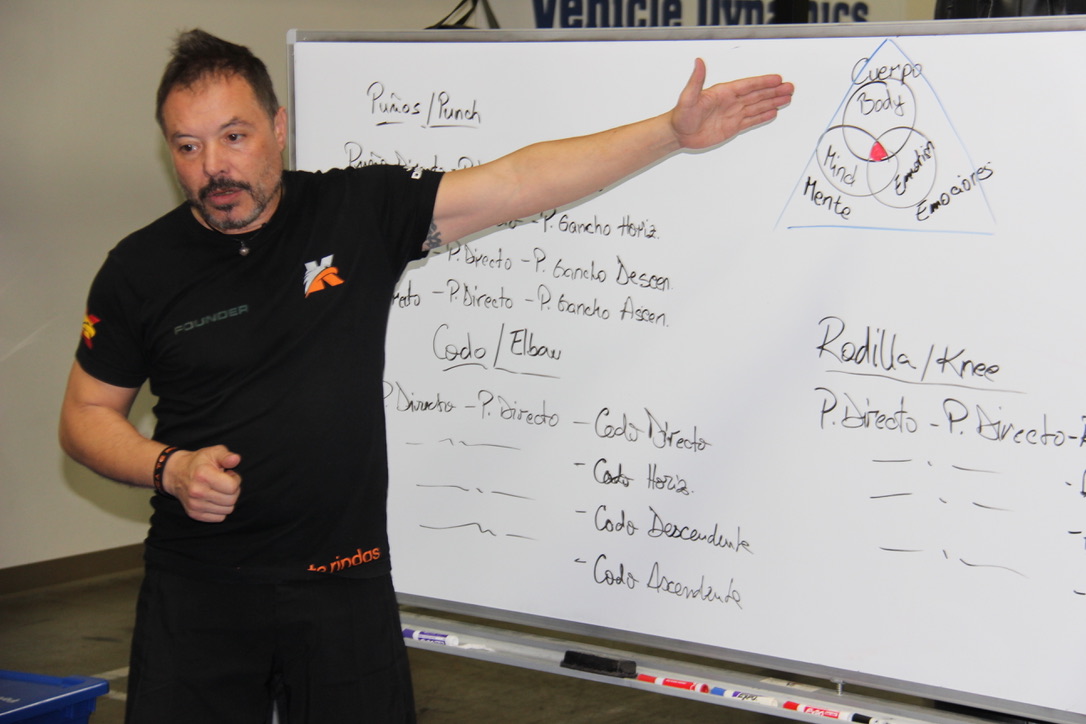
Does the student bury the face, close the eyes, stare at one hand, or keep useful visual windows through the shield?
Attention Recovery
After immediate contact is solved, does the student reopen the field, or remain mentally attached to the previous threat?
Structure Under Vision
Does looking cause the hands to drift away from the head, the elbows to flare, or the spine to lose organization?
Scanning Quality
Is the student collecting information, or performing empty head movement because the instructor said to scan?
Decision Timing
Can the student use new information soon enough to change position, action, or priority?
Breathing and Regulation
Does the student hold the breath and harden under pressure, or can they regulate enough to keep receiving information?
The instructor should also watch the partners. Poor partners can ruin good drills. They must provide clean information, appropriate pressure, and enough time for the target behavior to appear. Their job is to help create the problem, not to steal the round.
Pressure Is a Tool, Not the Objective
More pressure is not automatically better training. If every round drives the student beyond the point where perception, choice, and learning remain possible, the nervous system may simply rehearse freezing, flinching, staring, or bracing. Those behaviors are important to observe, but repeating them without a path forward does not create skill.
The instructor needs to find the edge at which the student is challenged but still capable of adaptation. Sometimes that means slowing the hands. Sometimes it means reducing the number of partners who are active. Sometimes it means keeping the physical pressure while simplifying the decision. Sometimes the student needs a short pause to identify what disappeared.
Pressure becomes valuable when it reveals a failure, allows correction, and then gives the student another opportunity to succeed. The goal is not to make the drill look violent. The goal is to produce a practitioner who can remain functional when violence changes the picture.
Vision Is Only One Part of What Deteriorates
We have chosen vision as the subject of this article, but it belongs to a larger family of capabilities that can deteriorate under pressure. Fine motor control, hearing, balance, breathing, memory, timing, communication, and judgment may all change. The exact response differs by person, training history, fatigue, environment, and perceived threat.
This matters because instructors should resist treating every failure as a technical mistake. A student may know the movement and still be unable to access it because attention has collapsed. Another may see the opening but cannot organize the body quickly enough to use it. A third may move effectively but lose the ability to communicate.
The Four-Man Box helps us isolate and reconnect these abilities. We can make the eyes the primary learning objective for one round, breathing for another, position for another, and decision-making for another. Over time, the separate lessons have to be reintegrated into the living method.
When pressure enters your training, does your protective structure help you see more clearly, or does it become the place where your awareness disappears?
Train One Visual Objective This Week
During your next Four-Man Box session, reduce the intensity enough to observe one thing clearly: the moment your field begins to narrow. Ask the partners to give you a simple secondary cue. Keep the Pensador connected, deal with the immediate pressure, identify the cue, and reopen the room.
Do not rush to make the drill harder. First make the behavior repeatable. Then add movement, positional change, limited tactical choices, and progressively greater pressure. The ability to keep seeing is built the same way as any other serious capability: deliberately, honestly, and over time.
Do Not Let the Immediate Problem Erase the Larger One
A close-range assault demands immediate action. The person in front of us matters. The strike matters. The structure matters. But the first problem may not be the only problem, and the most obvious threat may not remain the most important one.
Predator Alert is the discipline of staying connected to that reality. It trains the practitioner to protect the head, articulate the Pensador, act with purpose, and continue gathering information. It turns vision from a passive sense into an actively trained component of the method.
Address the problem in front of you without allowing it to erase everything developing around you.
That is a demanding skill. It is also one of the reasons the Four-Man Box remains such a valuable laboratory. Inside its controlled pressure, the practitioner learns that survival is not only about building a stronger shield. It is about remaining present, informed, and capable from inside it.
The practical observations in this article are grounded in training experience. The following research provides useful context on anxiety, visual attention, perception, and performance under pressure:
- Vine, Moore, and Wilson: Quiet Eye Training in Sport
- Nieuwenhuys and Oudejans: Effects of Anxiety on Police Handgun-Shooting Behavior
- Nieuwenhuys and Oudejans: Training With Anxiety and Performance Under Pressure
- Police Arrest and Self-Defence Skills Performance Under Anxiety
- Anxiety, Perceptual-Motor Performance, and Attentional Control
- A Review of Stress-Related Visual Attention and Performance
Shift Your Perspective, Take Action, And Forge Your Path To Greatness