
Capability Academy • Keysi Fighting Method
The Nucleus: Why Keysi Fighting Method Trains Problems, Not Just Techniques
Technique gives us the notes. Drilling teaches us how to produce and connect them. The Nucleus teaches us how to play the music when the arrangement changes.
There is a considerable difference between knowing how to produce a collection of notes and knowing how to play music.
A beginning musician must learn the fundamentals. The student learns how to hold the instrument, produce a clear note, maintain rhythm, practice scales, form chords, and move between them without losing the structure of the song.
Every one of those skills is necessary. None of them, by itself, is the music.
The real transformation begins when the musician can bring those elements together, listen to what is happening, respond to the other musicians, and express something coherent in the moment. The musician is no longer occupied with recalling one note at a time. The fundamentals have become part of a larger language.
Martial arts development follows a similar path.
We begin by learning individual movements. We develop strikes, protective structures, footwork, entries, controls, takedowns, escapes, and methods of recovery. We practice them repeatedly so the body can reproduce them with greater efficiency.
We then connect movements into combinations and partner exercises. These connections begin to form chords. Drills help us develop rhythm, timing, coordination, and familiarity with specific relationships.
But the final objective is not to spend an entire combative exchange searching for the next note.
The real skill is learning how to play the music.
Fundamental Vocabulary
Technique Is Necessary, but It Is Not the Final Objective
This is not an argument against technique.
A student cannot adapt something that has never been developed. Creativity without fundamentals usually becomes guesswork. Before a practitioner can move freely, there must be reliable mechanics, recognizable structures, and a functional vocabulary.
In Keysi Fighting Method, this vocabulary includes protective structures such as the Pensador, body mechanics, footwork, strikes, entries, trapping, manipulation, takedowns, positional movement, recovery, and disengagement.
An individual technique allows us to isolate a relationship and study it with greater clarity. It gives the instructor an opportunity to correct posture, structure, balance, direction, timing, and mechanical efficiency.
The problem begins when the example is mistaken for the complete answer.
A student may become very good at performing a technique from a familiar starting position with a cooperative partner. Change the distance, timing, direction, pressure, or position, however, and the technique may no longer fit the relationship.
Technique gives the student vocabulary. Understanding allows the student to participate in the conversation.
The Central Relationship
What Is a Nucleus in Keysi Fighting Method?
One of the distinctive ideas within Keysi is the Nucleus.
A Nucleus is the central relationship, principle, or developmental problem being investigated. It is not simply the name of a technique or a sequence that must always be performed in the same order.
The Nucleus tells us what we are trying to understand.
Protection
Protecting the head while entering close range.
Structure
Maintaining useful structure during a collision.
Orientation
Reorienting when another person enters the environment.
Recovery
Regaining mobility after losing the preferred position.
The individual actions used to solve the problem may change. The central relationship remains recognizable.
Suppose the Nucleus is maintaining protection while entering. The student may begin with a known attack and use a specific Pensador structure. The student protects, closes distance, strikes, controls, and recovers.
Then the distance changes. The attack comes from another direction. The timing shifts. A wall restricts movement. The student begins seated instead of standing. Another person enters the environment.
Each condition requires a different expression, but the Nucleus remains: maintain protection while entering.
A Long-Term Perspective
More Than 45 Years in the Ocean of Technique
I have spent more than 45 years studying multiple martial arts.
During that time, I have trained in systems from different cultures, lineages, environments, and tactical perspectives. I have studied striking, grappling, weapons, self-protection, traditional arts, modern training methods, and systems designed for specific professional or competitive environments.
I have seen versions of the developmental process we are discussing in many of them.
The terminology changes. The drills change. The preferred tools and ranges change. One system may organize the idea through forms. Another may use combinations, partner exercises, positional sparring, scenario training, competitive rounds, or pressure testing.
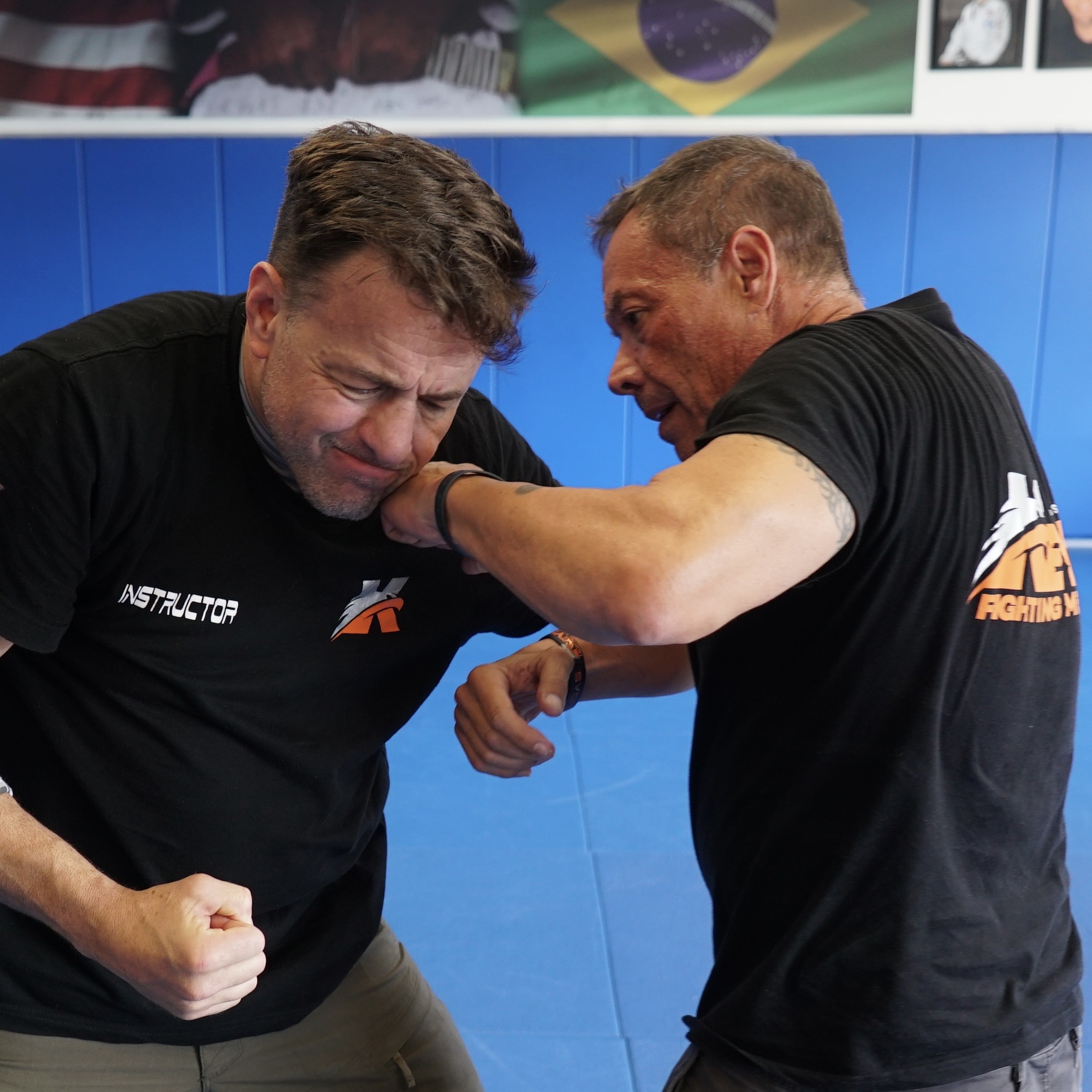
Some instructors develop this process deliberately. Others arrive at it through years of experience without giving it a particular name.
The underlying question remains similar: Can the student move beyond reproducing a technique and begin understanding the relationships that make the technique work?
This distinction matters because a martial art can easily become a collection of techniques.
The student learns one response for a punch, another for a grab, another for a takedown, and several more for each variation the instructor can imagine. New seminars, videos, books, classes, and training partners continue adding material to the collection.
The student may become very knowledgeable. Knowledge and functional understanding, however, are not always the same thing.
At some point, the number of possible situations becomes too large to manage through memorization alone. No instructor can provide a separate answer for every possible combination of distance, timing, direction, position, pressure, environment, and human behavior.
The danger is not having too few techniques. The danger is becoming so lost in the ocean of technique that we can no longer see the relationship in front of us.
After decades of studying different martial arts, I have come to believe that simplicity is mastery.
Simplicity does not mean possessing little knowledge. It means organizing a large amount of knowledge around a smaller number of dependable relationships.
The deeper martial skill is not simply knowing more. It is being able to perceive, organize, select, connect, and express what we know.
That is the territory the Nucleus helps us investigate.
The Developmental Progression
Notes, Chords, Rhythm, and Expression
The Notes
An individual strike, shield, step, trap, takedown, or escape. The student first needs to produce it clearly and reliably.
The Chords
Movements become connected. Protection becomes striking, entry, control, recovery, or disengagement.
The Rhythm
The student recognizes preparation, entry, contact, pressure, hesitation, recovery, and changes in tempo.
The Rehearsal
Structured drilling develops repeatable mechanics, familiar cues, and dependable technical connections.
The Improvisation
The laboratory changes selected variables while the student preserves the Nucleus.
The Performance
The student expresses understanding without knowing every detail in advance.
Two Necessary Environments
The Drill and the Laboratory Serve Different Purposes
It is important not to treat drills as inferior or laboratories as automatically superior. They serve different developmental purposes.
The Drill Develops
- Mechanical accuracy
- Repetition and coordination
- Positioning and balance
- Reliable technical responses
- Familiarity with known relationships
The Laboratory Develops
- Recognition and decision-making
- Timing and adaptation
- Recovery after failure
- Emotional management
- Selection among technical options
A laboratory is not an excuse for uncontrolled fighting. A well-designed laboratory has a Nucleus. The instructor knows which relationship is being studied, the student knows what must be preserved, and the variables are selected for a reason.
When mechanics deteriorate, return to the drill. When the student merely repeats a memorized sequence without reading the relationship, return to the laboratory.
The drill helps the student produce and connect the notes. The laboratory teaches the student how to play when the arrangement changes.
Changing Conditions
The Variables That Change the Music
A Nucleus can be investigated by changing one condition while preserving the central learning objective.
- Distance: Which actions become available or unavailable?
- Timing: Are you ahead of the moment, even with it, or behind it?
- Direction: Where are movement and pressure coming from?
- Position: Are you standing, kneeling, seated, or laying?
- Orientation: Can you perceive the problem clearly?
- Contact: Are you reading visually or through physical pressure?
- Environment: Are walls, vehicles, furniture, or restricted spaces involved?
- People: Has another person changed the tactical picture?
- Intensity: Can function be maintained as pressure rises?
- Uncertainty: What is known, and what must be discovered?
Changing everything at once can create confusion. Good training changes one variable, observes the result, preserves the Nucleus, and adds complexity progressively.
Practical Development
Protected Entry as a Nucleus
-
Stage One
Learn the Structures
Develop the Pensador, basic movement, striking mechanics, and an appropriate entry.
-
Stage Two
Build a Known Connection
Protect against a known attack, enter, disrupt structure, and recover.
-
Stage Three
Change One Variable
Alter direction, timing, distance, or level without changing the central objective.
-
Stage Four
Add Position or Environment
Explore the Nucleus near a wall, from a compromised orientation, or through another position in PensaRodaMundo.
-
Stage Five
Enter the Laboratory
The student no longer knows precisely which attack or obstruction will appear. The expression must emerge from the live relationship.
The exact sequence is not the lesson. The lesson is whether the student can preserve protection, position, awareness, and tactical purpose as the relationship changes.
The student is beginning to play the music.
The Serious Student
Building a Personal System of Martial Self-Education
Finding an instructor who can guide this process is difficult.
Many instructors are excellent at teaching technique. Some are excellent at producing competitors or preparing students for a particular environment. Far fewer can clearly explain how to move from technical reproduction into investigation, adaptation, and personal expression.
This means that serious students eventually need to develop a system of self-education.
Self-education does not mean rejecting instructors, abandoning the curriculum, or inventing movements without testing them. It means taking responsibility for how you study.
Every seminar, video, book, instructor, and martial art offers more material. Curiosity is valuable, but curiosity without organization can produce a warehouse of disconnected information.
The student needs guardrails.
Name the Nucleus
State the central relationship in one sentence before training. If you cannot identify what you are studying, the session may become a collection of unrelated movements.
Reduce the Vocabulary
Select a small number of tools that serve the Nucleus. Ask how much understanding can be extracted before adding more material.
Change One Variable
Keep the central problem stable while changing distance, timing, direction, position, pressure, or environment.
Ask Better Questions
Examine what changed, what remained consistent, which information was recognized, and where structure or decision-making failed.
Move Between Environments
Return to drilling when mechanics deteriorate. Return to the laboratory when repetition replaces recognition.
Record the Discovery
Record the Nucleus, the variable changed, what succeeded, what failed, and the next question to investigate.
Search for Simplicity
Determine whether several techniques express the same principle or whether several failures arise from the same underlying problem.
Mind Tools for the Training Journal
- What changed?
- What remained consistent?
- What information did I recognize or miss?
- Where did my structure fail?
- Did I force the technique after the relationship changed?
- What action naturally created the next opportunity?
- Did I remain protected, balanced, and able to continue?
- Where could I have disengaged?
Simplicity is not always the starting point of mastery. It is often the result of years spent organizing complexity.
A capable student does not merely wait for the next answer. The student learns how to investigate the problem, test an idea, recognize failure, return to fundamentals, and continue developing.
Freedom Within Structure
Adaptability Does Not Mean Anything Goes
Investigation must not become an excuse for random movement.
Personal expression still needs to remain connected to sound mechanics, protection, balance, awareness, useful positioning, tactical purpose, appropriate timing, and training safety.
The Nucleus creates freedom within structure.
A musician may improvise, but the performance still has rhythm, relationship, and direction. The musician is not producing random noise and calling it expression.
An adaptable response is not functional merely because it is different. It must still solve the problem without creating unnecessary weaknesses.
The Nucleus provides a stable center while allowing the expression to evolve.
Teaching the Method
The Instructor’s Responsibility
Teaching through a Nucleus requires more than demonstrating techniques.
The instructor must identify the central relationship being studied and select fundamentals that support it. The instructor must build an appropriate drill, decide which variable to change, and apply pressure progressively.
Is the student recognizing the relationship or anticipating the feed?
Is the student adapting or abandoning structure?
Is the student making a decision or simply moving faster?
Has pressure exposed a weakness that must return to the drill?
Does the student need more repetition or greater uncertainty?
A good instructor does not merely provide more answers. A good instructor creates environments that help students become better investigators.
The instructor teaches the notes, helps the student connect the chords, establishes the rhythm, and gradually creates opportunities for personal expression.
Eventually, the instructor must allow the student to play.
Capability Principle
Capability Is the Ability to Preserve Purpose While Changing Expression
Knowing a technique is information. Repeating it develops familiarity. Applying it under changing conditions begins to create capability.
People often perform well when a problem arrives in the exact form they rehearsed. The deeper test comes when the form changes.
Can the person still recognize the underlying relationship? Can the person preserve the objective while changing the method? Can the person remain functional when the preferred answer is unavailable?
Closing Thought
Learn the Notes, Then Learn to Play
The student must respect the fundamentals.
Notes, chords, scales, rhythm, and rehearsal all matter. There is no shortcut around disciplined technical development.
But the final objective is not to accumulate disconnected movements.
The objective is to understand the material deeply enough to recognize relationships, make decisions, adapt under pressure, and create a functional expression in the moment.
Technique gives us the notes.
Drilling teaches us how to produce and connect them.
The Nucleus gives the training a central idea.
The laboratory teaches us to express that idea under changing conditions.
Eventually, the student must stop merely repeating the lesson and begin playing the music.
Serious practitioners and instructors can investigate these ideas through the Pensador, PensaRodaMundo, progressive laboratories, multiple-direction training, and the larger Keysi methodology.
Explore the Keysi Fighting Method Instructor Program