
The Warrior’s Path Thought Line
Build Your Own Intelligent Physical Culture
Your training should develop the human machine, not merely exhaust it.
A Deliberate Practice
You Already Have a Physical Culture
I believe every person should develop an intelligent physical culture of their own.
I am not talking about collecting workouts. I am not talking about following the newest exercise trend, chasing numbers, or punishing yourself several times a week because someone told you that exhaustion is evidence of progress.
I am talking about studying the human machine you live inside and developing it deliberately.
You already have a physical culture, whether you recognize it or not. Your daily habits are creating one. The way you sit, stand, walk, breathe, move, recover, and respond to stress is shaping your body.
The question is whether that culture is being created intelligently.
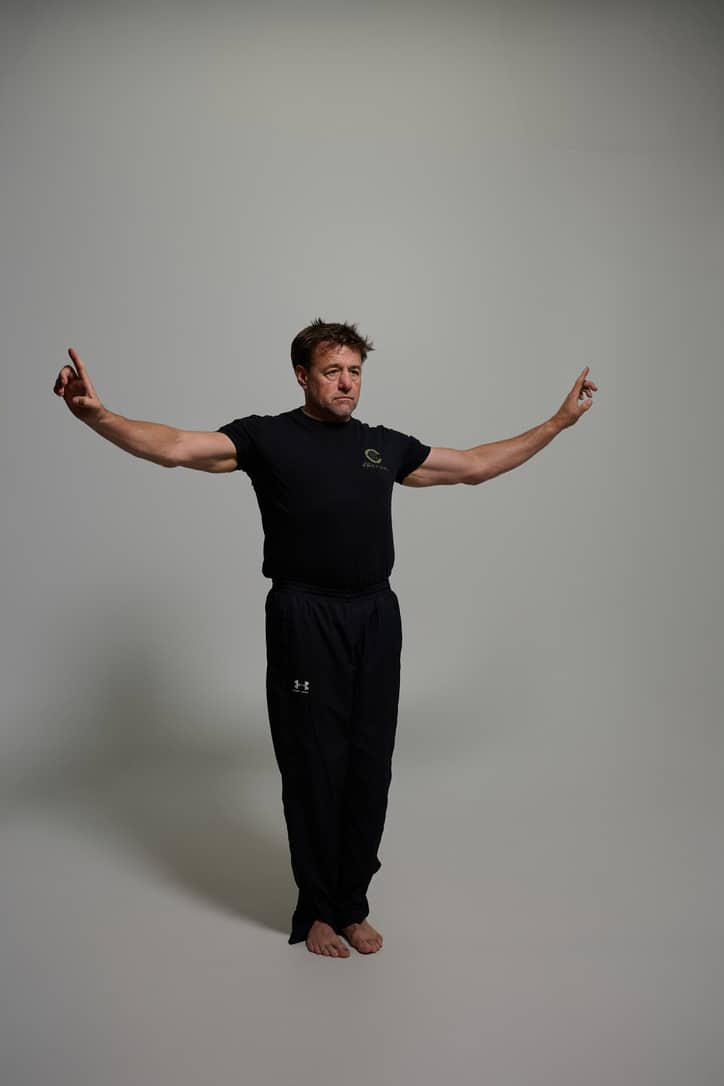
Is your physical culture improving your structure, expanding your capabilities, and helping you remain strong, mobile, resilient, and useful as you get older?
Or is it simply wearing you down?
Principle 01
Develop the Human Machine
Your body is not a collection of unrelated parts.
Strength affects posture. Posture affects breathing. Breathing affects the nervous system. Mobility affects movement options. Coordination affects how effectively you can apply strength. Recovery determines whether you can continue developing any of these qualities.
An intelligent physical culture recognizes these relationships.
The goal is not simply to improve one measurement. The goal is to develop a more capable human being.
Principles 02 Through 04
Structure, Alignment, and Conscious Control
Establish Structure
Every movement has an underlying structure. Your skeletal position, muscular support, joint relationships, and connection to the ground all influence your ability to produce and receive force.
Without structure, strength leaks away. Movement becomes less efficient, and the body frequently compensates by placing stress where it does not belong.
Organize Posture and Alignment
Posture is not about standing rigidly. It is the organization of the body around the task in front of you. Good alignment allows force to travel through the body efficiently while giving the joints room to operate.
Develop Conscious Control
You should develop the ability to recruit tension, direct force, maintain position, and relax what is not needed. The objective is not to remain tense. It is to gain ownership of tension.
Principle 05
Study the Breath
Breathing should be studied as a physical skill.
The breath influences your nervous system, emotional state, recovery, endurance, posture, and ability to remain composed under pressure. Most people breathe all day without ever learning how to breathe well.
An intelligent physical culture develops breath awareness, respiratory control, and the ability to change breathing patterns according to the situation.
There are times to increase energy. There are times to recover. There are times to create pressure and structural stability. There are times to release tension and calm the nervous system.
The breath becomes the bridge between the body and the mind.
Principles 06 and 07
Timing, Rhythm, Balance, and Coordination
Movement has timing. Walking has rhythm. Breathing has rhythm. Striking, lifting, running, climbing, and grappling all have rhythms.
Effective movement requires you to understand when to create tension, when to release it, when to move, and when to remain still.
Balance teaches the body to make constant adjustments. Coordination allows different parts of the body to contribute to the same objective without interfering with one another.
These qualities improve movement efficiency, physical confidence, reaction, and adaptability. They also become increasingly important as we age.
Principles 08 and 09
Control Flexion, Extension, and Rotation
The human body is designed to bend, extend, rotate, and move laterally. Those movements should not simply be available. They should be controlled.
Flexion control is particularly important because life frequently places us in compressed, folded, compromised, or grounded positions. But flexion should be developed alongside extension, rotation, and lateral movement.
The objective is usable articulation. Can you move through these positions deliberately? Can you maintain structure while moving? Can you produce or absorb force there? Can you return without losing control?
Mobility gives you access to a position. Control gives you ownership of it.
Develop Suppleness and Usable Range
Suppleness is not passive flexibility. Your range should be accessible, controlled, and capable of supporting real movement.
Principle 10
Pursue Accuracy and Economy
More effort is not always better.
Intelligent movement uses the appropriate amount of force for the task. It removes unnecessary tension, wasted motion, and inefficient positioning.
Accuracy helps ensure that an exercise, drill, or movement produces the adaptation you intended. Economy allows you to perform with less fatigue and greater consistency.
The objective is not to avoid hard work. The objective is to make your hard work more productive.
Principle 11
Develop Elasticity and Responsive Strength
The body should be able to create force, but it should also be able to absorb, redirect, and release it.
Old physical-culture systems sometimes referred to this quality as spring.
Elasticity allows movement to remain responsive rather than rigid. It contributes to footwork, striking, throwing, running, jumping, balance, and the ability to recover from unexpected forces.
Useful strength is not merely strong. It is adaptable.
Principle 12
Progress Gradually and Intelligently
The body requires time to adapt.
Intensity can be useful, but intensity without progression frequently becomes destruction.
An intelligent physical culture builds foundations before adding complexity, speed, load, volume, or pressure. It respects the current condition of the person while continuing to move that person forward.
The goal is not to prove what you can survive today. The goal is to build what you will still possess tomorrow.
Principle 13
Transfer Physical Development Into Life
Your physical culture should improve your life outside the training environment.
You should be able to move better, breathe better, recover more effectively, manage stress, perform physical tasks, and remain capable for a longer period of time.
Training should not continually break the body in the pursuit of temporary performance.
Done correctly, physical culture expands your relationship with the human machine. It gives you more options and allows you to participate more fully in your own life.
The Warrior’s Path
Build a Culture, Not Just a Workout
An intelligent physical culture is not a finished routine.
It is a living practice that changes as your body, responsibilities, environment, and knowledge evolve. You study yourself. You identify weaknesses. You develop missing qualities. You preserve what is valuable. You question methods that no longer serve the objective.
Most importantly, you take ownership of the process.
This thought line is foundational to the Warrior’s Path Program we teach inside The Capable Academy.
The Warrior’s Path is our learning environment for physical and mental culture. It brings together breath development, structural strength, joint expansion, mobility, internal training, traditional tool culture, recovery, resilience, and self-leadership.
I did not create all of these methods. I spent a lifetime searching for them, studying them, testing them, and organizing them into a practical process.
The goal is not to preserve old systems for nostalgic reasons. The goal is to preserve the knowledge that still helps us become stronger, calmer, more adaptable, and more capable.
You do not need to follow someone else’s physical culture blindly.
But you should build one of your own.
Build it deliberately.Build it intelligently.
Build it to develop the human machine.