
Most people lump all “fighting skills” together. In C-Tac, we separate them on purpose because each domain demands a different mindset, tool set, and training plan. Sometimes you have to break something down, learn the parts, and then put it back together to truly understand it at great depth.
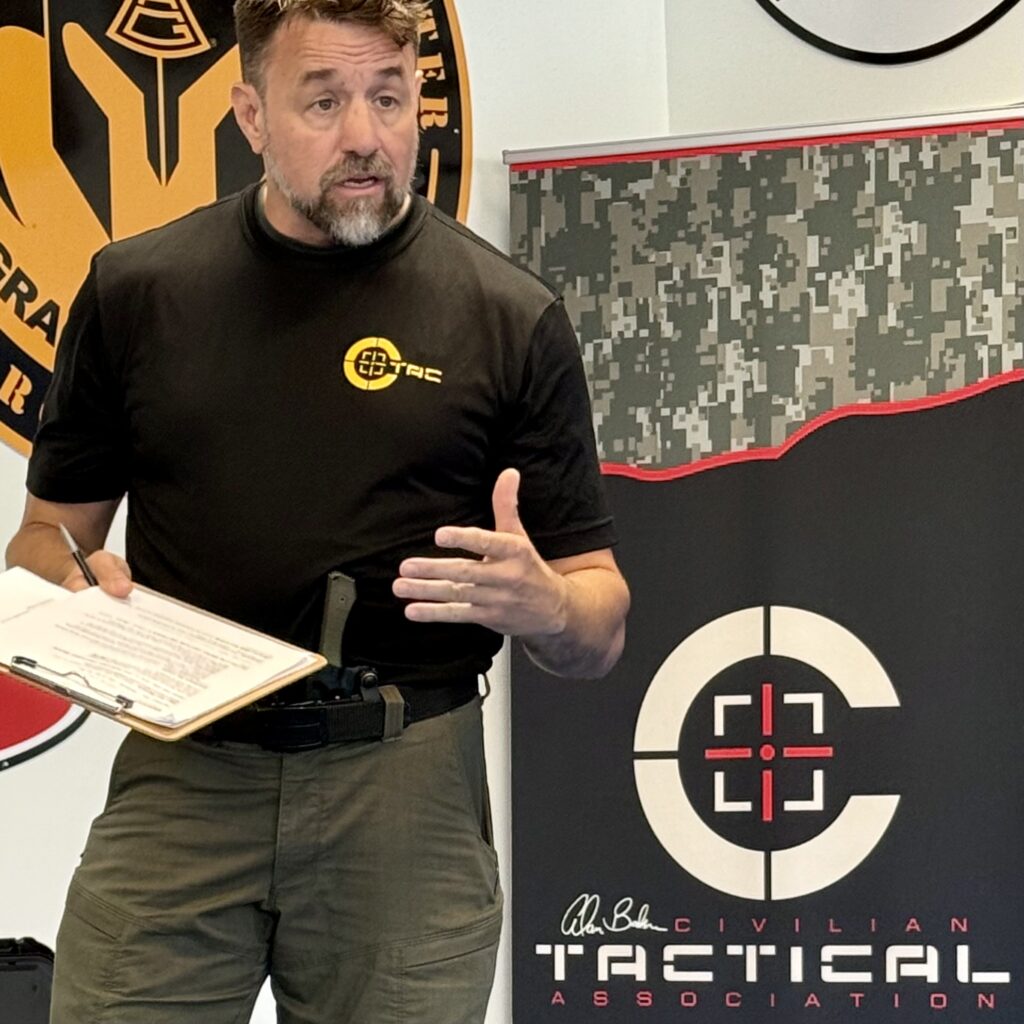
Self-protection is the bodyguard mindset applied to your own life, and the goal is to build systems that make avoidance your default. Start with protective intelligence: check local alerts and crime data before you move, vary routes and routines, and harden your home with layered security that deters, detects, delays, and denies. Tighten digital and financial hygiene with a password manager, two-factor authentication, credit freezes, and clear rules for location sharing. Addmedical readiness so you can help yourself or others when minutes matter by carrying a tourniquet and pressure bandage and by completing Stop the Bleed and basic CPR. Establish simple family SOPs with rally points, code words, who calls 911, who grabs the med kit, and a short contact ladder so everyone knows what to do without debate.
On the move, treat vehicles, hotels, and public spaces as environments to manage. Control doorways and choke points, choose bright parking near cameras, position bags away from windows, and plan clean exits before you need them. Inside buildings, read entries and exits, cover and concealment, hard rooms, and camera locations, and ride the edge of crowds rather than the center. Build force continuum options you have actually trained: calm boundary language, open hand posture, soft control entries, less lethal tools where legal, and lethal force only when necessary and lawful. Install habits with daily micro drills such as a one-beat threshold check at every doorway, a five-second scan for five cues when entering a space, a parking lot protocol that keeps your head up and hands free, and a two-breath reset after any stress spike.
Another pillar of self-protection is your physical condition. Your body is the machine that has to observe, move, fight, carry, and recover, so keeping it ready is mission-critical. Bruce Lee hammered this point: strength and flexibility exist to support technique; technique alone won’t hold up without conditioning behind it. He also reminded us that a fight isn’t won with a single punch or kick; you need the capacity to endure, which is precisely what fitness buys you under stress. In practice, that means staying strong enough to control space, mobile enough to change levels and get up, and conditioned enough to keep your brain online so you can de-escalate, protect family, retain tools, or exit fast.
Close the loop with documentation and legal prep so you can articulate what you saw, why it mattered, what you did to avoid it, and why your actions were necessary and proportional. Strengthen your network by enrolling neighbors, coworkers, and family in a simple safety circle and rehearse together twice a year. Add a small go bag, backup power, and a forty eight hour plan for home and car. Finally, train your physical state, Mental state, and your eyes. Raise alertness without anxiety, practice reading rooms for patterns and anomalies, and develop the reflex to notice indicators of potential threats. This is the work that keeps you left of bang and gives you lawful, practical answers when avoidance is not enough.
Self-defense starts when you are already behind on time. Maybe you were surprised, perhaps you saw the problem but were trying to stay within legal limits and de-escalate. Either way, the exchange has begun, and you need answers across the full force continuum, not just a single tool. Build real options: verbal control (“gift of gab”) you have actually drilled, nonverbal cues (open hands, address position, body angle), soft-control clinch mechanics, less-lethal tools you can access cleanly, and, only when necessary, lethal force. An encounter is not always a full-fledged fight; many are low- to mid-level events that can be steered with voice, posture, and positioning. Talking about this is not enough. You need intelligent reps that install these behaviors into your nervous system so they show up under stress, and you need to understand your state’s use-of-force law so your decisions are both practical and defensible.
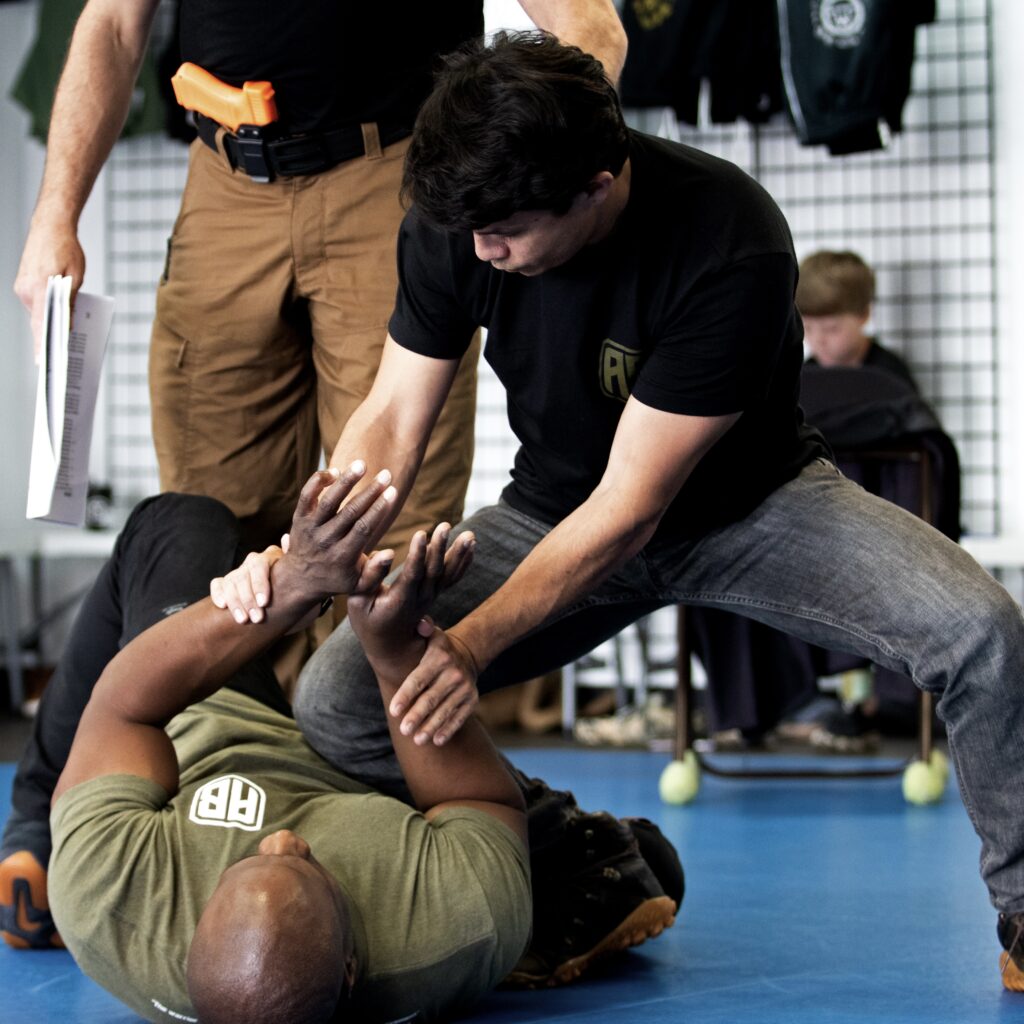
Self-Offense is a decisive, lawful action when there is no safe alternative. Think of it as the far end of the spectrum: preempting or overwhelming a lethal threat to protect life. The saying often attributed to Gen. James Mattis, “Be polite, be professional, but have a plan to kill everybody you meet,” speaks to readiness, not recklessness. In C-Tac, we refer to this training as the Full Spectrum of Violence, encompassing the full range of responses, from non-violent to the highest levels of force, while adhering to the law and your own moral framework. Many systems never address this end because of tradition or instructor bias; that gap can become ingrained in your habits without you realizing it. You should at least understand what the higher-level options are, when they are justified, and how to articulate why you acted.
People often equate this end of the force spectrum with a firearm. That can be true, but a complete program includes other lawful options if you are properly trained and within local law, such as less-lethal tools (blunt object, handheld light), impact or edged tools where legal, improvised objects, positional control, and vehicle-based escape. The critical first step is recognizing when you are actually being forced to that level. Under high stress, an untrained mind can freeze, so define in advance the conditions that justify escalation in your environment and under your state’s laws. A simple guide is the ability-opportunity-intent framework with preclusion: if the attacker has the ability and opportunity to cause death or greatbodily harm, is acting with clear intent, and you have no safer alternative, you may be in lethal-force territory. Decide this ahead of time, train decision-making under pressure, and ensure your actions remain necessary, proportional, and lawful.
Put simply: self-protection aims to avoid the fight, self-defense manages the fight that finds you, and self-offense ends the fight when no lesser option will do. Train all three. Build the plan that keeps you out of trouble, the skills that let you steer trouble down, and the ability to act decisively when there is no other choice.
There Is More To It Than You Think
Real self-defense is bigger than punches and countermeasures. It starts with a shift in perspective and how you operate as you move through the world. You build habits of self-protection, sharpen your tactical optics, and develop the skill to diagnose your environment, spotting patterns, choke points, and vulnerabilities, then make targeted changes to reduce risk. It is a disciplined way of living: awareness first, innovative procedures, lawful decision-making, and continuous improvement so your systems get stronger over time.
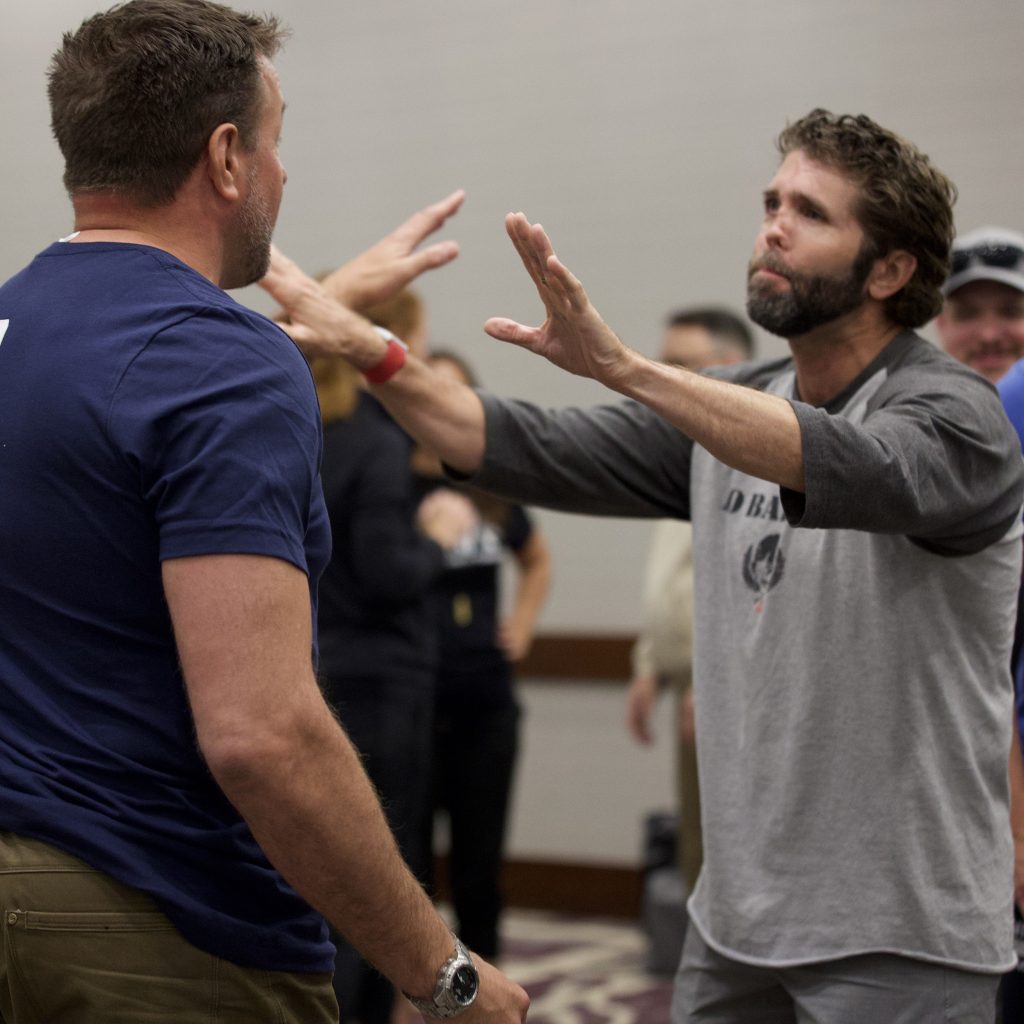
When you put your hands on another person, you have to account for how your method operates inside the legal system and how it looks to bystanders, cameras, and a jury. The standard you will be judged by is usually some version of necessity, proportionality, reasonableness, and imminence. In plain English, you need to be able to explain why you believed harm was about to happen, why lesser options were not sufficient, and why the level of force you used was the minimum needed to stop the threat. A useful mental checklist is ability, opportunity, and intent with preclusion. Did the person have the ability to cause serious harm, the opportunity to do so, and clear intent, and were you out of safer alternatives? If you cannot articulate those elements, your use of force will have weak footing.
Optics matter. Assume you are on camera and that witnesses will only see fragments. Your behavior should look like protection, not punishment. Use clear boundary language that is easy to quote later. “I do not want any problems. Back up. Stop.” Keep your hands visible and open until you must act. Favor control-oriented mechanics that look like restraint, not rage. Avoid gratuitous strikes, especially once the threat has broken contact or gone limp. If you carry, protect the belt line, and use compact movements that deny access to your tools. The more your actions look measured and professional, the easier it is for a reasonable observer to understand why you did what you did.
Match the tool to the threat. Many encounters can be steered with voice, posture, and position. If contact is required, use soft control entries and pressure that create space to exit. Move up the scale only when lesser measures fail and the risk rises. When the threat stops, you stop. As soon as it is safe, call 911, request police and medical, and render basic aid if you can do so without endangering yourself. Be ready to articulate the sequence in one short, factual statement: what you saw, what you said, what you did to avoid, why you believed action was necessary, and how you stopped when the threat ended. Laws vary by state, so know your local standards on duty to retreat, defense of others, and weapons carry. The goal is not only to win the moment, but to be able to explain it clearly afterward so your actions stand up to legal and social scrutiny.
In Today’s World, You Need More
Martial arts are a rich source of fighting knowledge if you are in a full-on fight. The gap becomes apparent at the lower levels of force, where most real encounters actually begin. Modern life is increasingly litigious, so you cannot treat every problem like a sparring round. You need a force continuum much like a law enforcement officer uses: awareness and positioning first, then verbal control, nonthreatening posture and hand placement, soft-control clinch mechanics, less-lethal options where legal, and only then lethal force when there is no safer alternative. Each rung needs a training method, not just a lecture, so those behaviors live in your nervous system when stress spikes.
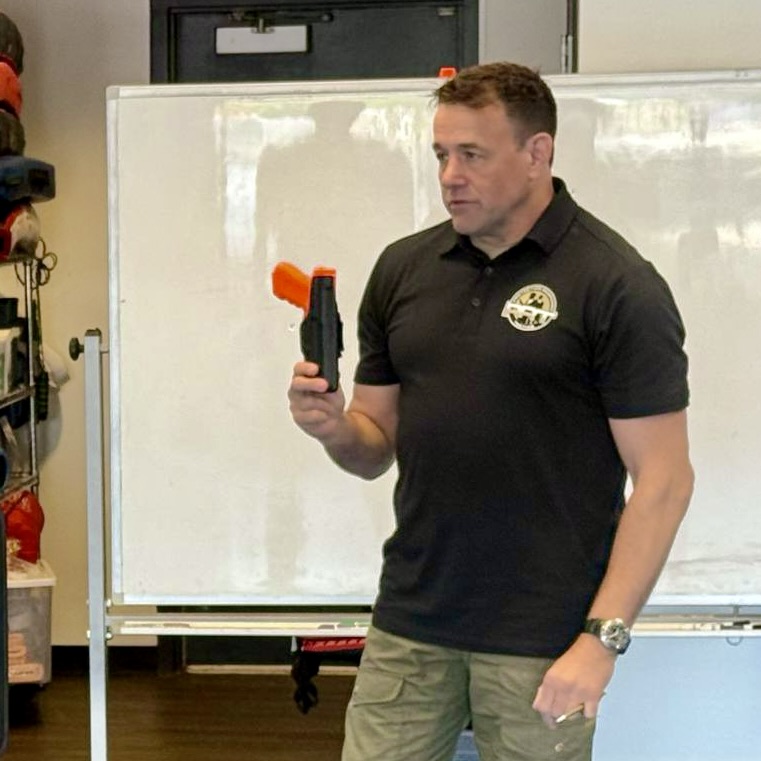
If you carry a firearm, your training must change. Carrying affects stance, striking choices, clinch entries, ground decisions, and even how you stand in a doorway. Weapon protection and access discipline have to be built into your method, not bolted on after the fact. You cannot just have a gun while you kickbox. You need habits that guard the belt line, deny grips, and keep the weapon secure in tight spaces. You also have to plan for the second opponent. Many assaults involve a wingman who appears late; train to keep moving, keep turning, and keep your head up so you do not fixate on one person, while the real danger arrives from the side.
A complete program also respects weapons as part of combat science. Historically, many arts were designed around a weapon-first mindset, but much of that was lost as the industry shifted toward commercialization and entertainment. Bring it back with practical, lawful tools and clear standards. Include improvised weapons awareness, edged and blunt defense where permitted, and environmental tactics that use walls, corners, cars, and stairs. Wrap it all in de-escalation, optics, and legal articulation. Your actions should look like protection, not punishment; your words should be quotable and straightforward; and you should be able to explain why your decisions were necessary and proportional. That blend of force continuum, carry-aware mechanics, multiple-opponent awareness, weapon literacy, and legal discipline is what turns martial skill into real self-protection.
Shift Your Perspective, Take Action, And Create Change
Gentleman in Conduct. Scholar in Thought. Savage in Action.
~ Sifu Alan ┃ www.sifualan.com ┃ www.civtaccoach.com┃www.prtinstructor.com
Sifu Alan Baker is a nationally respected authority in Defensive Tactics Program Development, High-Performance Coaching, and martial arts, with over 45 years of training experience across multiple systems. As a lifelong martial artist and tactical instructor, Alan has dedicated his career to creating practical, adaptable, and effective training systems for real-world application. He has worked extensively with law enforcement agencies, military units, and private security professionals, designing programs that emphasize scenario-based training, everyday carry (EDC) integration, and combative efficiency under pressure.
Alan’s client list includes elite organizations such as the Executive Protection Institute, Vehicle Dynamics Institute, The Warrior Poet Society, ALIVE Active Shooter Training, Tactical 21, and Retired Navy SEAL Jason Redman, among many others. He is the creator of both the C-Tac® (Civilian Tactical Training Association) and Protection Response Tactics (PRT) programs—two widely respected systems that provide realistic, principle-based training for civilians and professionals operating in high-risk environments.
In addition to his tactical and martial arts work, Alan is the founder of the Warrior’s Path Physical Culture Program, a holistic approach to strength, mobility, and long-term health rooted in traditional martial arts and the historic principles of physical culture. This program integrates breathwork, structural alignment, joint expansion, strength training, and mental discipline, offering a complete framework for building a resilient body and a powerful mindset. Drawing from his training in Chinese Kung Fu, Filipino Martial Arts, Indonesian Silat, Burmese systems, and more, Alan combines decades of experience into a method that is both modern and deeply rooted in timeless warrior traditions.
Alan is also the architect of multiple online video academies, giving students worldwide access to in-depth training in his systems, including Living Mechanics Jiu-Jitsu, C-Tac® Combatives, breathwork, functional mobility, and weapons integration. These platforms allow for structured, self-paced learning while connecting students to a growing global community of practitioners.
Beyond physical training, Alan is a sought-after Self-Leadership Coach, working with high performers, professionals, and individuals on personal growth journeys. His coaching emphasizes clarity, discipline, focus, and accountability, helping people break through mental limitations and align their daily actions with long-term goals. His work is built on the belief that true mastery begins with the ability to lead oneself first, and through that, to lead others more effectively.
Alan is also the author of three books that encapsulate his philosophy and approach: The Warrior’s Path, which outlines the mindset and habits necessary for self-leadership and personal mastery; The Universal Principles of Change, a practical guide for creating lasting transformation; and Morning Mastery, a structured approach to building a powerful daily routine grounded in physical culture and discipline.
To explore Alan’s books, digital academies, live training opportunities, or to inquire about seminars and speaking events, visit his official website and take the next step on your path toward strength, resilience, and mastery.

1 thought on “Self-Protection, Self-Defense, and Self-Offense: What’s the difference and why it matters”