
Pekiti-Tirsia Kali • Filipino Martial Arts • Tampa, Florida
Timing, Position, and the Knife Jab: Training With Guro Joe Wakey
In this video, Sifu Alan Baker trains in Tampa, Florida with Guro Joe Wakey, exploring timing concepts behind a Pekiti-Tirsia Kali knife jab drill and the importance of being in the right place at the right time.
Media Description
Training The Nervous System To Be On Time
In this video, I am in Tampa, Florida training with Guro Joe Wakey. We had just finished a private lesson where we spent time working through hubud-related material, tie and untie concepts, and a specific section on knife jab timing.
The point of the lesson was not to turn a drill into a fantasy fight scene. The point was to examine how a drill can be used correctly when you understand its purpose.
Drills often get criticized because they do not look exactly like a fight. That criticism can be fair when drills become empty choreography. But a good drill has a job. It gives the body repetitions. It teaches timing. It programs position. It helps the nervous system learn where to be when stress begins to rise.
In a real problem, the body does not rise to theory. It tends to fall back on what has been trained. That is why proper drilling matters. The goal is not to memorize a pattern for its own sake. The goal is to use the pattern to install awareness, timing, positioning, and useful response.
A good drill is not the fight. A good drill prepares the body to recognize timing, position, and pressure before the fight becomes chaos.
Capability Academy PrincipleTraining With Guro Joe Wakey
Guro Joe Wakey teaches Pekiti-Tirsia Kali and practices the art under the auspices of the Pekiti-Tirsia Kali Global Organization and Tuhon Tim Waid. His work is connected to the preservation and practice of the indigenous combat arts of the Philippines.
Pekiti-Tirsia Kali is one of the Filipino martial arts systems with a deep emphasis on edged weapons, impact weapons, empty-hand application, footwork, timing, counter-offense, and close-quarter problem solving. It is a system with a strong combat identity and a long-standing relationship to the blade culture of the Philippines.
The phrase connected to this work, “Pekiti-Tirsia Kali – Saevio Militaris Faber,” points toward the martial and military character of the system. It is not casual movement. It is a serious study of timing, structure, weapon relationship, and survival-minded positioning.
I appreciate training with people like Guro Joe because they help preserve information that should be studied carefully. This is not just about collecting techniques. It is about staying connected to serious lineages, serious teachers, and serious training environments.
Preserving A Living Filipino Martial Art
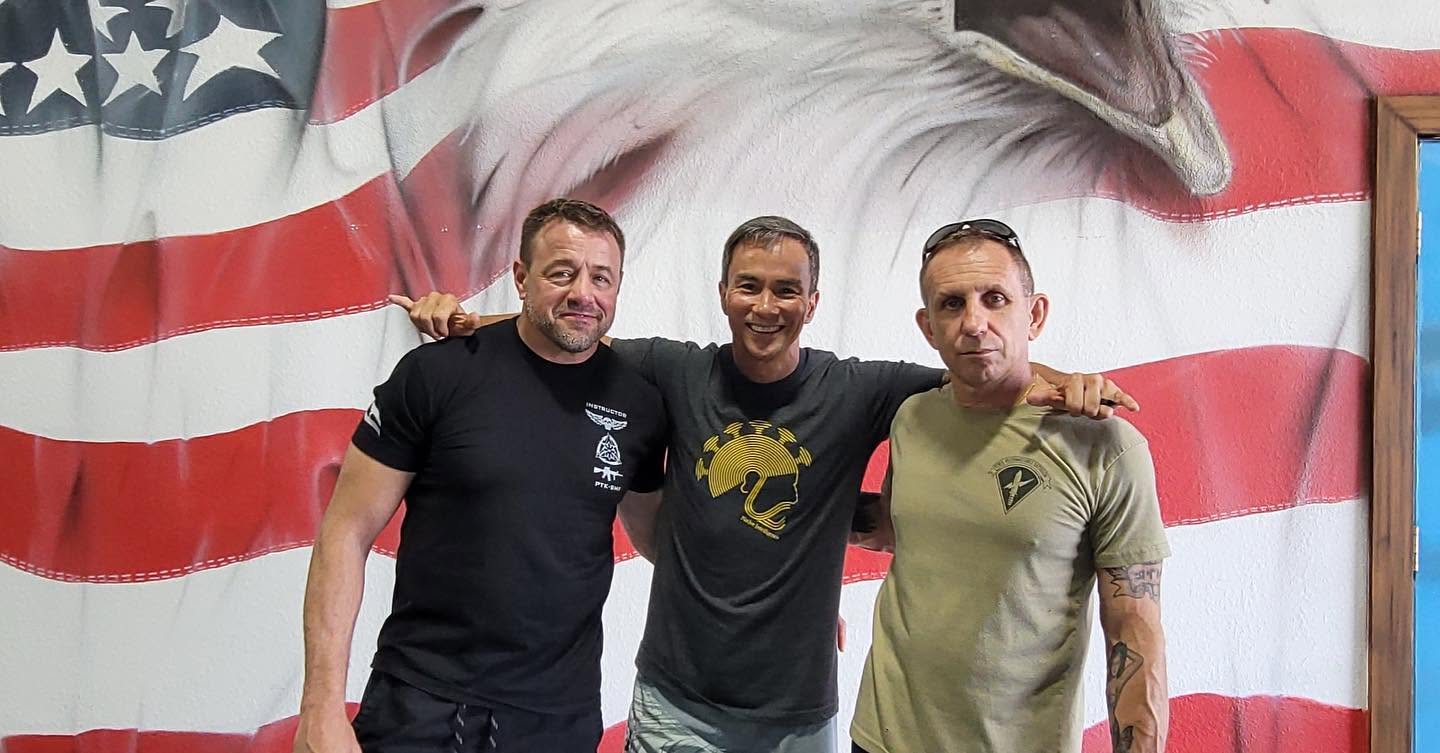
Sifu Alan Baker with Guro Joe Wakey and Tuhon Tim Waid. Training relationships matter because they connect the student to the people, standards, and living culture behind the art.
Pekiti-Tirsia Kali is not simply a collection of movements. It is a living fighting art with a history, a lineage, and a body of knowledge that has been preserved through direct transmission.
That kind of preservation matters. When an art carries culture, strategy, tactics, and generations of accumulated experience, it deserves to be studied with respect.
For the Capability Academy, this connects to a larger principle: capability grows when the student places themselves near people and traditions that carry real knowledge. Books matter. Videos matter. Notes matter. But direct training with a knowledgeable instructor reveals things that cannot always be understood from the outside.
Key Lessons From The Training
Timing Matters
The earlier you recognize the line of attack, the more options you have for position, control, and response.
Position Changes The Answer
The same attack can require different responses depending on whether you are ahead, slightly late, or very late.
Drills Build Recognition
A proper drill helps train the nervous system to recognize pressure, timing, and position under increasing stress.
The Knife Jab And The Number Five Line
In the lesson, Guro Joe focused on a knife jab line that is commonly seen in training as a low-line thrust or number five line.
The larger point was timing. If the line is recognized early, the response can be different. If the weapon is already approaching centerline, the response has to change. If the threat is already deep into the space, the body may need a more immediate emergency action.
That is an important training idea. The technique is not separate from timing. A movement that is useful when you are ahead of timing may not be the right answer when you are behind. A response that makes sense when you are slightly late may not be available when the weapon is already close.
This is why high-level martial arts training must include timing, not just shape. A person can know the movement and still be late. A person can understand the drill and still fail to recognize the moment. The art lives in the relationship between timing, position, pressure, and decision.
Ahead Of Time, Slightly Late, And Very Late
One of the valuable parts of Guro Joe’s explanation was the difference between being ahead of timing, slightly behind timing, and very late.
When the movement is recognized early, the defender has the opportunity to get outside the line and address the weapon-side relationship sooner. When the timing is slightly late, the defender may need to buy a little more time while still working toward the outside position. When the timing is very late, the response becomes more immediate and more protective.
That distinction matters because it stops the student from thinking in one fixed answer.
Real pressure changes the available options. The drill gives the student a place to study those changes in a controlled training environment. It helps the student ask better questions: Am I early? Am I late? Am I in the line? Did I move to a better angle? Did I protect the center? Did I control the space?
Those questions are valuable because they develop judgment, not just movement.
The same movement does not mean the same thing if the timing changes.
Training PrincipleWhy Drills Matter
In the video, I made the point that drills often get a hard rap because people say, “That is not how it will look in a fight.”
They are right in one sense. A drill is not the fight. But that does not make the drill useless.
A well-designed drill gives the student a way to develop attributes. It can train timing, sensitivity, pressure recognition, line familiarity, structure, rhythm, and nervous system response. It can also give the instructor a way to isolate a principle so the student can study it more clearly.
The problem is not drilling. The problem is forgetting why you are drilling.
If the drill becomes performance, it loses value. If the drill becomes empty repetition, it loses value. If the drill is never pressure-tested or connected back to application, it loses value.
But when the drill is used correctly, it becomes a bridge between information and capability.
Footwork, Angles, And Body Position
Another important piece of the lesson was the footwork.
Guro Joe explained the body opening, the broken step position, and the use of forward angle movement to create a better position. The point was not simply stepping for the sake of stepping. The footwork supports the timing and changes the relationship to the line.
In edged weapon training, the body cannot stay casually in the path of the problem. Angles matter. Position matters. How much of the body is exposed matters. Whether the hand rises too high matters. Whether the bridge, eyes, and center are protected matters.
These are the details that make a drill worth studying.
The student is not just learning where to put the hands. The student is learning how the body should organize itself in relation to the line of attack.
From Drill To Skill
One of the things we discussed in the video is the difference between keeping something as a drill and letting it become a technique.
In application, the goal may include pinning, controlling, striking, entering, disengaging, or creating another response. But in the drill, the goal is often to keep the pattern alive long enough to develop the attribute being studied.
That distinction is important for instructors.
If you turn every drill into a finishing sequence too early, the student may never build the timing, rhythm, and recognition the drill was designed to develop. But if you never connect the drill back to practical application, the student may mistake movement for capability.
The teacher has to know what phase the student is in. Are we building recognition? Are we building timing? Are we building pressure? Are we studying application? Are we testing the material?
That is where good instruction matters.
Capability Principle
Capability is not created by movement alone.
Capability is created when movement becomes timing, timing becomes recognition, recognition becomes decision-making, and decision-making can hold up under pressure.
In this lesson, the knife jab drill becomes more than a pattern. It becomes a way to study timing, position, pressure, and the body’s ability to respond when the line changes.
That is the deeper value of serious martial arts training. It teaches the student how to see.
Why This Matters Beyond Filipino Martial Arts
This lesson is rooted in Pekiti-Tirsia Kali, but the principle applies far beyond one system.
In martial arts, defensive tactics, firearms training, leadership, business, and life, timing changes the answer. Being early gives you options. Being late reduces options. Being unaware removes options almost entirely.
That is why training must do more than give the student information. It must build recognition. It must develop timing. It must teach the student how to adjust before the problem becomes worse.
The serious student learns to look for timing in everything.
When is the right time to move? When is the right time to wait? When is the right time to change angle? When is the right time to disengage? When is the right time to act decisively?
These are not just technical questions. They are capability questions.
Training With Guro Joe Wakey
Guro Joe Wakey teaches in South Tampa, Florida, near MacDill Air Force Base. If you are interested in connecting with him or learning more about his Pekiti-Tirsia Kali training, you can reach out to me and I will help make the connection.
I appreciate Guro Joe taking the time to share this material and help preserve the fighting art of Pekiti-Tirsia Kali. These arts carry history, culture, and hard-earned knowledge, and they deserve to be trained with seriousness and respect.
If you want to connect, visit sifualanbaker.com.
FAQ
Who is Guro Joe Wakey?
Guro Joe Wakey teaches Pekiti-Tirsia Kali in South Tampa, Florida, and practices the art under the auspices of the Pekiti-Tirsia Kali Global Organization and Tuhon Tim Waid.
What is Pekiti-Tirsia Kali?
Pekiti-Tirsia Kali is a Filipino martial art connected to the Tortal family system, with a strong emphasis on edged weapons, impact weapons, empty-hand application, timing, footwork, and close-quarter combat principles.
What is the purpose of the knife jab drill?
The drill helps the student study timing, position, line recognition, nervous system response, and the difference between being early, slightly late, or very late in relation to the attack.
Why do martial arts drills matter?
Drills matter when they are used correctly. They help isolate and develop specific attributes such as timing, sensitivity, structure, and recognition before those attributes are tested under more pressure.
How does this connect to the Capability Academy?
This lesson connects to the Academy because it shows how timing, awareness, repetition, and pressure can turn information into practical capability.
Sifu Alan Baker
Founder of the Capability Academy
Shift Your Perspective, Take Action, And Forge Your Path To Greatness