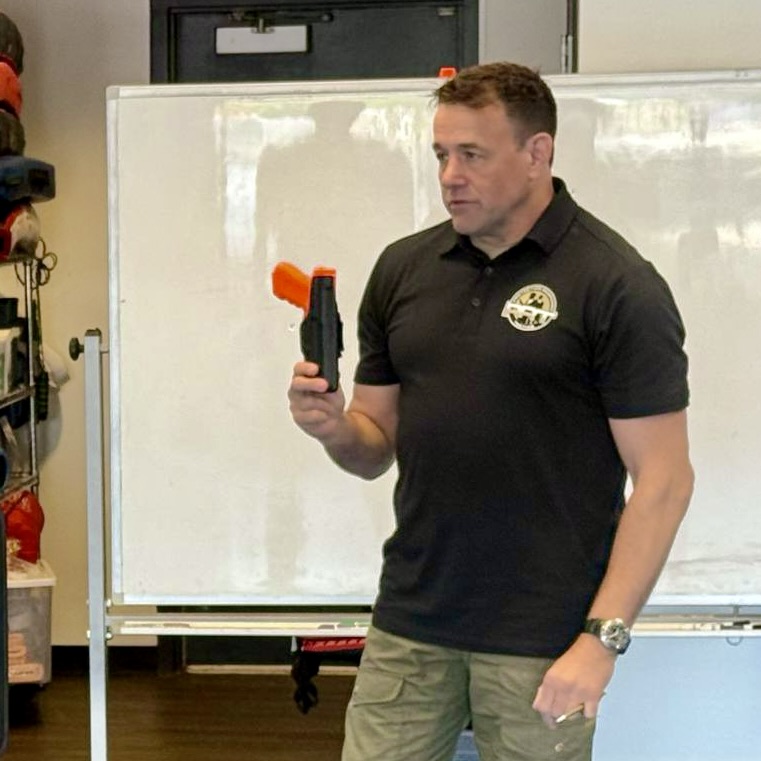
In C-Tac, I teach state development. My teachers used state work to put you in an athletic posture and a focused mind so you could perform under pressure. The same approach applies to everyday protection. Gear helps and techniques matter, but who you are in the moment decides outcomes. Your aim is to build a reliable self-protection state you can enter on command. A state is the combined setting of body, breath, attention, and intent. When you set those dials intentionally, perception sharpens, decisions become clearer, and movement becomes simple and efficient. You stop reacting from panic and start acting from preparation.
One of the teaching and learning principles we teach in C-tac is the Layered Skill Development Principle. This principle helps you seek depth in your training. It also allows our instructor to ensure they have the answers to your real skill development. Layered Skill Development is one of the foundations of our training in C-Tac. It replaces the collector mindset with depth. Instead of chasing the next shiny move, you return to core skills and deliberately add resistance, timing, context, stress, and adaptability until those skills hold up under fatigue and confusion. That is how knowledge turns into performance you can trust. The sequence matters because each layer supports the next; skip one and the stack collapses under pressure.
The C-Tac Layered Skill Development Principle
Layer 1 is Technique. Build clean mechanics you can repeat on demand: positions, angles, footwork, grips, and lines of force. Keep sets short and focused so quality stays high, then stop, correct, and film one repetition from the coach side and one from the opponent side to see structure and detail. This is the vocabulary of movement. Layer 2 is Attribute Development. Now make the technique live on a resisting human by adding timing, rhythm, coordination, speed, and strength. Use tempo ladders and time caps, for example, run shield entries at slow, medium, then fast pace while keeping posture intact. Train temporary attributes like raw speed and power, but put more emphasis on timeless tools like timing and placement that improve for decades and do not depend on youth. Layer 3 is Body State. Posture, breath, alignment, and tension control set your nervous system. Learn to move along a simple tension scale from relaxed to fully engaged on purpose; reducing residual tension increases mobility, efficiency, and real power while protecting longevity. Layer 4 is Mind State. This is your internal command system. Develop focus, emotional regulation, and presence so decisions stay clean when stress spikes; use two slow breaths to reset and a single cue to direct attention, then act. Stack the layers in order, and your training becomes functional, durable, and usable when it counts; instructors gain a clear structure for building capability, and students gain a reliable path to mastery that carries from the mat to real-world problems.
Expanding On The Cooper Color Code
The Cooper Color Code is a helpful starting point, but it is only a set of labels. Most of the industry repeats the colors without teaching how to train them. In our work, we attach drills to each level so you can enter it, hold it, and exit it at will. For daily life, your home base is Yellow, a relaxed but alert state. You build Yellow with small habits. Every time you cross a threshold, pause a beat, breathe once, map exits and locate cover, then move. In transit, keep your eyes on the horizon, scan left to right, and note one anomaly without staring. Keep your phone down in parking lots, at pumps, near doorways, and anywhere you can be boxed in. These micro-routines keep you out of White and make awareness sustainable rather than exhausting. Build the state into your day so it becomes automatic.
Carrying a firearm can add security, but making it your default response raises risk. Build real skills and tools across the full force continuum so you always have options. Your first priority is to defuse and control, not escalate. Proper training gives you options, allowing you to choose the least force necessary and maintain control over situations. That means building a simple ladder you can climb one rung at a time: awareness and positioning, verbal control, nonverbal cues, soft-control clinch mechanics, less-lethal tools, and only then lethal force when it is clearly justified.
Your voice is a primary tool. Develop it like any other skill. Practice calm, clear language and rehearse boundary setting in a realistic environment where you can work through verbal exchanges and resistance. Short scripts help: “I do not want any trouble,” or “Please give me space.” Then pair the words with movement to a better position. We also train nonverbal cues because your body speaks before your mouth does. Open hands, balanced posture, relaxed shoulders, and a calm face reduce threat signals and lower the chance of a confrontation. In our work, we use the address position, keeping the hands active and up in front of you. It communicates non-aggression while dramatically increasing your ability to respond if the encounter escalates.
“You should correct your mistakes in training so you don’t have to make them on the street.”
Good programs turn these ideas into reps. Run boundary language rounds with a partner who adds realistic pushback. Drill the address position into soft-control entries so your hands can move from de-escalation to protection without a big wind-up. Add less-lethal options like a handheld light or other blunt tools and practice accessing them cleanly under mild pressure. Finish each session with a short debrief and articulation practice: one sentence on what you saw, why you chose that level of force, and how you disengaged. You should correct your mistakes in training so you don’t have to make them on the street. Many instructors talk about these skills; few offer a structured curriculum to build them. That is precisely what we aim to change.
You should have answers and tools for every part of a combative encounter. If the only option you trust is your firearm, stress will pull you toward that single solution. When you build more trained options across the force ladder, you can solve problems at lower levels and reserve higher force for the moments when you have no other choice.
In C-Tac, we use a mental framework called the Combat Blueprint. Martial arts and defensive tactics can feel overwhelming because there are countless styles and techniques. The Combat Blueprint cuts through the noise by focusing on high-yield fundamentals that matter in real fights. It is designed to make training efficient by concentrating your time on elements that directly improve skill and decision-making. Time is your most valuable resource, so the Blueprint ensures that every session moves you toward real capability.
The Blueprint is organized around five Primal Environments of study. Marksmanship develops precision and control, enabling you to operate a firearm effectively under pressure. Edged and blunt weaponry builds the ability to use knives, sticks, and improvised tools with adaptable tactics. Striking refined punches, elbows, knees, and kicks while integrating mechanics, rhythm, and range control. Hand fighting, pummeling, and what I call giraffe wrestling develop close-quarter control in tight spaces where clinch skills decide outcomes. Ground combat encompasses grappling and anti-grappling on the floor, grounded striking techniques such as dog boxing, and managing weapons when the fight goes to the ground.
These pillars form the foundation, but the Combat Blueprint is more than a list. It is a dynamic training plan that helps you schedule work, balance your week, and progress from fundamentals to advanced application without skipping steps. Start with the basics, pressure test them, add context and resistance, then layer in complexity only when the base is stable.
Used this way, the Blueprint becomes a tool for structuring your journey with purpose and efficiency. Whether you are refining your marksmanship, exploring edged-weapon mechanics, or honing your clinch and ground game, the framework ensures your time is invested wisely. The result is uniform growth across all aspects of combat and self-defense and a practitioner who is well-rounded, adaptable, and lawful under pressure.
Train How You Carry
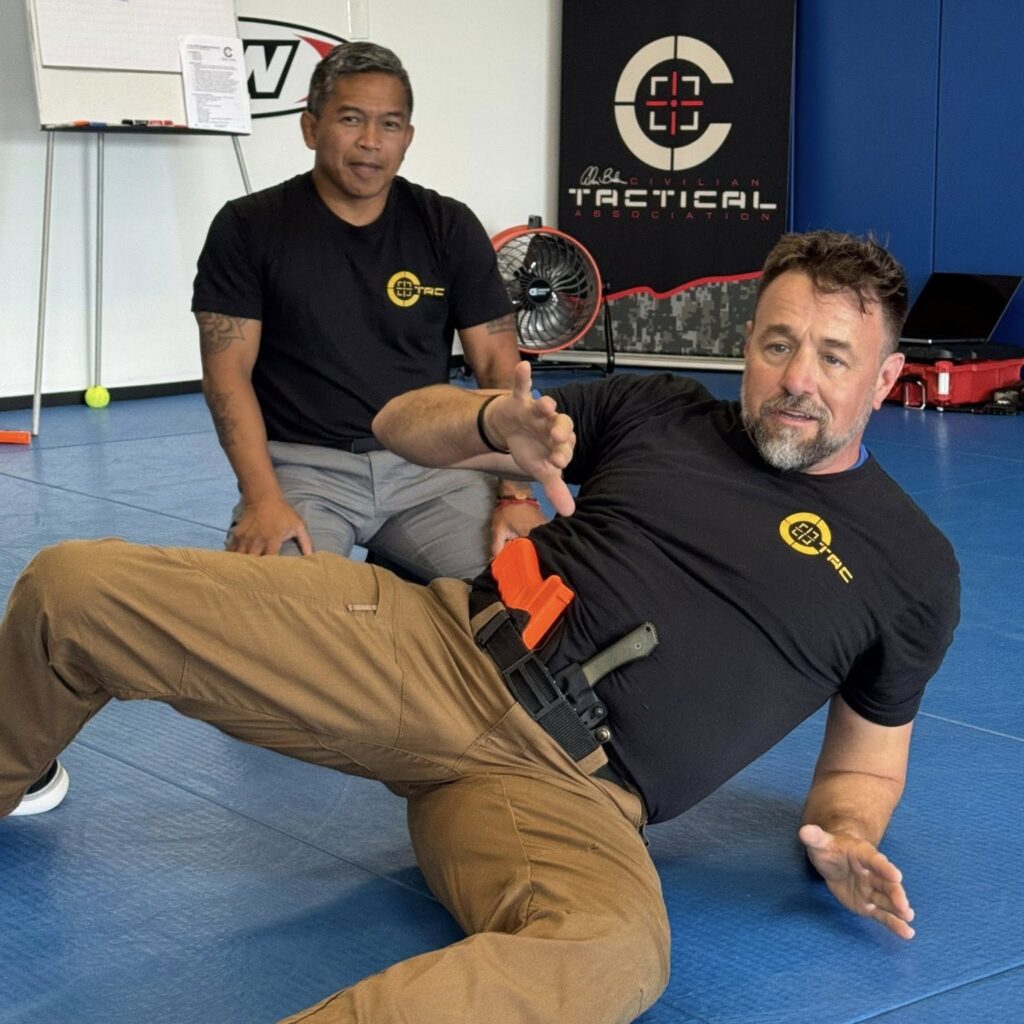
If you carry concealed, your training should reflect it. Adding a dedicated training kit to your regular practice changes how you move at the lower levels of force, and it should. The moment you have a pistol, holster, spare magazine, and even a training blade on your body, your striking, clinch entries, and tie-ups must account for weapon protection and control. It is far better to discover these adjustments on the mat with inert gear than in a parking lot under stress. When I started wearing a full training kit during my usual sessions, I realized how many habits I had hardwired that were fine for the academy but poor choices in a street environment. Positions I would accept on the mat exposed my weapon in close quarters. Hand fights I liked in sports gave up access to my waistband. I had to go back and rewrite my nervous system, stripping out those systemized habits and replacing them with responses that protect the tool, the line of fire, and my legal footprint.

Training with the kit forces applicable constraints. You learn weapon-side awareness, access discipline, and how to shield and retain under pressure. Your striking tightens up because long, looping shots create grabs. Your clinch favors underhooks, head position, and hip control that deny hands to your belt line. Your ground choices change, too. You stop gifting the opponent your holster side, you frame differently, and you prioritize positions that protect and recover access if things escalate. None of this says martial arts cannot be used for self-defense. They absolutely can. If you train and your opponent does not, you will likely do well in a fair fight. I just do not plan for fair fights. Bad actors plan for advantage, not parity. I want a broader understanding of real violence and training that reflects it.
If you decide to make this shift, do it safely and legally. Use inert blue guns, trainers, and a rigid concealment holster during practice. Work your verbal skills, your address position, and your soft-control entries first, then pressure test retention, access, and disengagement with appropriate protective gear. Keep your local laws and range rules in view, and build habits you can defend in court as well as on the street. Train how you carry so your reflexes match your reality.
All of the tools in this article come directly from our C-Tac® self-defense program. We offer a clear training path for individual students and a full instructor track for those who want to teach the system. If you are ready to build these skills with structure and accountability, you can learn more here: https://civtaccoach.com
Shift Your Perspective, Take Action, And Create Change
Gentleman in Conduct. Scholar in Thought. Savage in Action.
~ Sifu Alan ┃ www.sifualan.com ┃ www.civtaccoach.com┃www.prtinstructor.com
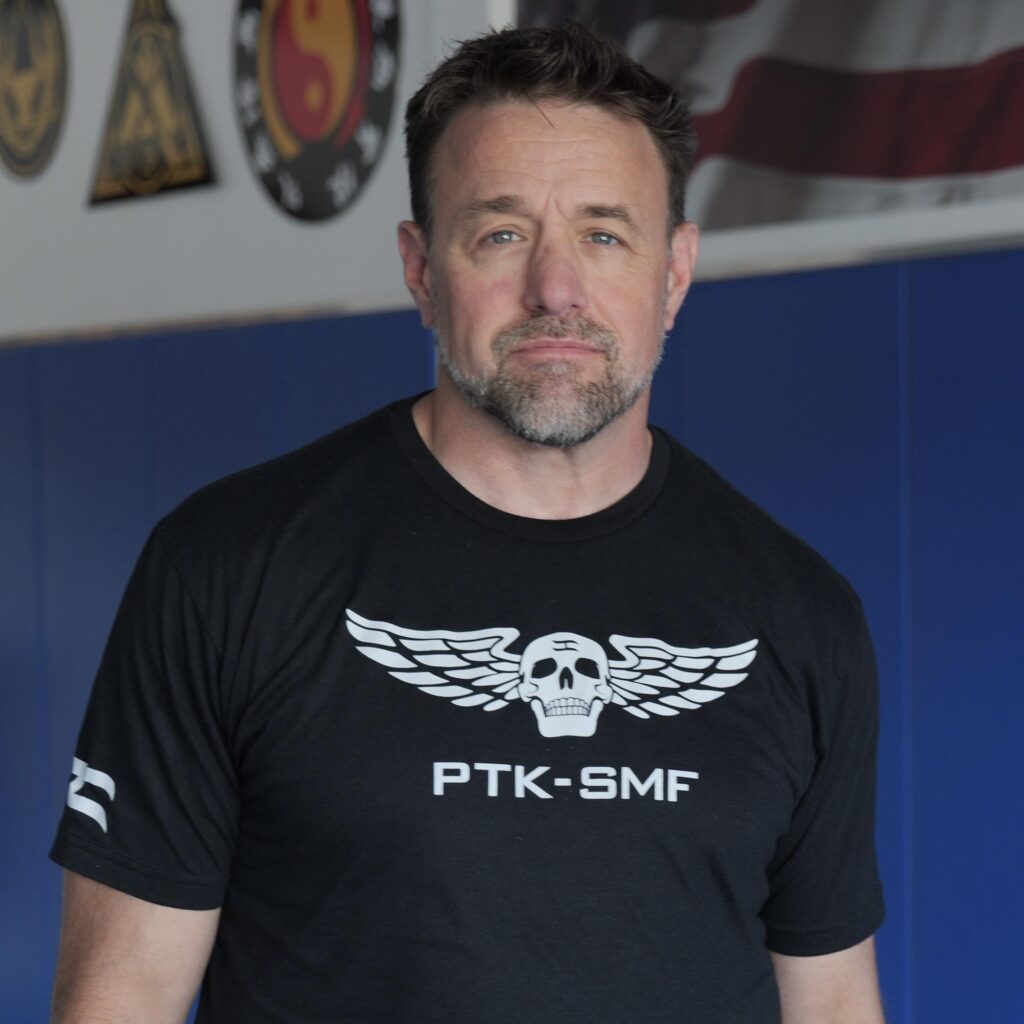
Sifu Alan Baker is a nationally respected authority in Defensive Tactics Program Development, High-Performance Coaching, and martial arts, with over 45 years of training experience across multiple systems. As a lifelong martial artist and tactical instructor, Alan has dedicated his career to creating practical, adaptable, and effective training systems for real-world application. He has worked extensively with law enforcement agencies, military units, and private security professionals, designing programs that emphasize scenario-based training, everyday carry (EDC) integration, and combative efficiency under pressure.
Alan’s client list includes elite organizations such as the Executive Protection Institute, Vehicle Dynamics Institute, The Warrior Poet Society, ALIVE Active Shooter Training, Tactical 21, and Retired Navy SEAL Jason Redman, among many others. He is the creator of both the C-Tac® (Civilian Tactical Training Association) and Protection Response Tactics (PRT) programs—two widely respected systems that provide realistic, principle-based training for civilians and professionals operating in high-risk environments.
In addition to his tactical and martial arts work, Alan is the founder of the Warrior’s Path Physical Culture Program, a holistic approach to strength, mobility, and long-term health rooted in traditional martial arts and the historic principles of physical culture. This program integrates breathwork, structural alignment, joint expansion, strength training, and mental discipline, offering a complete framework for building a resilient body and a powerful mindset. Drawing from his training in Chinese Kung Fu, Filipino Martial Arts, Indonesian Silat, Burmese systems, and more, Alan combines decades of experience into a method that is both modern and deeply rooted in timeless warrior traditions.
Alan is also the architect of multiple online video academies, giving students worldwide access to in-depth training in his systems, including Living Mechanics Jiu-Jitsu, C-Tac® Combatives, breathwork, functional mobility, and weapons integration. These platforms allow for structured, self-paced learning while connecting students to a growing global community of practitioners.
Beyond physical training, Alan is a sought-after Self-Leadership Coach, working with high performers, professionals, and individuals on personal growth journeys. His coaching emphasizes clarity, discipline, focus, and accountability, helping people break through mental limitations and align their daily actions with long-term goals. His work is built on the belief that true mastery begins with the ability to lead oneself first, and through that, to lead others more effectively.
Alan is also the author of three books that encapsulate his philosophy and approach: The Warrior’s Path, which outlines the mindset and habits necessary for self-leadership and personal mastery; The Universal Principles of Change, a practical guide for creating lasting transformation; and Morning Mastery, a structured approach to building a powerful daily routine grounded in physical culture and discipline.
To explore Alan’s books, digital academies, live training opportunities, or to inquire about seminars and speaking events, visit his official website and take the next step on your path toward strength, resilience, and mastery.