
In the reality of violence, there is a hierarchy of weaponry, a progression that reflects both the escalation of danger and the diminishing range of control. At the top of that hierarchy are projectile weapons, with firearms being the most dominant. They offer range, stopping power, and the ability to neutralize threats without allowing them to get close. Next comes edged weapons, blades that can be concealed, quickly deployed, and cause devastating damage in close quarters. Following that are blunt weapons like sticks, impact tools, or improvised objects. These require proximity but can still generate significant force and control when used with skill.
It’s only after those options are either unavailable or have failed that we move into empty-hand striking, a risky but sometimes necessary phase of the fight. Striking can create space, interrupt an attack, or serve as a transition to disengage or draw a tool. And finally, at the bottom of this hierarchy is grappling. While grappling has its place and can be highly effective in the proper context, it represents the last frontier of combat. If you’ve been pulled into a grappling exchange, it means everything else, distance, awareness, weapon access, tactical advantage, has collapsed. You’re now in the most vulnerable stage of the fight, where you’re entangled with a threat and often unable to access tools, maneuver easily, or disengage safely.
In my approach, I teach this hierarchy not to diminish the value of grappling, but to frame it correctly. Grappling is not the preferred starting point; it’s the final layer of survival when all else has failed. A complete fighter or protection professional must understand this sequence, train for all ranges, and prioritize control of distance and tools first, because that’s where the fight is often won, or lost.
I think this is an essential mindset and perspective to adopt when training in your chosen form of combat science.Understanding the full spectrum of violence, not just the small slice presented by a single art or sport, is critical for anyone serious about protection or survival. Too often, systems are built in isolation, focusing exclusively on one range, one context, or one method of engagement. When that happens, you get tunnel vision, and tunnel vision in a real fight can get you hurt or worse.
Some systems, especially those with a sport or traditional base, train practitioners to only prepare for empty-hand exchanges. While those skills have value, if you’re ever confronted with a weapon-based threat, something far more likely in real-world violence, you’re not going to be prepared. You’ve trained your body and nervous system for the wrong scenario. You’ve built a toolbox with no tools for the most dangerous realities. That’s a tactical blind spot, and it’s one that can cost you your life or the life of someone you’re responsible for protecting.
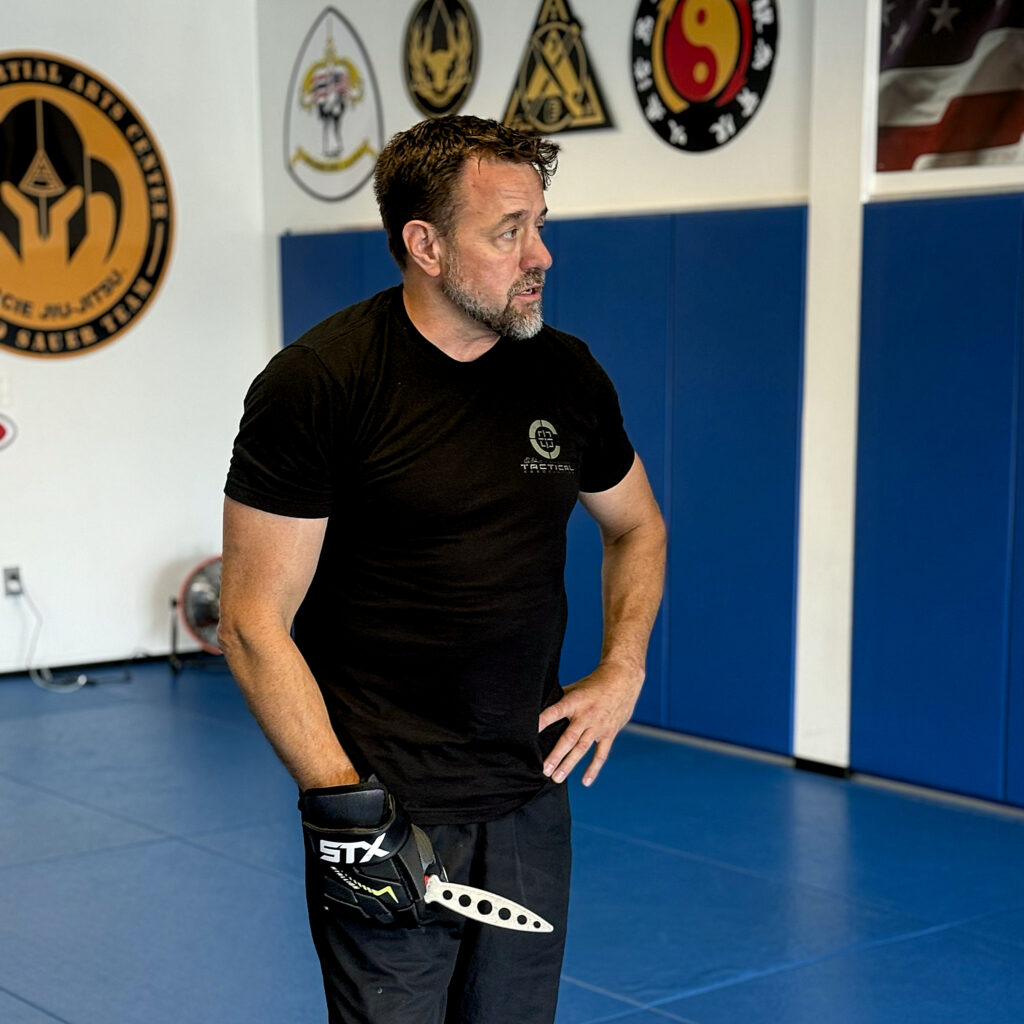
Likewise, some systems teach practitioners to immediately seek the clinch or go to the ground, without ever considering the implications of doing so against an armed opponent or in a multi-attacker situation. They teach grappling as the default, rather than the last resort, and they fail to give students a working model of the entire combative exchange, from situational awareness, verbal de-escalation, and range control to force escalation, weapon access, and legal aftermath.
If you’ve never been taught how to manage range, deal with improvised weapons, maintain situational awareness, or make force decisions under stress, then you’re not being trained for reality. You’re being trained for a drill. And drills don’t fight back.
True combat science is about layered understanding. It gives you the ability to read a threat, apply the right tactic at the right time, and adjust dynamically as the situation evolves. If your training doesn’t provide you with that full spectrum, if it never takes you beyond the lens of your chosen art, then you owe it to yourself to expand your perspective. The goal is simple: to be prepared for whatever shows up, not just what you’re comfortable with.
With that said, there are critical factors that affect how and when we can apply the tools within the hierarchy of combat. One of the most important and most often overlooked is the legal system we’re all bound by in modern society. While weaponry sits at the top of the combative hierarchy in terms of effectiveness, you may be legally prohibited from using it depending on where you live, who you are, and the specific context of the encounter.
Legal boundaries vary widely by state, country, and jurisdiction. You may live in an area where carrying a weapon is restricted, or where using a tool in self-defense, even in a justified scenario, can still land you in legal trouble. Just because something is effective does not mean it is legally defensible. You must understand the rules of engagement where you operate. Ignoring that reality can cost you everything after the fight is over.
Another reality is that you may not get to choose how the fight begins. You could be ambushed. You might not have time to deploy a weapon. You may be caught at bad range, blindsided, or already in contact before your brain even catches up. That’s why a full-spectrum understanding of the combative exchange is essential. It’s not about what you want to do; it’s about what the moment allows, legally, tactically, and ethically.
I bring this up because these points are rarely emphasized in the industry. Many instructors avoid these conversations because they don’t have the answers, or they know their curriculum falls short. And frankly, if you started thinking too critically, you might realize what they’re teaching is incomplete. They sell a controlled, linear product, and to do that, they often need you to stay unaware of the full reality.
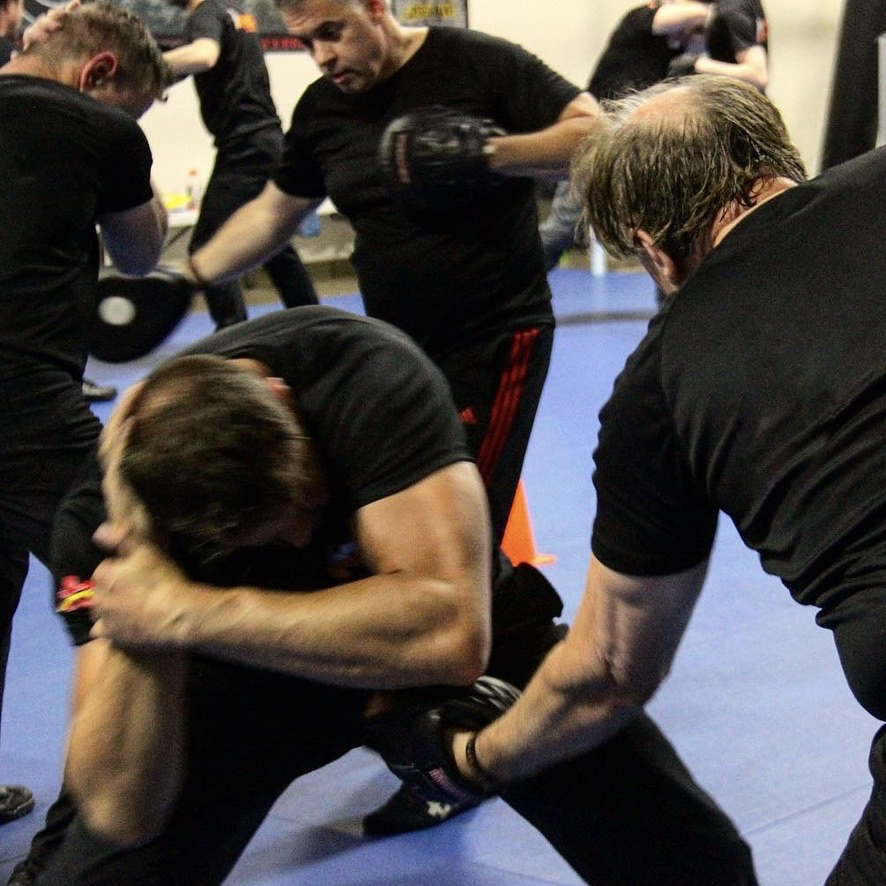
But developing a broad view of the violent encounter is what builds real capability. This kind of perspective will reveal the gaps in your knowledge and your training. Because the truth is, martial arts on their own do not always address these questions unless the instructor has gone out of their way to seek them out, pressure test them, and integrate them into their system.
As a practitioner, student, or protector, you have a responsibility to look beyond technique. You need to understand context, consequences, and the constraints of real violence. That’s where true combative intelligence begins, and it’s what separates a martial artist from someone who is truly prepared.
For most of human history, the study of combat began with weapons. A warrior’s primary tool was a blade, a stick, or some form of battlefield weapon. Empty-hand techniques were secondary, used only in the worst-case scenario when the weapon was lost, broken, or out of reach. The idea of leading with empty-hand training would’ve been seen as incomplete or even reckless in a real combative context.
But after World War II, a cultural shift occurred. Returning U.S. servicemen who had encountered martial arts like Karate and Judo overseas brought these systems back to the West. These arts, stripped down for military instruction and civilian self-defense, emphasized simplicity, efficiency, and accessibility. In the decades that followed, martial arts began to evolve into something more aligned with fitness, discipline, and sport, less with battlefield survivability.
Hollywood played a massive role in accelerating this change. Starting in the 1960s and 70s, martial arts films portrayed heroes fighting barehanded, often with exaggerated movements and dramatic effect. These portrayals glamorized unarmed combat and shifted public perception. What the audience saw on screen became the new “norm,” and the deeper context of real combative systems, especially weapon-based methods, was pushed to the background.
Add to that the rise of commercial martial arts schools. As martial arts became mainstream, they adapted for safety, legality, and mass instruction, particularly for children. Teaching blades and sticks to large groups of civilians, especially minors, raised insurance concerns and potential liability. As a result, most schools leaned heavily into empty-hand techniques and sport-based curricula.
The outcome of all this is that today, many people assume martial arts is primarily an unarmed discipline. But that’s not how it started. And for those of us who are serious about personal protection and combative reality, it’s essential to remember this history. Weapon integration must be a part of the conversation, because in real violence, tools are often involved. A complete system prepares you for both the weapon and the moment you no longer have it.
For myself, the hierarchy of weaponry is a teaching and learning principle. For myself, the hierarchy of weaponry is not just a concept; it’s a core teaching and learning principle and a compass I use to align all aspects of training with the realities of real-world violence. It gives structure to how I design scenarios, how I build curriculum, and how I guide others in their own development. Whether I’m working on lesson plans, evaluating a student, or pressure testing a new drill, the hierarchy helps me stay grounded in the truth of how violence actually unfolds.
When I’m organizing my own training, this principle is what helps me avoid blind spots. It acts like a filter, pointing out where I’ve been overtraining in one area and neglecting another. If I’ve been spending too much time in grappling, it reminds me to cycle back to weapons work. If I’m working with firearms, it pushes me to stay sharp with my verbal skills, my positioning, and my hand-to-hand options. It keeps me honest. It keeps me complete.
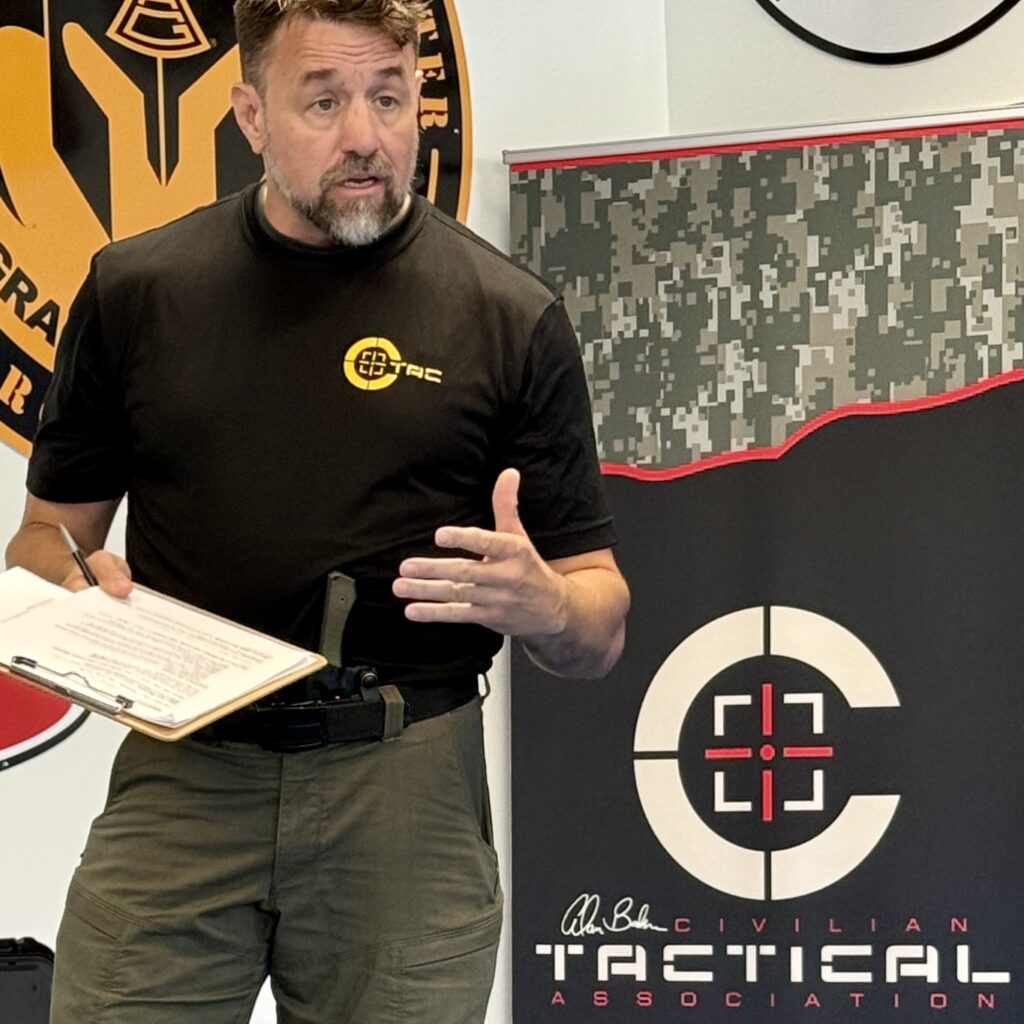
In the C-Tac program, this principle is one of the major guideposts we use to build a proper mindset both for myself and for my students. It gives context to why we train the way we do. It explains why grappling is taught last, and why striking isn’t treated as the first line of defense. It frames the idea that weapons exist for a reason, that they must be integratedintelligently, and that the real enemy is not just the attacker. It is distance, timing, and lack of preparation.
When you train through the lens of the hierarchy, you’re not just collecting techniques. You’re building a decision-making framework that works under pressure. You’re training to make smart, fast, legally defensible choices in the moment. You’re training to survive.
That’s why I teach it. And that’s why I use it every day in my own journey.
Shift Your Perspective, Take Action, And Create Change
Gentleman in Conduct. Scholar in Thought. Savage in Action.
~ Sifu Alan ┃ www.sifualan.com ┃ www.civtaccoach.com┃www.prtinstructor.com
Sifu Alan Baker is a nationally respected authority in Defensive Tactics Program Development, High-Performance Coaching, and martial arts, with over 45 years of training experience across multiple systems. As a lifelong martial artist and tactical instructor, Alan has dedicated his career to creating practical, adaptable, and effective training systems for real-world application. He has worked extensively with law enforcement agencies, military units, and private security professionals, designing programs that emphasize scenario-based training, everyday carry (EDC) integration, and combative efficiency under pressure.
Alan’s client list includes elite organizations such as the Executive Protection Institute, Vehicle Dynamics Institute, The Warrior Poet Society, ALIVE Active Shooter Training, Tactical 21, and Retired Navy SEAL Jason Redman, among many others. He is the creator of both the C-Tac® (Civilian Tactical Training Association) and Protection Response Tactics (PRT) programs—two widely respected systems that provide realistic, principle-based training for civilians and professionals operating in high-risk environments.
In addition to his tactical and martial arts work, Alan is the founder of the Warrior’s Path Physical Culture Program, a holistic approach to strength, mobility, and long-term health rooted in traditional martial arts and the historic principles of physical culture. This program integrates breathwork, structural alignment, joint expansion, strength training, and mental discipline, offering a complete framework for building a resilient body and a powerful mindset. Drawing from his training in Chinese Kung Fu, Filipino Martial Arts, Indonesian Silat, Burmese systems, and more, Alan combines decades of experience into a method that is both modern and deeply rooted in timeless warrior traditions.
Alan is also the architect of multiple online video academies, giving students worldwide access to in-depth training in his systems, including Living Mechanics Jiu-Jitsu, C-Tac® Combatives, breathwork, functional mobility, and weapons integration. These platforms allow for structured, self-paced learning while connecting students to a growing global community of practitioners.
Beyond physical training, Alan is a sought-after Self-Leadership Coach, working with high performers, professionals, and individuals on personal growth journeys. His coaching emphasizes clarity, discipline, focus, and accountability, helping people break through mental limitations and align their daily actions with long-term goals. His work is built on the belief that true mastery begins with the ability to lead oneself first, and through that, to lead others more effectively.
Alan is also the author of three books that encapsulate his philosophy and approach: The Warrior’s Path, which outlines the mindset and habits necessary for self-leadership and personal mastery; The Universal Principles of Change, a practical guide for creating lasting transformation; and Morning Mastery, a structured approach to building a powerful daily routine grounded in physical culture and discipline.
To explore Alan’s books, digital academies, live training opportunities, or to inquire about seminars and speaking events, visit his official website and take the next step on your path toward strength, resilience, and mastery.
1 thought on “The C-Tac Hierarchy Of Weaponry Principle ”