
Field Notes From the Path
The Perpetual White Belt: What Combatives at the Lake Reinforced About Mastery
The more experience we gain, the easier it becomes to enter a room as the expert. Real growth requires us to enter as a student too.
I recently finished a three-and-a-half-week teaching tour that ended in Double Springs, Alabama, at a three-day event called Combatives at the Lake.
Chris Magyar hosted the event at a remarkable property on the lake. It was the kind of place that immediately changed the pace of the weekend. People arrived, found their sleeping space, settled in, walked the property, and started getting to know one another before the formal training even began.
I taught primarily on Saturday, sharing material from the C-Tac Civilian Tactical program. But at an event like this, teaching is only part of the opportunity. When I was not in front of the room, I was spending time with the participants and talking with the other instructors.
That part is always important to me.
The Student Mindset
Enter the Room as a Student
I am a big believer in the fact that you do not know what you do not know. I am also not a big fan of remaining unaware of those blind spots.
That is why, whenever I am around high-level educators, I make it a point to become a perpetual white belt. I may have been invited to teach, but that does not mean I have nothing to learn. Experience should not remove curiosity. If anything, experience should make us more responsible for protecting it.
Being a perpetual white belt does not mean pretending that you have no knowledge. It means refusing to let what you already know prevent you from seeing what someone else can teach you.
Experience should deepen your responsibility to remain a student.
Capability Academy Principle
Simplicity Is Mastery
The instructors at the event taught different material and brought different perspectives to the room. Yet the weekend reinforced a principle I have taught for years: simplicity is mastery.
People often associate mastery with knowing more techniques, collecting more information, or building increasingly complicated systems. That may look impressive, but complexity is not always evidence of depth. Sometimes it is evidence that the essential lesson has not yet been distilled.
A master can take a complicated problem, identify the few elements that matter most, and communicate them in a way that can be understood and applied. The goal is not to make the work shallow. The goal is to remove what is unnecessary so the important pieces become clearer.
This is especially important in combatives. Under pressure, we do not rise to the level of an elaborate explanation. We depend on principles, decisions, and actions that have been trained clearly enough to remain available when conditions become difficult.
I have written before about the power of simplifying the journey. Alabama did not give me a new slogan. It gave me another opportunity to watch that principle emerge through different instructors, different subjects, and different conversations.
That kind of reinforcement matters. A sound principle should survive changes in personality, teaching style, and subject matter. When several experienced people take different roads and arrive at the same conclusion, it is worth paying attention.
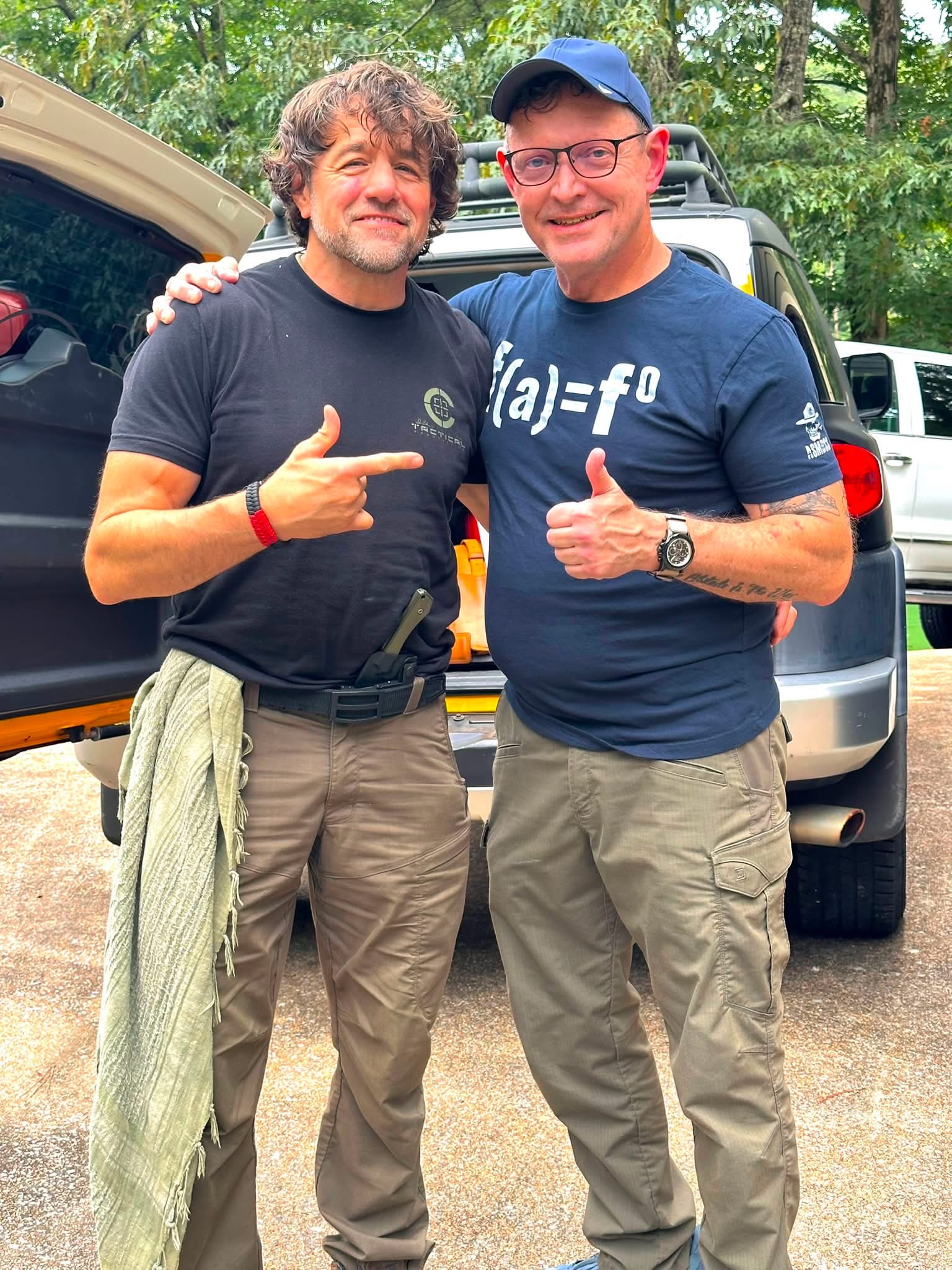
Alan Baker with Coach Chris Mize at Combatives at the Lake in Double Springs, Alabama.
Learning Beyond the Schedule
The Room Is Part of the Curriculum
Events like this are valuable because the curriculum is larger than the scheduled instruction. The room itself becomes part of the curriculum.
You are exposed to new personalities, new experiences, and new ways of solving problems. A conversation during a break may reveal a blind spot. Watching another instructor explain a familiar idea may give you language that improves your own teaching. Time spent with a participant may become the beginning of a meaningful professional relationship or friendship.
If you handle these environments correctly, they become opportunities for growth and expansion. Your knowledge grows, but so does your network, your perspective, and your ability to contribute.
A strong network is not simply a list of contacts. It is a community of capable people who can exchange knowledge, create opportunities, solve problems, and help good work move into the world. People with meaningful relationships and trusted placement within a community are often the people who can get things done.
A Capability Environment
Train. Connect. Apply.
A strong event offers more than information. It creates an environment where knowledge, relationships, and application reinforce one another.
01
Train
Study the formal material, test your assumptions, and pay attention to the principles that remain useful across different systems and teaching styles.
02
Connect
Make time for the conversations between sessions. Listen to the people in the room and build relationships around shared work rather than simple contact collection.
03
Apply
Leave with one clear idea you are prepared to simplify, practice, and integrate. Information becomes capability only when it is put to work.
The Capability Practice
Prepare for Your Next Event
The next time you attend a seminar, conference, retreat, or training event, do not measure its value only by the notes you take during the formal sessions. Before you arrive, ask yourself:
- What am I here to learn?
- Who in this room may see something that I cannot yet see?
- Which conversations should I make time for?
- Which relationship should I continue developing after the event?
- What is one idea I will simplify and apply when I return home?
The Final Question
Contribute Without Ceasing to Learn
Show up ready to contribute. Bring your knowledge, your experience, and your willingness to help. But leave enough room to listen.
Enter as both an instructor and a student. Leave with one clearer perspective, one stronger relationship, and one action you are prepared to apply.
Will you enter the next room ready to prove what you know, or ready to discover what you do not?
Continue the Journey
Remain a Perpetual White Belt
Keep searching for the simple principles that hold up under pressure. Then put them to work.