
The Sifu Journal · Training
From Fighting Stance to Living Technique
What a question about foot placement can teach us about deeper martial arts training.
By Sifu Alan Baker · A deeper study
Start with the objective
A student’s question
A student recently asked me a good question about fighting stance and base.
He had heard two different perspectives on the position of the rear foot. One emphasized pointing the toes more toward the opponent to support forward movement. The other emphasized turning the foot outward to establish a stronger base. He wanted to know whether one was correct or whether the answer depended on the objective.
My first response was simple: before I tell you where your rear toes should point, I want to know what you are asking the stance to do.
Are you preparing to move? Receiving pressure? Working within a particular drill? Trying to maintain your position while someone changes the direction of force?
Those details matter. A position that serves one objective may need to change when the objective changes. Two instructors can offer different answers because they are addressing different problems.
The foot-position question deserves a thoughtful answer. It also opens the door to a much larger discussion about how we learn martial arts, how we develop useful movement, and why our training has to grow beyond the study of individual techniques.
01 · Technical study
There is value in studying the details
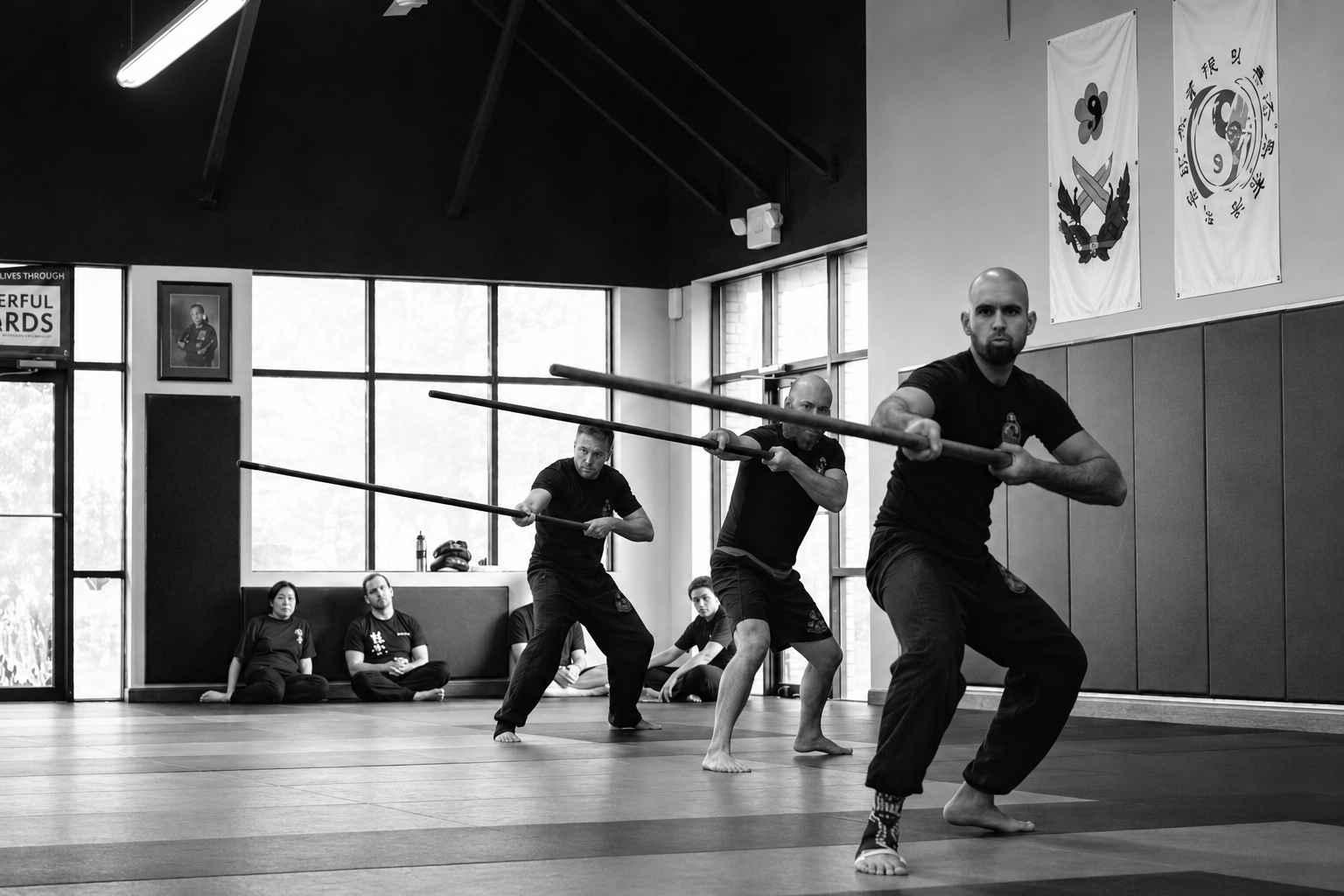
I think the first level of learning is commonly technique-focused.
As humans, we like clear answers. Put your foot here. Turn your hips this way. Keep your elbow in this position. This is correct, and that needs to be corrected.
There is real value in that process. We can slow things down, change one detail, and study the result. We can examine where our weight is going, how our skeleton is aligned, and whether our placement supports what we are trying to accomplish.
I enjoy that kind of study. After decades of training, I still find value in having someone adjust a small detail and help me feel something I had overlooked.
The problem begins when we take an answer that worked under particular conditions and make it the answer to every situation.
If a foot position helps you receive pressure from one direction, that tells you something useful about that position under those conditions. It does not settle every question about moving, turning, changing distance, or responding to pressure from somewhere else.
We also need to examine more than the foot. Stance width, weight distribution, hip position, the relationship between the knees and feet, and the direction of the task all belong in the conversation.
A photograph can show you where someone stood. It cannot show you everything that brought them there or what they needed to do next.
02 · Context matters
Define the exchange before deciding on the position
When someone asks about an optimal fighting stance, I want to understand what kind of exchange they have in mind.
A family member grabbing your wrist during an uncomfortable interaction is different from a hard round on the mat. In one situation, your objective may be to calm things down and create space. In the other, you and your partner have agreed to train within a particular set of rules.
A self-protection situation introduces other considerations. Can you leave? Is there someone you are responsible for? What does the environment allow? Is there one person involved, or do you need to keep track of others?
In my teaching, I distinguish between self-protection, self-defense, and what I call self-offense. Those terms help us examine awareness, response, and initiative. They are teaching distinctions, and the objective and circumstances still govern what is appropriate.
We should also keep the intensity of a training round separate from the seriousness of a real encounter. A demanding sporting exchange can be physically intense within agreed boundaries. A situation that initially looks minor can carry uncertainty that a training round does not.
Before we decide which placement is better, we need to establish the problem we are trying to solve.
That does not make the answer vague. It makes the question more precise.
03 · Adaptation
The technique has to become a living technique
As an exchange becomes more dynamic, your partner stops providing the exact conditions you studied.
The pressure changes. The distance changes. You begin an action, and the other person moves somewhere you did not expect. A position that was useful a moment ago now needs adjustment.
This is where technique has to become what I call a living technique.
A living technique can change with the situation. Its outward shape may look different because the conditions supporting it have changed. The principles that make it useful still have to be present.
Can you maintain balance? Can you organize your structure in relation to the pressure? Can you move from where you are? Can you recognize when holding your position has stopped serving the objective?
Those questions become increasingly important.
If you are trying to consciously arrange every detail of your rear foot while the exchange continues, the moment you are trying to solve may already have changed. That does not mean foot placement no longer matters. It means the earlier study needs to become available through movement.
Biomechanics makes a useful distinction here. Models of dynamic stability account for both the position and velocity of the body’s center of mass. Where the body is located does not tell the whole story once it is moving. That research does not prescribe a universal fighting stance, but it helps explain why a still position cannot answer every movement question. Research on dynamic stability
04 · C-TAC mind tool
Layered Skill Development gives us a path
One reason we teach the Layered Skill Development principle in C-TAC is to give students and instructors an organized educational path.
Without a framework, it is easy to spend years acquiring more material without recognizing which parts of our development have received very little attention.
Our outline identifies four layers:
- Technique.
- Attribute development.
- Body state development.
- Mind state development.
The purpose is to revisit what we know with increasing depth. Each layer gives us another way to study the same material and identify what is missing. I explain the framework more fully in Technique, Attributes, or Body State: Which Are You Training?
The student’s stance question gives us a practical way to understand this progression.
At the technique layer, we examine placement. Where are the feet? How are the hips positioned? What are the points of support? What does this arrangement allow us to do?
At the attribute layer, we develop the qualities needed to adjust that arrangement. Timing, coordination, balance, and sensitivity become part of the study. Can you recognize a change in pressure and respond while the opportunity still exists?
At the body state layer, we examine how you are using your body within the position. Are you unnecessarily rigid? Can you regulate tension? Can you maintain useful structure while breathing and moving?
At the mind state layer, we examine attention, emotional control, and connection to the objective. Can you remain aware of what is happening, or have you become so committed to one answer that you no longer recognize the need to change?
This is why the outline matters. It gives us something concrete to work through when our training has remained concentrated in one area.
The student continues refining technique, but the scope of the study expands.
05 · Base and root
Basing out and rooting deserve separate attention
I also want to separate two ideas that are often discussed as though they mean the same thing: basing out and rooting.
When I talk about basing out, I am referring to mechanical placement. Where are your points of support? How is your body organized in relation to them? How does that arrangement relate to the force you are receiving or producing?
When I talk about rooting, I am emphasizing your ability to regulate tension within that structure.
Different traditions use the word root differently. I am explaining how I use it in my teaching.
You can stand in one position, clench your jaw, raise your shoulders, and tighten areas that are contributing very little to the task. You can then release some of that unnecessary tension without moving either foot.
Your foot placement has remained the same, but the way you are using your body has changed.
That is a useful distinction to feel.
Turning the rear foot outward changes the mechanics of your position. It may help with a particular task. But I would not call that rooting by itself. I would also want to examine how you are organizing and regulating tension.
Nor does rooting mean becoming completely loose. The skill involves producing useful tension where and when it is needed, while recognizing what can be released.
Research on muscular co-contraction illustrates a related tradeoff: simultaneous muscular activity can contribute to joint stability while carrying an energy cost. That supports studying the regulation of tension rather than assuming that either maximum tension or maximum relaxation is always desirable. It does not establish a scientific definition of rooting. Research on stability and energy efficiency
This is part of what I discuss in Timeless Tools and Mastering Tension Control. We should develop the ability to change how we use our body, alongside learning where to place it.
06 · A deliberate education
Give credit to systems that deliberately teach these qualities
This is an area where I want to give credit to the Northern Shaolin, Southern Shaolin, and Wing Chun training I have experienced.
What I appreciate is the time devoted to these qualities. Structure, stance, and body control receive deliberate attention. There are methods for studying them and a process for refining them.
Other systems certainly discuss these ideas, and many produce practitioners who demonstrate exceptional control. My point concerns the educational process.
Telling a student to relax is an instruction. Helping that student recognize unnecessary tension, change it, and retain useful structure is a teaching responsibility.
Telling someone to have better base is a starting point. We still need methods that help them understand what is failing and develop the ability to correct it.
In my experience, practitioners who receive sustained, organized training in these areas often become particularly skilled at them. They have spent time developing qualities that other students may be expected to discover on their own.
There are additional Chinese martial arts traditions worth recognizing for their specific methods.
In Taijiquan, the study of weight transfer and the relationship between empty and full gives practitioners a detailed way to examine support and movement. Chen-style curricula also explicitly include standing practice and silk-reeling exercises. Yang Family teaching, Chen Xiaowang curriculum
In Xingyiquan, foundational posture work such as San Ti Shi provides a structured starting point for studying bodily organization. Yiquan places standing practice, or zhan zhuang, alongside moving exercises such as shi li, commonly translated as testing strength. These provide distinct opportunities to investigate connection in stillness and movement. Sun Lutang’s Xingyi manual, Yiquan practice methods
Baguazhang contributes an especially relevant example through circle walking and turning. It gives this conversation a moving context rather than leaving our attention entirely on stationary stance. Hung Gar, as a specific southern tradition, also deserves recognition for its foundational stance training. Yin Yuzhang’s Bagua manual, Lam Family Hung Gar
These traditions have different methods, terminology, and priorities. Naming them does not mean every school teaches identically or defines rooting as I do.
What connects them to this discussion is that these qualities have identifiable places in their training. That is the lesson I want instructors to consider: if an ability matters, where and how are you teaching it?
07 · Purposeful practice
Drilling helps the position become adaptable
You can spend useful time studying a single position. Eventually, you need to experience what happens when the conditions change.
This is one reason I value drilling across Catch Wrestling, Shooto, Combat Submission Wrestling, Judo, Chinese Shuai Jiao, Filipino Dumog, and the clinch work of Thai Boxing.
These arts study techniques. They also provide ways to explore relationships between people in motion.
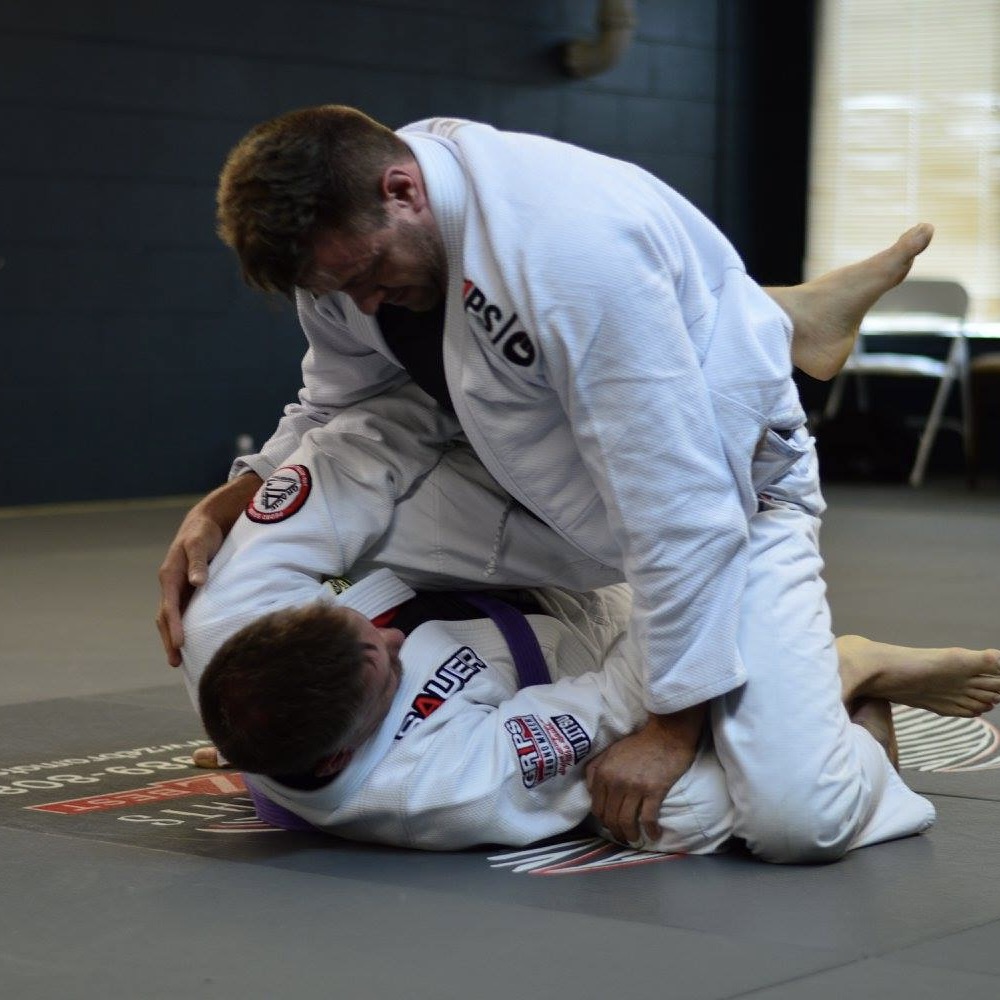
A controlled pummeling drill can help you feel how often support, alignment, and pressure need to change. Rolling in Jiu-Jitsu presents similar opportunities. Your partner has intentions of their own, and your understanding has to account for them.
The design of the drill matters. A highly predictable exercise can help isolate a detail. An exercise with more variability can ask whether you recognize when that detail needs adjustment.
Both have a place.
In The Art of Drilling, I discuss the value of giving exercises specific developmental purposes. A drill does not have to reproduce every aspect of a fight to teach something useful. We do, however, need to understand what it develops and what remains to be trained elsewhere.
08 · Resistance training
Two approaches to training against resistance
As practitioners gain experience, I believe resistance training needs an intentional place in their development.
I organize this discussion around two broad approaches: environmental training and scenario-based training.
They can overlap, but the distinction helps us understand what each contributes.
When I say environmental training, I mean working within a particular training environment against a partner who has their own objectives.
Rolling in Jiu-Jitsu is one example. Hand fighting and pummeling in wrestling are others. Kickboxing and Thai Boxing provide sparring environments. At other ranges, Filipino martial arts can include controlled resistance work using appropriate training sticks and training knives.
Each environment presents different problems. Your partner changes distance, interrupts your timing, alters pressure, and prevents you from completing what you intended.
In my view, each major range or environment you study should have an appropriate method of introducing resistance. The amount and type should serve the purpose of the training and the experience of the people involved.
Scenario-based training adds a situation to interpret.
There may be different partners, assigned roles, environmental restrictions, or more than one role player. There is also an objective that should guide the exercise.
That objective might involve communicating, creating space, protecting another person, or leaving. Success needs to be evaluated in relation to that purpose. Otherwise, every scenario can become another contest to overpower someone.
Protective equipment can support carefully controlled contact, but equipment alone does not make an exercise well designed. Clear boundaries, competent supervision, and appropriate participant behavior remain essential.
09 · Pressure and uncertainty
Learning to function as uncertainty increases
These training methods also allow us to introduce greater uncertainty and pressure progressively.
More chaos does not always require harder contact. It can involve less predictable timing, changing conditions, competing demands on attention, or a partner who stops responding in the familiar way.
Physical intensity, uncertainty, and the seriousness of the simulated situation are different variables. We should be deliberate about which one we are developing.
A practitioner may perform well in a familiar drill and struggle when the same material appears in an unfamiliar context. That is useful information. It gives us something to study.
I treat the ability to function under pressure and uncertainty as a perishable part of my training. I want regular opportunities to revisit it rather than assume that past experience will always be available in the same way.
The purpose is to develop the ability to notice, decide, and act while the situation changes. Simply enduring an overwhelming exercise does not tell us whether those abilities improved.
This connects back to all four layers. We need mechanics we can use, attributes that support adjustment, a body state that allows us to function, and a mind state that keeps us connected to the objective.
10 · Keep studying
Return to the original question
Now put the student’s rear-foot question into a dynamic training environment.
You are working with a resisting partner. Pressure changes. Distance changes. Your partner moves, and you need to reorganize.
The direction of your rear toes is probably not the main thing occupying your attention.
But that does not make the earlier discussion unimportant.
You may have spent considerable time examining foot placement, learning how to establish support, and discovering where unnecessary tension interfered with your movement. That study contributes to the adjustments you can now make.
We all have to begin somewhere. Technique gives us a place to start, a way to slow the problem down, and something specific to examine.
Then the understanding has to grow.
So my answer to the student begins with the objective: what are you asking the stance to accomplish?
From there, study the mechanics. Develop the attributes. Examine your body state and your mind state. Introduce appropriate resistance, and find out what changes when the other person has a say.
Keep returning to the details as your experience expands.
That is how a position you have learned becomes something you can use. That is how technique becomes a living technique.
Shift Your Perspective, Take Action, And Create Change.
Sifu Alan Baker