
Using Protective Equipment Without Losing Reality In Training
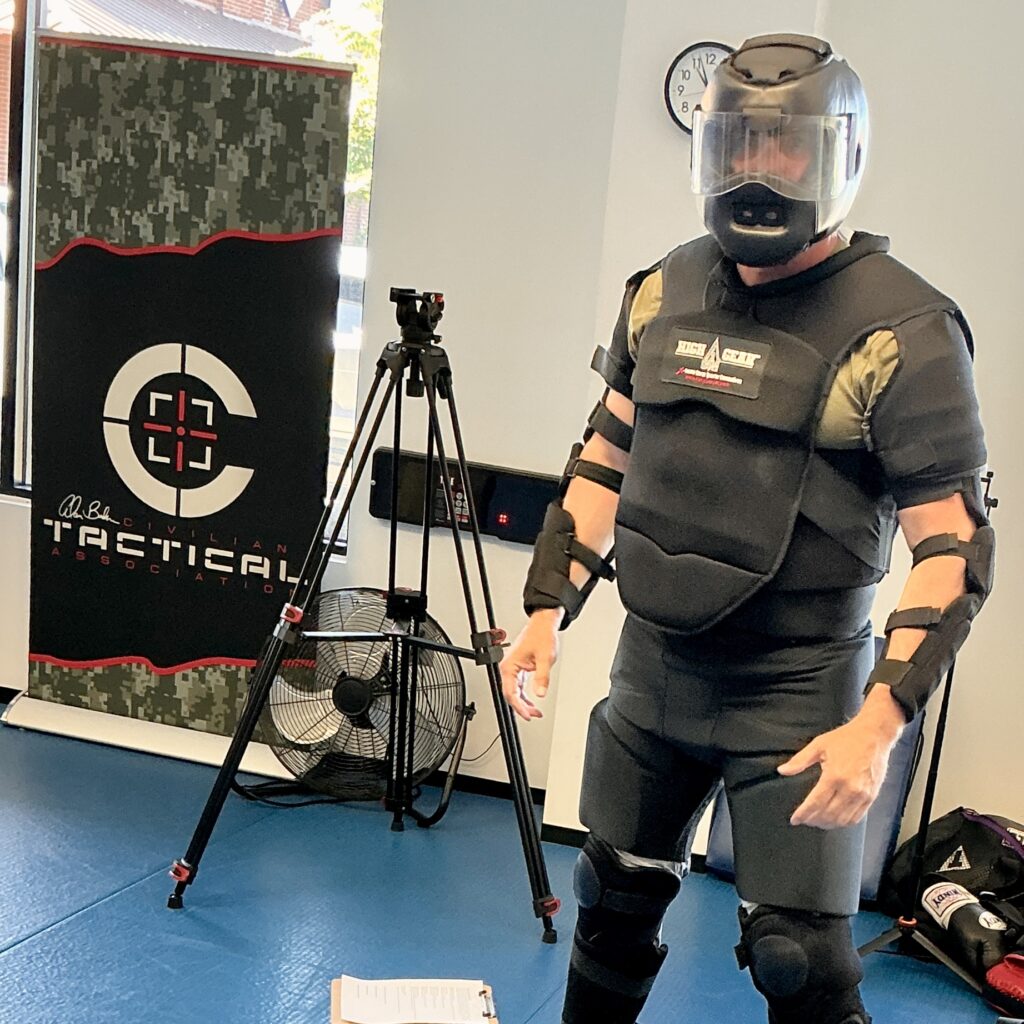
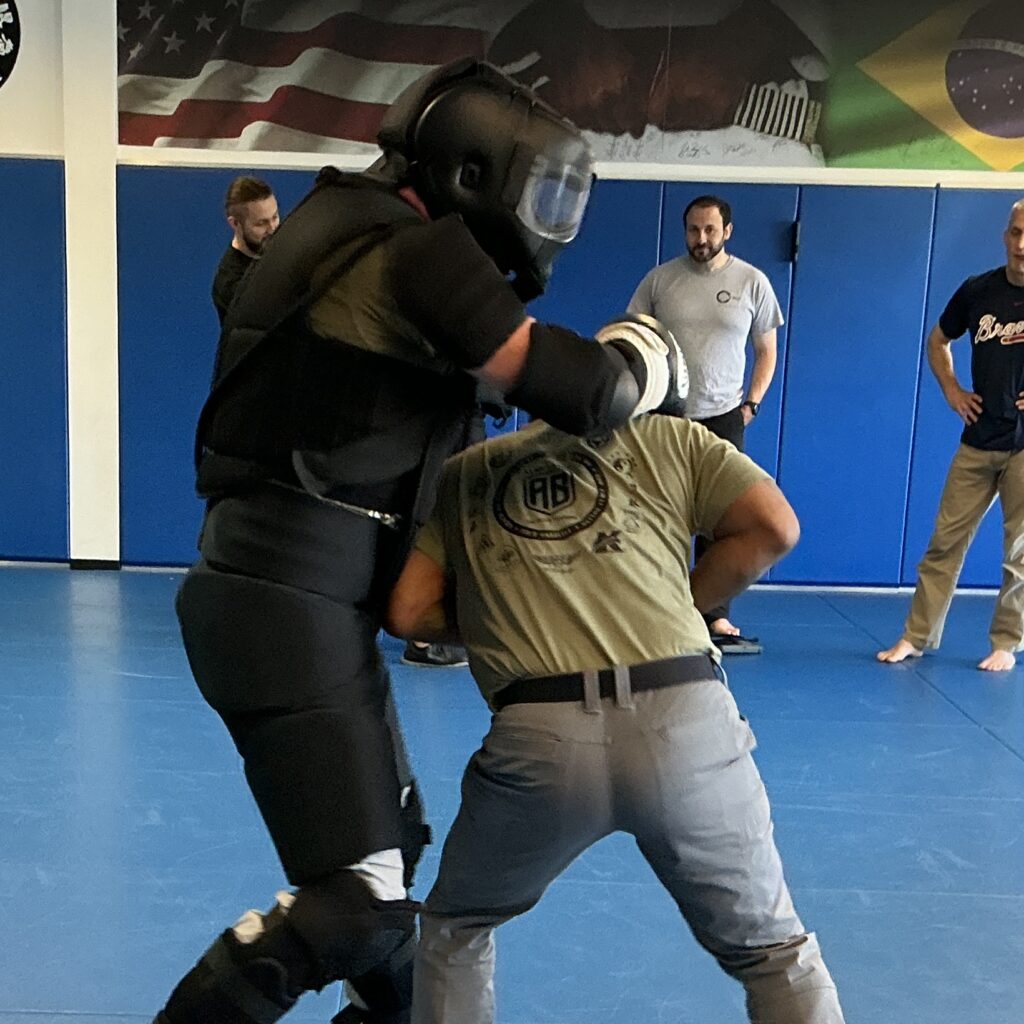
If you spend any time in the defensive tactics, martial arts, or combatives world, you have seen the same scene play out. People suit up in large, padded outfits, full-face helmets, thick gloves, groin protectors, shin guards, and sometimes chest and back armor. The instructor announces that they are going “full force” and that now the training is “real.” From the outside, it looks intense and impressive. From the inside, everyone feels the adrenaline spike. They breathe hard, struggle, shout, and come away with the sense that they did something truly serious and realistic.
I know this method very well. I have been using gear-based training in one form or another for over three decades. I have used it in martial arts academies, civilian self-defense programs, with law enforcement officers, security teams, and protection agents. I have put the gear on myself and have also put it on students and instructors across the country. In other words, I am not speaking as an outsider taking shots at something I do not understand. I absolutely see the purpose of this type of training, and there are substantial positive benefits to using it.
Protective equipment allows us to adjust certain variables that would otherwise be too hazardous. It lets students feel contact. It lets them experience the chaos of movement around walls, vehicles, obstacles, and uneven terrain. It allows us to explore adrenalized states and test our emotional control. It can be a very powerful tool in a larger training process.
But like any powerful tool, it has side effects. There are negatives that come with the positives, and if you do notrecognize them, those negatives will quietly corrupt your training. The gear will begin to lie to you. It will create an illusion of safety and, even more dangerously, an illusion of skill. You will walk away believing certain things “work” or”do not work” based on data that is fundamentally distorted by the equipment itself.
What concerns me is that I do not see a lot of instructors in the industry using this kind of training in an intelligent way, especially in the modern combatives community. I see a lot of people convinced they are doing high level, reality basedwork just because they are exerting aggressive force in padded suits. They equate being loud and violent in gear with being realistic and effective. In my experience, that is absolutely not the case. If you do not understand the distortions gear introduces, you will be fooled by your own drills.
The first and most obvious distortion is that vital targets disappear. In real world violence, certain targets have an outsized effect on how quickly an encounter can change. Eyes, throat, neck, and groin are not magic switches, but when they are attacked decisively and at the right time, they tend to produce significant shifts. People lose posture. They lose vision. Their breathing is disrupted. Their orientation collapses. Their aggression can drop drastically, even if only for a moment. These are the kinds of openings that can allow you to escape, create distance, or finish the fight.
Once you wrap someone in a thick padded suit, most of those targets are either physically covered or declared off limits.The helmet and face cage block everything around the eyes. The padding around the neck and throat prevents direct access and absorbs impact. The groin is hidden behind cups and foam. In many programs, there are also rules that forbidstriking too close to the eyes or attacking the throat and groin directly, even through the gear. From a safety and liability standpoint, that makes sense. I am not arguing that we should run full-power eye gouges in open scenarios.
The point is that once those targets are blocked or banned, they are effectively gone from the drill. That changes the universe you are operating in. You are no longer working inside a model of real violence where those decisive targets are available. Instead, you are working inside a padded universe where only specific options are allowed to shine. The techniques that remain are usually the big, gross motor, high power actions that are safe to use against heavy armor. Heavy swings, powerful clinch work, big tackles, and explosive drives become the center of the experience. Over time, if you are not careful, you start to believe that these are the only options that count. It is not that the vital targets stopped working. It is that you removed them from the test.
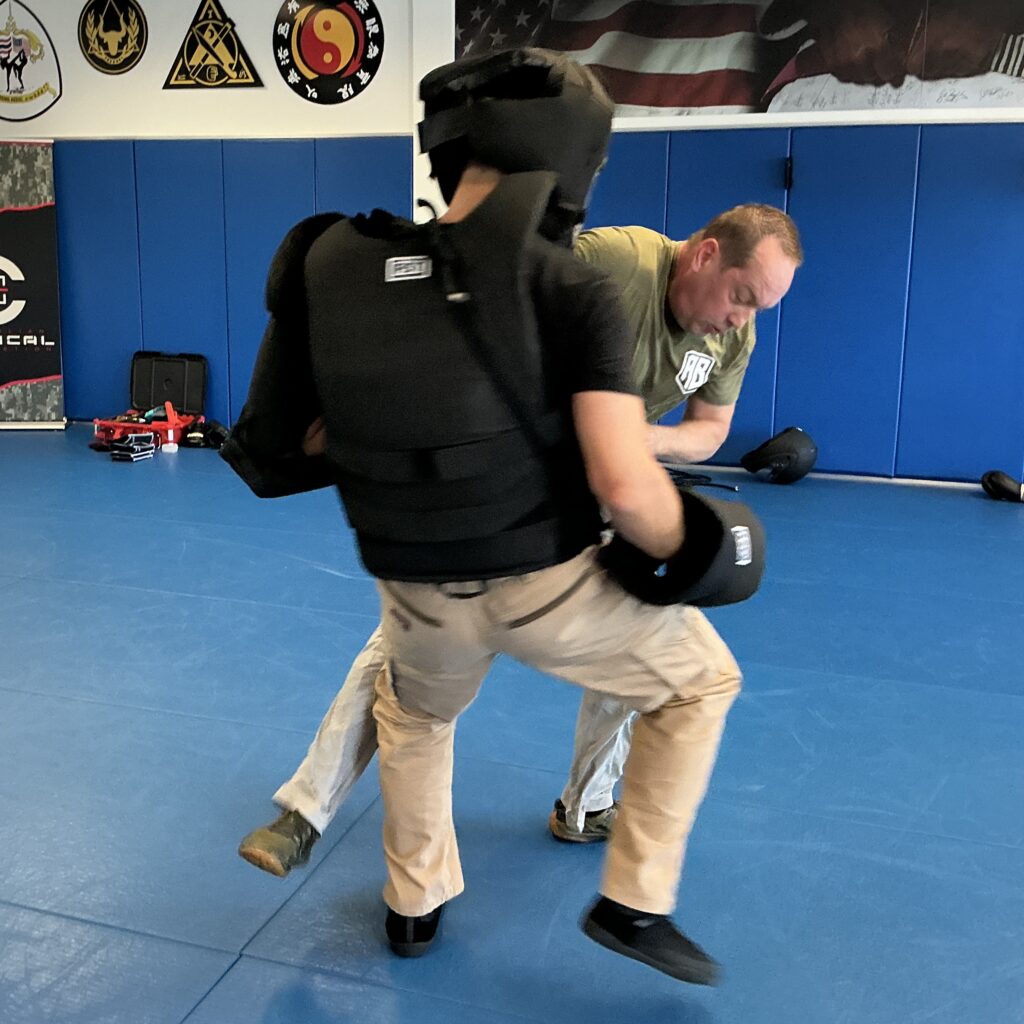
The second distortion is more subtle, but just as important. Even if your rules say that students are allowed to “target” vulnerable areas through the gear, the feedback they receive is not the same. In the real world, a committed shot to the eyes or a serious strike to the throat tends to cause a dramatic change in behavior. It might not “finish” the fight, but it almost always forces a break in the attacker’s structure, breathing, or mental focus. People grab their face. They recoil. They lose orientation. Their aggression and confidence are shaken.
Inside a padded suit, that same motion lands as a muted tap on the visor or a dull push on the padded throat ring. The person inside does not feel the sharpness, the vulnerability, or the sudden fear that would come with an unprotected strike. They feel a bump and keep driving forward. If you run drills like this repeatedly, the student learns a dangerous lesson. They land technically correct shots that would have real consequences in an actual assault, but in the drill those shots seem to do nothing. At the same time, the big, dramatic, padded techniques are the ones that visibly change the scenario. Slowly, the student is conditioned to believe that precise attacks on high value targets are “weak” and that only brute force will get the job done.
In other words, the gear is not only blocking certain targets, it is actively training people to ignore them. It is rewriting their internal hierarchy and their nervous system of what matters in a fight, all without anyone saying a word. This is what I mean when I say the data is corrupted. The student thinks they are learning how violence works in the street, but what they are actually learning is how violence works in a padded simulation where pain, fear, and vulnerability are artificially suppressed.
The third distortion happens in the mind and is connected to identity and role. When someone puts on a padded suit and a face cage, something in their psychology changes. They stop feeling like a normal human and start feeling like a character. They are “the attacker.” Their job is to be the bad guy. They feel armored, protected, and insulated from consequences. They know, at some level, that they are not going to be clawed in the eyes, crushed in the throat, or seriously injured. That knowledge creates artificial bravery.
In real violence, even aggressive criminals experience fear and doubt. They worry about getting hurt, getting caught, or being identified. They flinch. They hesitate. They sometimes break off the attack when the risk feels too high. Inside a padded suit, the role player often has none of those brakes. They charge harder, stay in longer, and tolerate positions and impacts that a real attacker would not. They are not reacting as a true criminal or aggressor; they are reacting as a padded superhero whose job is to make the drill as intense as possible.
The defender feels a psychological shift as well. Once the helmets go on and the cameras come out, many students movefrom a survival mindset to a performance mindset. They feel they need to look good, win the drill, and impress the instructor and their peers. The focus drifts away from outcome based decisions like early avoidance, boundary setting, or timely disengagement. Instead, the unspoken goal becomes to dominate the brawl. People start chasing a “win” inside the scenario, even if that win would be a poor choice in actual life.
Let me reiterate this clearly: I am not opposed to protective gear. I think it is an incredible tool. The issue is not the equipment itself, but how it is used and how the training is framed. From the very beginning, it is critical that participants have the proper perspective. They need to understand that the gear is there to pressure test specific ideas, not to validate their entire tactical game. When students enter a drill knowing exactly what layer is being trained, they can focus on the right lessons, extract what they truly need from the experience, and walk away with far more value than if they simplybelieve they were “fighting for real” against a suit.
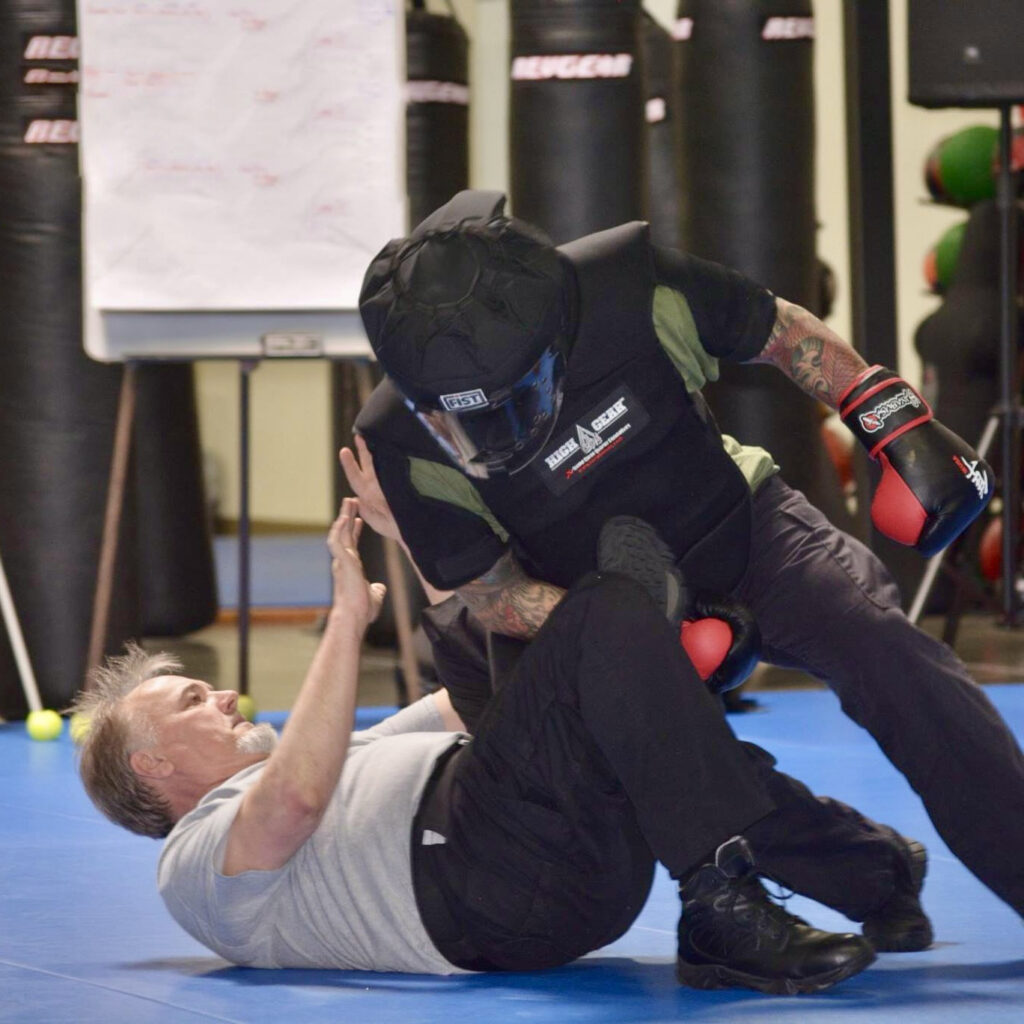
Instructors are not immune either. When everyone is suited up and the drill looks dramatic, it is easy to feel like a director trying to produce a good show. The training becomes a performance for the group or for social media, and the real purpose gets lost. Without meaning to, the instructor may begin to value intensity and spectacle more than quiet, intelligent choices that do not look impressive on camera.
When you put these distortions together, you can see the shape of the problem. The gear blocks or dulls vital targets. It erases the true feedback from vulnerable areas. It makes the attacker unnaturally brave and makes the defender concerned with performance. The entire lab you are working in is tilted away from reality, but if you do not acknowledge it, you treat the results as truth. You begin to believe that your students are “battle tested” because they survived a few rounds in padded chaos. You believe that only big, strong techniques work because those are the ones that show up best in the suit. You believe you are doing something advanced simply because it is loud and exhausting.
None of this means that gear is useless. As I said earlier, I have used it for decades and will continue to use it. Protective equipment allows us to explore impact and intensity in ways that would simply be irresponsible without it. We can test movement in and around vehicles without breaking bones. We can run scenarios that trigger real adrenal responses in our students, which is very important if we want them to experience some of the internal chaos that comes with real confrontation. We can give people a felt sense of what it is like to struggle, be off balance, be pressed against a surface, or deal with someone who is driving into them with commitment.
The key is to understand gear as a tool to examine specific layers of the fight, not as a magic portal into full realism. Every training method has strengths and weaknesses. Bag work, pad work, partner drills, technical sparring, slow work, live grappling, and scenario training all bring something to the table and all leave something out. Gear-based training is no different. The mistake is not in using it. The mistake is in using it blindly.
This reminds me of something one of my mentors at the Executive Protection Institute, Professor John Musser, teaches when he is explaining the science of protection to future agents. He often says that any deterrent you put in place against a potential threat will do something good and it will do something bad. You cannot afford to look only at the good side; you have to recognize the trade-off and understand the balance. The same principle applies to any training you design as an educational leader. Every method you choose will bring benefits and drawbacks, and how acceptable that balance is depends entirely on the mission you are trying to accomplish with that scenario.
So how do we use gear intelligently instead of letting it rule the process? The first step is to be honest about what, exactly, we are testing in each scenario. Before anyone puts a helmet on, the instructor should be able to answer a simple question in clear language: what is the purpose of this drill? Are we working on emotional management under pressure? Are we exploring movement in a confined space, such as inside or around a vehicle? Are we testing verbal de-escalation, communication, and pre-conflict positioning? Are we focusing on integrating everyday carry tools into a dynamic situation? Are we working specifically on grappling against a resisting opponent in an environment where falls and collisions are safer because of the gear?
Once that purpose is clear, everyone involved can interpret the experience correctly. They know they are examining one slice of the problem, not the entire truth of real-world violence. They stop seeing the scenario as the ultimate test of what”works” and start seeing it as a laboratory exercise for a specific set of variables.
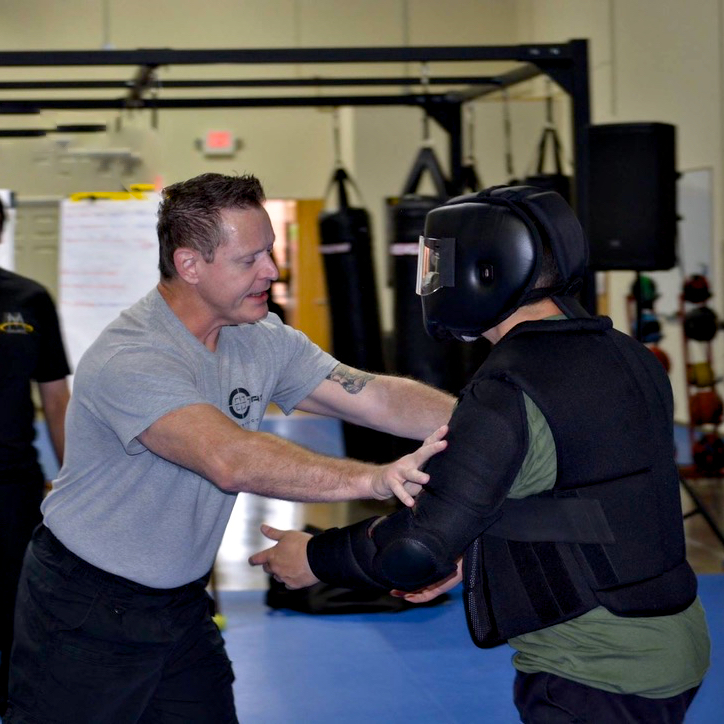
The second step is to protect high-value targets elsewhere in the curriculum. If the padded universe removes eyes, throat, neck, and groin from the equation, you must make sure those targets stay alive in other parts of your program. That means carving out time for carefully controlled technical work in street clothing and realistic footwear, where those targets are the focus. It means slow and medium speed partner exchanges where contact to those areas is mimicked with a light touch, but treated as a serious event in the narrative of the drill. It means talking openly about how the body and strategy would change if those shots landed at full power. In short, you ensure that the suit does not erase those targets from your students’ mental map.
The third step is to build consequences for good shots into the gear based scenarios themselves. Just because the attacker does not physically feel an eye jab or a throat shot does not mean your rules have to pretend nothing happened. You can design your training culture so that a clean hit to a vulnerable area forces a reaction, even inside the suit. Touch the visor with a technically sound eye jab, and the role player must at least break off the attack, cover, or exhibit some realistic compromise. Land a strong simulated throat shot, and they must show that their breathing and posture are affected. Hit a properly armored groin cup with full commitment, and the scenario acknowledges that as a major event, not a minor speed bump. You can even score your scenarios so that intelligent target selection, wise disengagement, and legally sound choices are valued more than raw domination of the brawl.
A fourth step is to rotate gear levels and intensities instead of living in one extreme. If all of your “serious” training happens in full armor at maximum speed, you are automatically biased toward the things that are safe and visible in that environment. Instead, you might intentionally cycle through sessions with no gear and slow work focused on precision and body alignment, sessions with light gear and moderate speed focused on decision making and positioning, and sessions with full gear and higher intensity focused on emotional regulation, environmental awareness, and movement through space. When students experience all three, they learn to connect the technical details they develop at low speed with the chaos they encounter at high speed.
Finally, you have to be very careful not to build a culture that worships “champions of the suit.” If the informal status in your group goes to the person who charges hardest in gear, takes the most hits, and looks the toughest in the scenario, you are drifting away from intelligent training. You are teaching your people to value performance over survival. Instead, you can deliberately praise and highlight the students who make smart pre-conflict choices, who de-escalate successfully, who protect third parties effectively, or who disengage and escape at the right moment. You can make it clear that minimizing injury over the course of the training year is a sign of good design and good decision-making, not a sign of weakness.
This brings me back to the combatives community in particular. There is a strong current in that world right now that equates aggression with realism. If a drill is loud, messy, and exhausting, it is assumed to be good and high-level. If there is footage of people in suits smashing into each other and bouncing off walls, everyone feels they are doing something”real.” There is a kind of adrenaline-fueled theater that has become normal, and it can be seductive for instructors and students alike.
In C-Tac, whenever we begin a seminar or an instructor camp, I often start by talking about the difference between an experience-based event and an educational event. Both are valuable, but understanding the distinction is critical. Most people in the marketplace do not know the difference, because you do not know what you do not know. As a result, they assume that faster, harder, and stronger automatically means more “real” and closer to truth. That is not always the case. While intense training has its place, you also need an equal amount of time spent slowing things down, having realdiscussions, and actually learning intelligent skills, attributes, and higher-level tactics. This is not always the exciting or“sexy” part of training, which is why it often gets skipped or rushed in many programs. As educators, we have torecognize the difference and deliberately maintain a balance between both types of training.
The question I would challenge people to ask is simple: What are you really teaching? Are you building transferable skills and decision-making that hold up under the social, legal, and physical realities your students will actually face? Or are you building actors who are very good at playing within one narrow, padded rule set? If you never step back and analyze the distortions, the gear will lie to you, and you will pass those lies on to your students.
Protective gear is not the enemy. Ignorance is. When you understand that suits remove vital targets, mute feedback from vulnerable areas, make attackers artificially brave, and push everyone toward performance instead of survival, you can account for those distortions in your design. You can use the equipment to explore particular layers of conflict while keeping your overall curriculum anchored to real-world outcomes. You can take advantage of what gear offers without being fooled by what it hides.
If you do that, you move beyond simply running “hard drills.” You begin building practitioners and protectors who can think clearly, adapt in chaos, and act with intelligence when it matters most.
Shift Your Perspective, Take Action, And Create Change
Gentleman in Conduct. Scholar in Thought. Savage in Action.
~ Sifu Alan ┃ www.sifualan.com ┃ www.civtaccoach.com┃www.prtinstructor.com
Sifu Alan Baker is a nationally respected authority in Defensive Tactics Program Development, High-Performance Coaching, and martial arts, with over 45 years of training experience across multiple systems. As a lifelong martial artist and tactical instructor, Alan has dedicated his career to creating practical, adaptable, and effective training systems for real-world application. He has worked extensively with law enforcement agencies, military units, and private security professionals, designing programs that emphasize scenario-based training, everyday carry (EDC) integration, and combative efficiency under pressure.
Alan’s client list includes elite organizations such as the Executive Protection Institute, Vehicle Dynamics Institute, The Warrior Poet Society, ALIVE Active Shooter Training, Tactical 21, and Retired Navy SEAL Jason Redman, among many others. He is the creator of both the C-Tac® (Civilian Tactical Training Association) and Protection Response Tactics (PRT) programs—two widely respected systems that provide realistic, principle-based training for civilians and professionals operating in high-risk environments.
In addition to his tactical and martial arts work, Alan is the founder of the Warrior’s Path Physical Culture Program, a holistic approach to strength, mobility, and long-term health rooted in traditional martial arts and the historic principles of physical culture. This program integrates breathwork, structural alignment, joint expansion, strength training, and mental discipline, offering a complete framework for building a resilient body and a powerful mindset. Drawing from his training in Chinese Kung Fu, Filipino Martial Arts, Indonesian Silat, Burmese systems, and more, Alan combines decades of experience into a method that is both modern and deeply rooted in timeless warrior traditions.
Alan is also the architect of multiple online video academies, giving students worldwide access to in-depth training in his systems, including Living Mechanics Jiu-Jitsu, C-Tac® Combatives, breathwork, functional mobility, and weapons integration. These platforms allow for structured, self-paced learning while connecting students to a growing global community of practitioners.
Beyond physical training, Alan is a sought-after Self-Leadership Coach, working with high performers, professionals, and individuals on personal growth journeys. His coaching emphasizes clarity, discipline, focus, and accountability, helping people break through mental limitations and align their daily actions with long-term goals. His work is built on the belief that true mastery begins with the ability to lead oneself first, and through that, to lead others more effectively.
Alan is also the author of three books that encapsulate his philosophy and approach: The Warrior’s Path, which outlines the mindset and habits necessary for self-leadership and personal mastery; The Universal Principles of Change, a practical guide for creating lasting transformation; and Morning Mastery, a structured approach to building a powerful daily routine grounded in physical culture and discipline.
To explore Alan’s books, digital academies, live training opportunities, or to inquire about seminars and speaking events, visit his official website and take the next step on your path toward strength, resilience, and mastery.
I just passed this article on to my friends I train with, as well as one of my teaching partners and presenters. I saw this morning the event you are attending in North Carolina, and signed up for the newsletter. I have used the “Impact Suit”, consisting of the padded football helmet, chest & groin protection, and now I don’t feel that I used it affective, because I was following someone else’s “dictates” that felt wrong to me, and you’ve outlined my misgivings. Thank you! I hope to connect with you soon, and return to my writing as well, which I haven’t done since December 2017, but you can see some of the subjects I covered at https://pptlifestyle.wordpress.com/infortorials
Roy,
thank you for the feedback and for being a part of the community!
~ JAB