
Let me start by saying this clearly: I love grappling.
I have been involved with multiple grappling systems for over 30 of my overall 45 years of training. Brazilian Jiu-Jitsu, Judo, Catch Wrestling, and Combat Submission Wrestling, to name a few. Grappling is one of the most honest training modalities you can engage in. You can’t fake it on the ground. It teaches you truths about yourself, about pressure, control, timing, and composure under resistance. Grappling will change your body, your mind, and your tolerance for discomfort. It builds physical intelligence like nothing else.
So yes, grapple! It’s good for you.
It will sharpen your awareness.
It will develop your timing and sensitivity.
It will force you to become comfortable being uncomfortable.
It will make you tougher.
It develops the willpower & grit.
And if approached with the right mindset, it will forge a more dangerous, more disciplined version of you.
Done right, standard grappling makes you harder to kill. It builds alignment. It teaches joint control. It gives you deep insight into leverage, weight distribution, and how to stay calm when you’re under pressure.
However here’s the truth no one likes to talk about: most traditional grappling systems, especially those rooted in sport, fall apart quickly the moment a weapon enters the fight. And this is where the conversation needs to evolve. If you’re training in grappling for competition, sport, or fitness, that’s fantastic. Keep going. I support it completely. But if your goal is to protect yourself or your loved ones in violent, real-world situations, then you need to be aware of the massive holes that exist in standard ground game methodology when it comes to armed environments. These are scenarios with no referee and no rules, where knives or guns may be present, where multiple attackers could be involved, where the fight might take place in a parking lot, stairwell, or even inside a vehicle, and where you might already be injured when it starts. In those moments, position, control, and submission aren’t enough. If your grappling doesn’t account for weapons, and harsh enviroments, you’re playing a completely different game, one you might not be prepared to survive.
So what are some of the things missing?
Good Optics
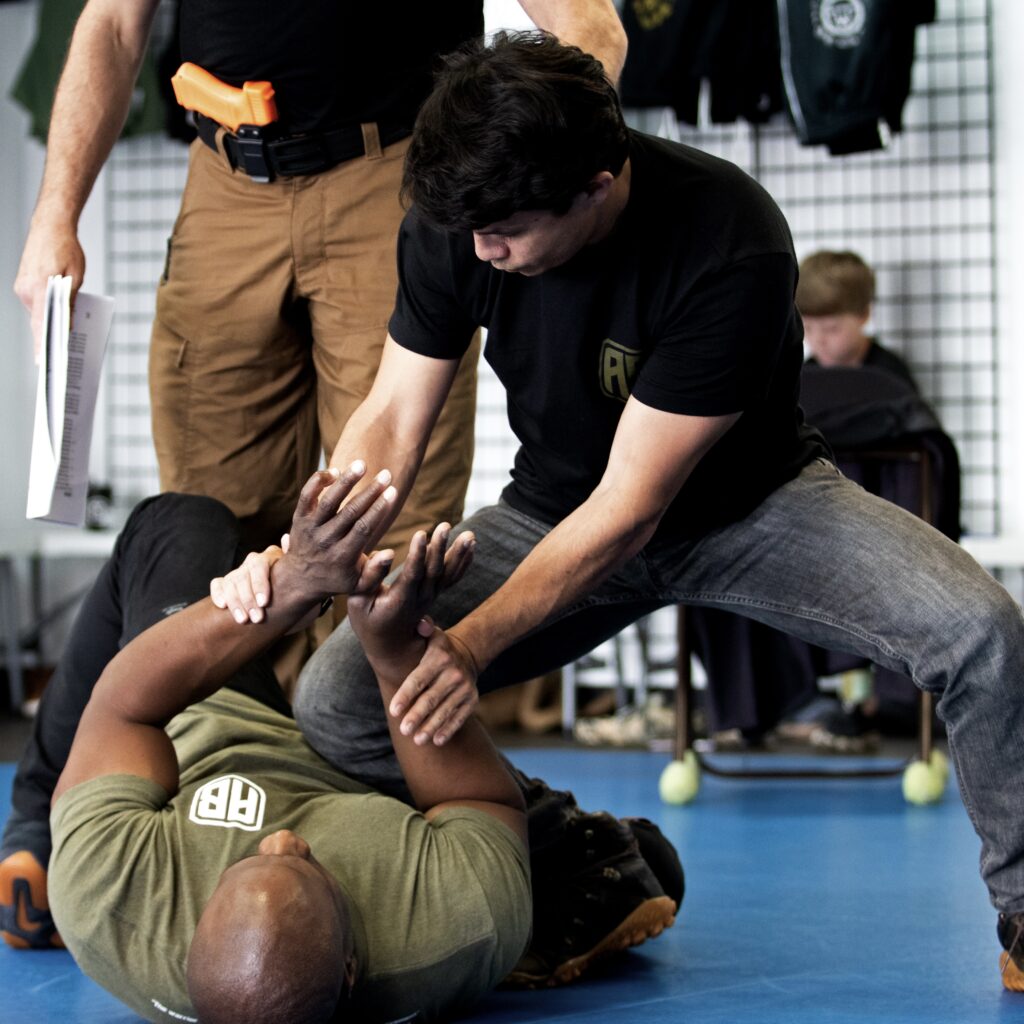
Let’s start with something that’s rarely talked about in most martial arts classes: Good Optics. I’m not talking about cameras or gear. I’m talking about how you see, what you notice, and how well your vision supports your survivability in real-world violence.
Most martial arts systems, especially those rooted in sport or traditional one-on-one formats, do not train you to use your eyes effectively in chaotic, uncontrolled environments. In fact, they often do the opposite. You’re taught to lock onto your opponent, to tunnel in, focus, and commit. While that works in a controlled match, it’s a liability when you’re fighting for your life in a dynamic setting.
If you’re only training to fight the one guy in front of you, you’re missing the bigger picture, literally. In the real world, the guy in front of you might be a distraction, and his partner, the one reaching for a weapon, could be flanking you from your blind spot. This is why training your vision and building habit-based situational awareness is non-negotiable.
You need to train your eyes to stay up, not buried in the clinch. You need 360° observation habits built into your nervous system so your body naturally scans and reads the environment even under stress. If it’s not trained, it won’t be there when you need it. You will default to your training under pressure, and if your training is tunnel-visioned, your reactions will be too.
Part of this process involves pattern recognition. You need to learn to spot danger cues: the shift in posture, the hand drifting to the waistband, the nervous fidgeting, the too-casual guy hanging on the edge of the scene. These shapes and movements should light up your awareness. And that’s not something that happens on its own. It must be cultivated with intention. You have to train it, you have to drill it into your system. These ideas should be a part of how your train. At a minimum, you should have an optic-based decision-making system, a framework that relies on your ability to visually perceive your environment and process what you’re seeing in real time to make smart, tactical choices. This is critical in any high-stress or combative situation where the difference between reacting fast and freezing could mean the difference between success and failure, between surviving and not.
One well-known and highly effective example of this is the OODA Loop methodology, developed by U.S. Air Force Colonel John Boyd. But here’s the kicker: you cannot run a good OODA Loop if your optics are poor. If you don’t train your eyes to scan, to detect subtle cues, to register spatial threats, or to recognize pre-attack indicators, your loop fails right at the beginning. That’s why in our training, visual literacy is prioritized from day one. Your eyes lead the process. Your ability to see and interpret feeds everything else.
So in any training meant to prepare you for real-world violence, grappling or otherwise, optics must be addressed. Your eyes are a vital part of your defense system. If they’re not trained, you’re fighting blind.
Make Em Earn Flat

In some corners of the grappling world, it has become common to hear people talk about being “comfortable on your back.” While the entire community does not share that mindset, there are plenty of practitioners who treat this position as a badge of confidence or capability. From a purely sport-based grappling perspective, that may have its place. But in a self-defense environment, especially when weapons may be involved, this mindset can be dangerous.
If you’re armed or operating in an unpredictable setting, you simply cannot afford to be comfortable lying flat on your back. In our training, we instill the idea that the only time you should ever be flat on the ground is when your opponent is skilled enough to force you there. In other words, they have to earn it. We say this often during training: make them earn flat. It becomes a principle, not just a saying. Because when you’re flat, you have more surface area on the ground, and the more contact you have with the ground, the less ability you have to move. And movement is life. This is amplafied when you move from the mat to the parking lot.
In order to generate effective motion, particularly under stress, you need space. This is why one of the very first techniques taught in most grappling classes is the bridge. It teaches you to create movement from your hips, generate force from your core, and escape pressure. A flat body robs you of that capacity. It locks you into the earth and limits your options. In the grappling environment, we need space, movement and frame.
Another issue with being flat is neurological. If you spend years training to be relaxed and settled into your back, eventually that state becomes an ingrained habit in your nervous system. You no longer resist it. You accept it. And if the pressure in a fight becomes overwhelming, your body will revert to what is most familiar. That’s a problem. In a violent encounter, particularly one involving weapons or multiple attackers, the last thing you want is to be flat, comfortable, and passive. You want to be alive, alert, and mobile.
From a striking perspective, this position is also weak. You cannot produce a significant force from your back, especially if both shoulders are pinned. One of the guiding principles we teach is that you should be able to deliver 360 degrees of destructive force from any position. That ability is drastically reduced when you’re flat. Your ability to generate torque, leverage, and coordinated movement disappears. You become a target, not a threat.
So we train differently. We teach students to avoid settling, to fight for frames, angles, and elevation. We emphasize mobility and the constant drive to improve position. We train the nervous system to feel discomfort when flattened and to instinctively seek space and movement. It’s not about never being on your back. It’s about never being comfortable there. If your opponent wants you flat, make them earn it.
Weapon-Based Fundamentals
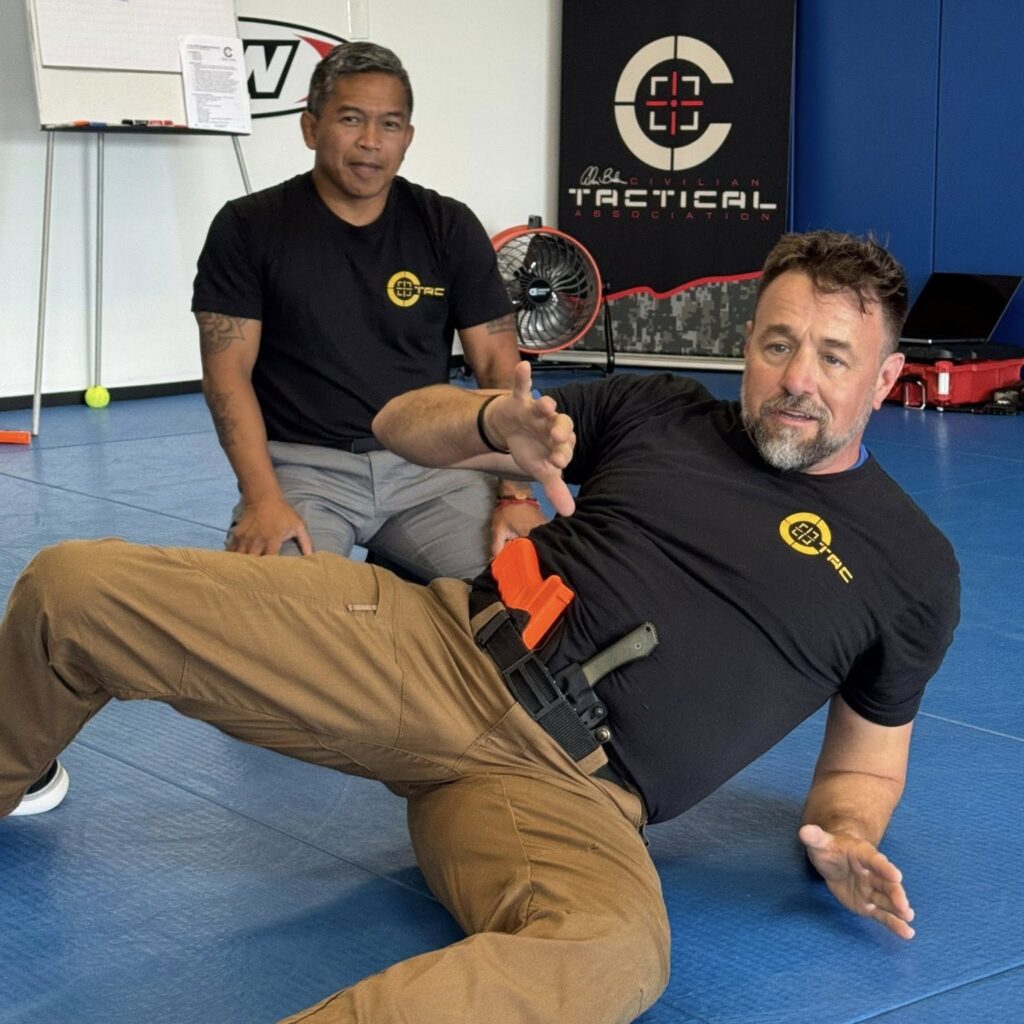
Over 18 years ago, I started to include a weapons kit in all of my training. It consisted of a firearm and a straight blade. When I first began integrating weapon systems into my grappling practice, one of the earliest and most glaring realizations I had was that many of the foundational techniques I had drilled for years, techniques considered “must-know” in traditional grappling, actually put me at a serious disadvantage in an armed context. In fact, many of these moves functioned like a delivery system, placing my firearm or blade right into my opponent’s hands, as if I had served it to them on a dinner plate.
I still vividly remember the moment I was first confronted with this problem during a training session with one of my tactical clients inside a shoot house hallway. I was breath-starved, under pressure, and outnumbered, with two opponents closing in on me. My system was overloaded, and in that instant, my body didn’t ask for permission. It just reacted. My nervous system defaulted to what it knew, to what had been drilled into me through years of repetition. I executed a technique that would’ve worked flawlessly on the mat, against a single opponent, in a weaponless environment. But in that real-world scenario, it failed me. The move I chose exposed my firearm and practically handed it to my opponent. That moment changed how I viewed everything.
These techniques, while undeniably effective in a pure grappling environment, were suddenly problematic. The minute I added tools to my beltline and started pressure testing those same movements with weapons present, it became clear that I had to rethink not only my tactics but my entire approach to fundamentals. My default mechanics were working against me.
The first step in adapting my approach was to establish a new framework for evaluating whether a technique was appropriate in an armed encounter. Every technique and strategy moving forward had to meet specific criteria based on my Everyday Carry (EDC) setup and the real-world scenarios I might face. These new objectives became the lens through which I analyzed and selected my training methods.
Here are the core priorities that guided the redesign of my grappling foundation:
Move the Weapon System Away From the Opponent
If a movement exposes your firearm, knife, or other tool to your opponent, you’re not just grappling; you’re arming them. Techniques had to be restructured to create space and keep the weapon side away from entanglement and control. I had to implement new techniques designed to shift weapon access away from the opponent and keep it under my control.
Free Yourself From Downward Pressure
Avoiding being pinned becomes more than just an athletic priority; it’s a matter of survival. You need the space to access tools, move freely, and maintain decision-making capacity. Techniques that prioritized mobility and explosive bridging had to replace static control positions. You are building the habit of fighting your way back to your feet.
Position to Deliver Destructive Force
In self-defense, control isn’t always the endgame. You may need to create an opportunity to finish the fight. That means finding positions that allow for devastating strikes or biomechanical breaks, like knees, elbows, or spine alignments, not just submissions. Some of the positions I used to rely on weren’t effective for striking, so I had to develop positions that supported both grappling and striking seamlessly.
Position for a Controlled Exit From the Ground
Your priority should not be to dominate from bottom positions but to get back to your feet as soon as the opportunity presents itself. Ground dominance means nothing if you’re unaware of the guy stepping in from the blindside. Your movement must always trend toward mobility and exit options.
Exit With Structural Damage
If you’re disengaging, it should hurt them. Attacking the structure, knees, ankles, or balance points on your way out creates hesitation or incapacitates their ability to pursue. We want finishing moves, techniques that do more than just win points or cause temporary discomfort. In a true self-defense encounter, the goal isn’t to “win” in the sporting sense, it’s to survive, neutralize the threat, and ensure they can no longer continue their attack. That means having finishing techniques that completely incapacitate the threat.
Create a Safe Weapon Deployment Path
Your escape should place you in a position to safely deploy a weapon if necessary. This means having the range, angle, and control to draw without being immediately countered or disarmed. Each technique we train should provide the opportunity to safely access and deploy a weapon system when needed.
Maintain 360-Degree Awareness and Optics.
As you exit or reposition, your eyes must stay active. Build the habit of scanning your environment for additional threats. We refer to this as developing “good optics,” and it must be trained into your nervous system. If your focus narrows to the man in front of you, you’ll miss the wingman closing in from behind.
As I implemented these requirements, my entire catalog of techniques started to shift. But it didn’t stop there. Eventually, the mechanics of my base movements, day-one fundamentals, also had to evolve. I had to retrain how I bridged, how I performed hip escapes, and even how I posted for balance. My entire mechanical vocabulary had to adapt.
The deeper I went, the more I realized that even my long-standing strategies and ingrained instincts had to be rewritten. For example, I had to learn to grapple with one hand constantly committed to protecting my weapon system. That meant I was no longer grappling symmetrically. I was now operating with one hand fighting and the other guarding, or preparing to draw. That simple change altered everything: posture, pressure, balance, and timing.
Over time, all of this work, revisiting my basics, reengineering techniques, and reprogramming instincts, led to the development of an entirely new curriculum. It became a distinct approach to grappling that looked nothing like what I had learned in sport systems. The goal was no longer to out-grapple the other person, but to survive, control, get to a weapon system, destroy if needed, and escape.
It wasn’t just a tweak. It was an entirely different animal.
Grapple to Fight, Not Grapple To Grapple.

When training in a grappling system, it is very common to be placed in a disadvantageous position and work to escape from it. Once you’ve achieved that escape, the next logical step in many systems is to move into a dominant position, and from there, continue grappling. This makes perfect sense if your entire focus is learning the art of grappling for its own sake, whether for sport, competition, or technical refinement. In our system, we refer to this mindset as being trained to “grapple to grapple.” That approach has value, but it becomes problematic when you consider the full scope of real-world self-defense or protection-based scenarios.
Suppose your nervous system becomes conditioned to automatically re-engage in grappling after every escape or positional change. In that case, you may find yourself falling into patterns that are not appropriate in a fight for your life. Grappling is a tool, but it is not always the final answer. Sometimes you grapple not to dominate, but to transition. You may need to grapple just long enough to gain the space to strike decisively. You may need to grapple to gain control of a limb to access a weapon. Or, in many cases, the smartest move is to grapple only long enough to get back to your feet and exit the situation entirely.
This becomes especially important in armed or multi-attacker environments. If your body is hardwired through years of training to immediately re-grapple after an escape, that decision might come from muscle memory rather than tactical intelligence. And if you are dazed or overwhelmed from the intensity of the encounter, your nervous system may take over and default to what it knows best. This could lead you to stay entangled when what you really needed was space, elevation, or a clean exit. At that moment, you may find yourself wishing that you had trained other responses into your body, ones that serve survival over dominance.
This is why it is critical to broaden your training. Grappling should not end with control or submission. It should also be a gateway to other outcomes, like powerful striking, weapon deployment, or escape. When we teach grappling within the self-defense context, we constantly include scenarios where grappling transitions directly into other modes of action. For example, we practice using grappling to establish frames that allow for strikes with force in all directions. We use clinch positions to access knives, flashlights, or firearms. And we train escapes that lead not to re-engagement, but to disengagement, creating distance, seeking cover, or simply getting off the X and leaving the danger zone.
Another benefit of approaching grappling this way is that it often puts you in a more upright posture, improving your field of vision. Having better optics is crucial in case there is a second attacker nearby. The last thing you want is to be focused solely on the person in front of you while their partner circles around or reaches for a weapon. The more upright or mobile you are, the easier it becomes to scan, assess, and act.
So yes, grapple. Train the mechanics, the control, and the flow. But also train your exit strategies, your transitions to strikes or weapons, and your ability to stay aware while entangled. Build a grappling game that is adaptable, strategic, and aligned with the realities of real violence. Train your body to make the right choice, not just the familiar one, when it matters most.
Seek Structural Damage Over Superficial Damage

Some submissions, tho they do suck, are not always conducive to “finishing” a fight. This is one of the reasons we say to Seek Structural Damage Over Superficial Damage. Choose a finish that will destroy your opponent’s ability to respond. Of course, all of this has to be applied with discretion. Not every situation warrants maximum damage, and part of being a responsible and capable practitioner is developing a solid decision-making process. That means learning to assess threats in real-time and respond with the appropriate level of force. However, if you find yourself in a scenario where your safety or the safety of someone you’re protecting is on the line, and the goal is to fully stop the threat, then you cannot afford to rely on techniques that are limited in their stopping power.
In these critical moments, your goal should not be to cause temporary discomfort or minor structural damage. A submission that tears a few ligaments or renders someone unconscious for sixty seconds might work in sport, but it may not be enough in a real-world fight. You need something that completely shuts the opponent down, something that disables their ability to get back up and re-engage when your back is turned. Because in the real world, when you get up to leave, you don’t want them getting up and coming after you.
The challenge is that many grappling systems do not prepare you for this. Submissions are often taught for points, for compliance, or for the controlled environments of competition. Rarely are they analyzed through the lens of “will this actually end a violent threat?” What’s more concerning is that most systems don’t openly acknowledge the limitations of these techniques. As someone who has spent decades immersed in grappling, I can tell you from experience: pain doesn’t always equal incapacitation.
Over the years, I’ve sustained significant injuries from grappling, torn ligaments, hyperextended joints, and dislocated fingers, and I still showed up to train week after week. Yes, it hurt. Yes, it limited what I could do. But it didn’t stop me. And if it didn’t stop me, then why would it stop a violent, motivated predatorial attacker on the street?
This is where self-defense training must evolve. We must move beyond the idea of submission as a “tap out” and begin looking at finishing methods through the lens of consequence and effectiveness. Whether your solution involves grappling, striking, or weapons, you need to have a finishing method in your arsenal that will truly do the job. That doesn’t mean always going to maximum force, but it does mean having the ability to go there when the situation absolutely calls for it. Violence exists on a spectrum, a continuum of destructive force. It’s critical to have tools and tactics that cover both ends of that scale. If you find yourself in a situation that demands higher levels of force but all you’ve trained are watered down techniques from a low force system, you’re in trouble. That gap in capability could cost you dearly when it matters most.
Take time to evaluate your training. Ask yourself: if I had to finish this now, could I? Is my go-to method enough to stop someone who is not interested in tapping, who doesn’t feel pain, who is high, or who is so aggressive that injury alone won’t stop them? If the answer is no, then you need to reassess your finishing tools and make sure you’re not just training for the mat, but for the chaos and consequences of the real world.
Environmental Weapons: Training to See and Use What’s Around You
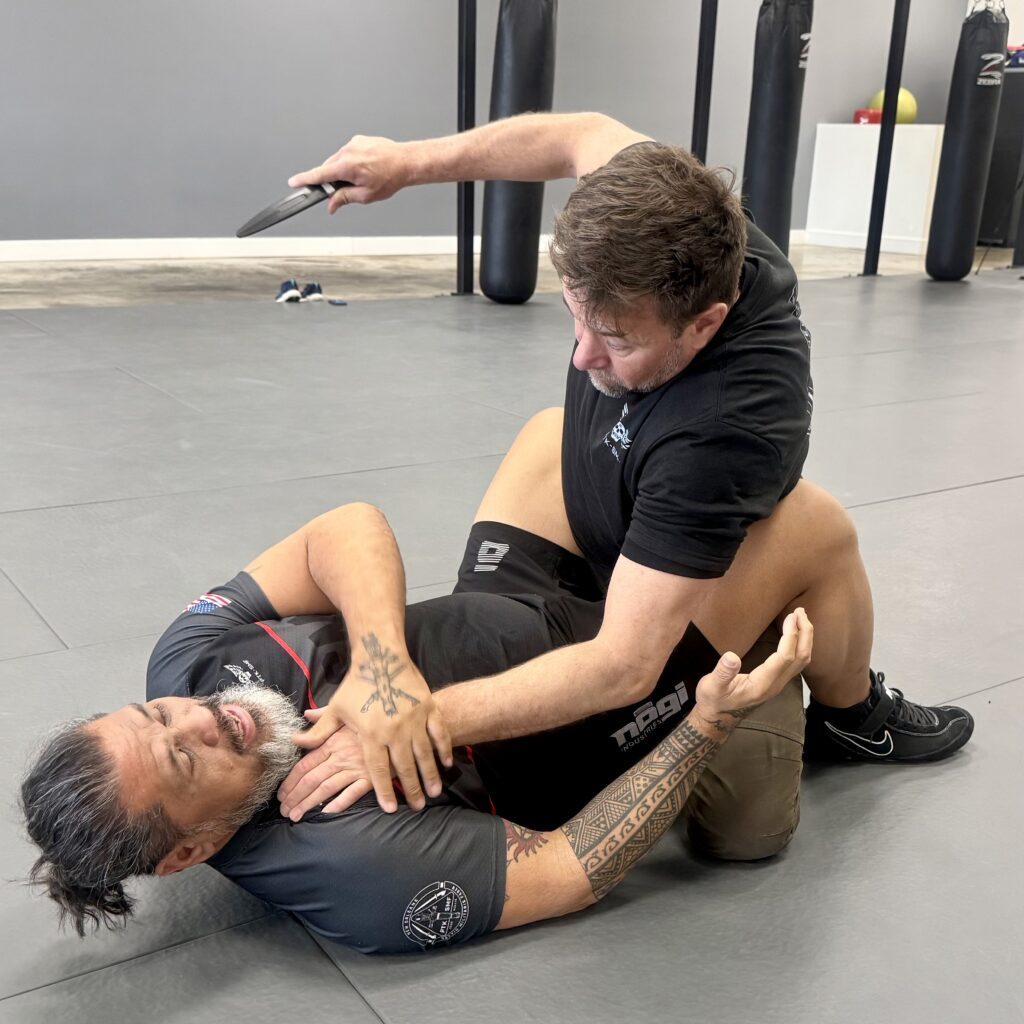
One of the critical components that is often completely overlooked in traditional grappling systems is the role of the environment itself and how it can be used as a weapon.
When I started integrating real-world self-defense considerations into my training, one of the first lessons I had to reinforce with my students was that anything in the environment can be a weapon. This includes blunt objects, edged tools, hard surfaces, and even unstable terrain. But in order to effectively use these environmental tools under pressure, the ability to see them and act on them must be trained.
In our academy, I began introducing this concept by tossing weapons of opportunity onto the mat during live rolling sessions. Things like training knives, sticks, small blunt tools, or makeshift items that could represent something commonly found in the real world. The goal was simple: if the students saw it and could use it, they had the green light.
What surprised me at first, but quickly made sense, was that most of the time, students didn’t see them, let alone use them. They were fully engaged with their partner, locked into the rolling mindset, and entirely focused on their opponent. That happens because most grappling systems condition you to stay narrowly focused. You’re trained to engage with one person in a controlled space, under rules, with no awareness of surroundings or outside variables. Even worse, in many academies, it’s considered a safety hazard to have anything on the mat, so students are never exposed to the concept of improvised weapons in the training environment at all.
But in the real world, that’s a dangerous oversight.
In a real altercation, whether it’s in a parking lot, a bar, a stairwell, or a restaurant, there are objects all around you. And those objects can and should be used to your advantage. If I’m fighting for my life, I might need to bounce someone’s head off a curb. I might need to smash their skull on the edge of a table. If I slip and fall during a confrontation near a brick wall, that structure becomes a tool for creating injury, dominance, or an exit opportunity.
The problem is that if you don’t train to recognize and use those tools, you won’t see them when it counts.
This is why we make the use of environmental weapons a regular part of training in our academy. Over the years, we’ve experimented with various methods to develop this skill. Sometimes we plant obvious tools around the mat to test recognition. Other times, we use scenario-based training that simulates real locations such as parking lots, alleyways, or inside vehicles, where every surface or item might be fair game. We teach students to identify hard edges, corners, poles, railings, chairs, curbs, gravel, and anything that can assist in creating dominance or escape.
It’s not about turning training into chaos. It’s about forging pattern recognition and behavioral response into the nervous system. You want your students to see differently. When the chaos hits, they should not only be thinking about the fight, but about the space they’re in, what they can use, how they can move, what exits exist, and what weapons of opportunity are within reach.
So my main point here is simple: if environmental weapon use isn’t part of your combative training in some way, your students are missing out on a critical layer of survival skill. Whether it’s through scenario training, weapons placement drills, or visual recognition work, this element needs to exist in your training curriculum. In a real fight, the environment will be there. You either use it, or your opponent might.
Your Technique Should Work Behind Time and Ahead of Time
Plan to be ahead of time. Prepare to be behind in time. (Ambush)

In the world of personal protection and real combat, not the safety of the training mat, timing is everything. It doesn’t matter how clean or advanced your technique is if it only works in perfect conditions. And let’s be honest: perfect conditions don’t exist in violent encounters.
That’s why I teach my students that your technique must work ahead of time and behind time. What does that mean?
Ahead of time is when you’ve anticipated the threat. You saw the cues. You picked up on the pre-contact indicators. You were situationally aware, you had control of the space, and you were mentally and physically ready to act before the opponent launched their attack. In this case, your technique is executed proactively. You get to move first. You dictate the pace. You dominate the action.
This is the ideal. This is what we train for. This is where our planning should live. We should be doing everything possible to build our awareness, sharpen our perception, and train the kind of physical literacy that allows us to move early, intercept, and control.
But we don’t always get that luxury.
Behind time is the ambush. It’s when the first time you know you’re in a fight is when you’ve already been punched in the face. It’s when the bad guy is already mid-attack, or you’re caught in a compromised position. It’s messy, disorienting, and it’s where a lot of people freeze or die if they haven’t trained for it.
And this is why your technique must also function behind time. You must train for worst-case timing. You need pressure-tested techniques that can be deployed when you’re already in a bad spot: pinned, off-balance, injured, in a confined space, or defending someone else.
Most martial artists don’t train here. They train ahead of time, where everything is controlled, the attacker is compliant, and the timing is ideal. That’s not reality. That’s choreography.
To be combat-effective, your techniques need to span the entire timing spectrum. They need to function when you’re first to act and when you’re late to react. You must be able to fire under pressure. You need to be able to move when pain, confusion, and chaos are already in play.
Plan for success. Train for failure. Prepare for the moments when you’re behind time and still have to fight your way out.
If your technique only works when you’re early, you don’t have a real technique. You have choreography.
Evolving the Way We Train for the Real World

If you’ve made it this far, you probably recognize the truth many never confront: real violence is not clean, not fair, and not built for your training comfort zone. It doesn’t happen in a pristine dojo, under rules, with predictable opponents. It happens behind time, in chaos, in compromised positions, and with tools in play. And if your grappling, or any of your combative training, hasn’t evolved to reflect that, then you’re preparing for the wrong fight.
This is exactly why the C-Tac system was born.
At the Civilian Tactical Training Association, we’ve built our entire methodology around this hard reality. Every principle outlined in this article, from weapon-integrated grappling, to environmental weapons, to real-world optics, to seeking structural damage, to operating across the full timing spectrum, is trained, tested, and drilled into our students and instructors. This is not theory. It’s pressure-tested, situationally grounded, and strategically layered training for civilians, protection agents, and those who are serious about surviving and prevailing in armed environments.
Our system teaches you how to fight smart, move with purpose, and make decisions under extreme stress. We don’t just teach techniques, we teach strategies, timing, and behavior patterns that work under pressure. We don’t train to win medals. We train to protect lives. C-Tac is not for everyone. It’s for those who are done pretending that sport solutions will save them in the parking lot. It’s for those who are ready to train with intelligence, intention, and intensity.
If that’s you, if you’re ready to take your training to the next level and evolve your approach to self-protection, then the C-Tac system is where you belong.
Shift Your Perspective, Take Action, And Create Change
Gentleman in Conduct. Scholar in Thought. Savage in Action.
~ Sifu Alan ┃ www.sifualan.com ┃ www.civtaccoach.com┃www.prtinstructor.com
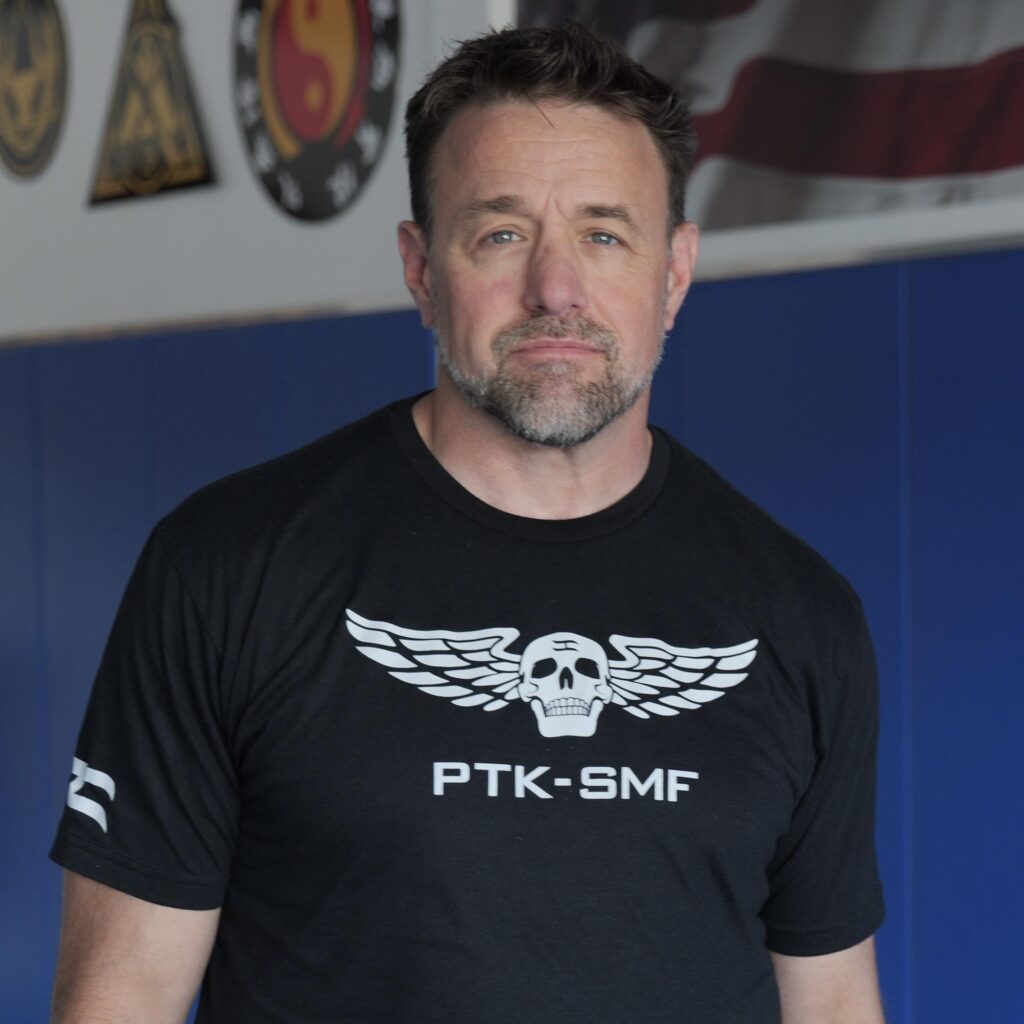
Sifu Alan Baker is a nationally respected authority in Defensive Tactics Program Development, High-Performance Coaching, and martial arts, with over 45 years of training experience across multiple systems. As a lifelong martial artist and tactical instructor, Alan has dedicated his career to creating practical, adaptable, and effective training systems for real-world application. He has worked extensively with law enforcement agencies, military units, and private security professionals, designing programs that emphasize scenario-based training, everyday carry (EDC) integration, and combative efficiency under pressure.
Alan’s client list includes elite organizations such as the Executive Protection Institute, Vehicle Dynamics Institute, The Warrior Poet Society, ALIVE Active Shooter Training, Tactical 21, and Retired Navy SEAL Jason Redman, among many others. He is the creator of both the C-Tac® (Civilian Tactical Training Association) and Protection Response Tactics (PRT) programs—two widely respected systems that provide realistic, principle-based training for civilians and professionals operating in high-risk environments.
In addition to his tactical and martial arts work, Alan is the founder of the Warrior’s Path Physical Culture Program, a holistic approach to strength, mobility, and long-term health rooted in traditional martial arts and the historic principles of physical culture. This program integrates breathwork, structural alignment, joint expansion, strength training, and mental discipline, offering a complete framework for building a resilient body and a powerful mindset. Drawing from his training in Chinese Kung Fu, Filipino Martial Arts, Indonesian Silat, Burmese systems, and more, Alan combines decades of experience into a method that is both modern and deeply rooted in timeless warrior traditions.
Alan is also the architect of multiple online video academies, giving students worldwide access to in-depth training in his systems, including Living Mechanics Jiu-Jitsu, C-Tac® Combatives, breathwork, functional mobility, and weapons integration. These platforms allow for structured, self-paced learning while connecting students to a growing global community of practitioners.
Beyond physical training, Alan is a sought-after Self-Leadership Coach, working with high performers, professionals, and individuals on personal growth journeys. His coaching emphasizes clarity, discipline, focus, and accountability, helping people break through mental limitations and align their daily actions with long-term goals. His work is built on the belief that true mastery begins with the ability to lead oneself first, and through that, to lead others more effectively.
Alan is also the author of three books that encapsulate his philosophy and approach: The Warrior’s Path, which outlines the mindset and habits necessary for self-leadership and personal mastery; The Universal Principles of Change, a practical guide for creating lasting transformation; and Morning Mastery, a structured approach to building a powerful daily routine grounded in physical culture and discipline.
To explore Alan’s books, digital academies, live training opportunities, or to inquire about seminars and speaking events, visit his official website and take the next step on your path toward strength, resilience, and mastery.