
Capability Academy • C-Tac • Warrior’s Path Podcast
The C-Tac Combat Blueprint: A Strategic Map For Self-Defense Training
In this Warrior’s Path Podcast episode, Sifu Alan Baker and Bob Burgee discuss the C-Tac Combat Blueprint, a thought tool designed to help students identify training gaps, avoid becoming systemized, simplify their study, and build a more complete approach to civilian protection.
Podcast Guide
In This Episode
- 01:04 Why the Combat Blueprint exists
- 01:34 Bob Burgee joins the conversation
- 04:26 Avoiding systemization in martial arts
- 06:50 Recognizing gaps in knowledge
- 07:54 Simplification and training depth
- 09:16 Technique, attribute development, and body state training
- 10:46 The five pillars of the Combat Blueprint
- 12:04 Why these are called Primal Environments
- 14:34 Building a baseline in each environment
- 17:37 Pressure testing and finding truth
- 20:14 Avoiding the trap of old stories without current training
- 26:43 Easy, consistent, and sustainable training
- 33:06 Resistance environments for each pillar
- 35:39 Finding out what you do not know
- 36:03 The volume knob and adjustable resistance
- 37:31 Timeless tools and training for the long path
- 47:21 Subsystems inside the ground pillar
- 51:44 EDC grappling and changing the basics
- 56:41 Final thoughts on testing, training, and humility
Media Description
Warrior’s Path Podcast 019
This episode of the Warrior’s Path Podcast focuses on one of the central thought tools inside the C-Tac program: the Combat Blueprint.
Eventually, the podcast will transition under the Capability Academy podcast structure, but the purpose will remain the same. These conversations are designed to help serious students think better, train better, and build a more complete understanding of martial arts, self-protection, personal development, and capability.
In this episode, Bob Burgee joins me to discuss how the Combat Blueprint helps students avoid common pitfalls in self-defense training. Bob is the Technical Director for the Capability Academy and the video academy platforms across our extended campus. He has also been a long-term partner in building, managing, and developing several of our digital training environments.
The Combat Blueprint helps students see where their knowledge is strong, where it is weak, and where a martial arts system may have unconsciously shaped their assumptions. It is not a fighting style. It is a strategic map for self-education.
The Combat Blueprint is not a fighting style. It is a thinking tool that helps you see the whole landscape of violence.
C-Tac Thought ToolThe Combat Blueprint
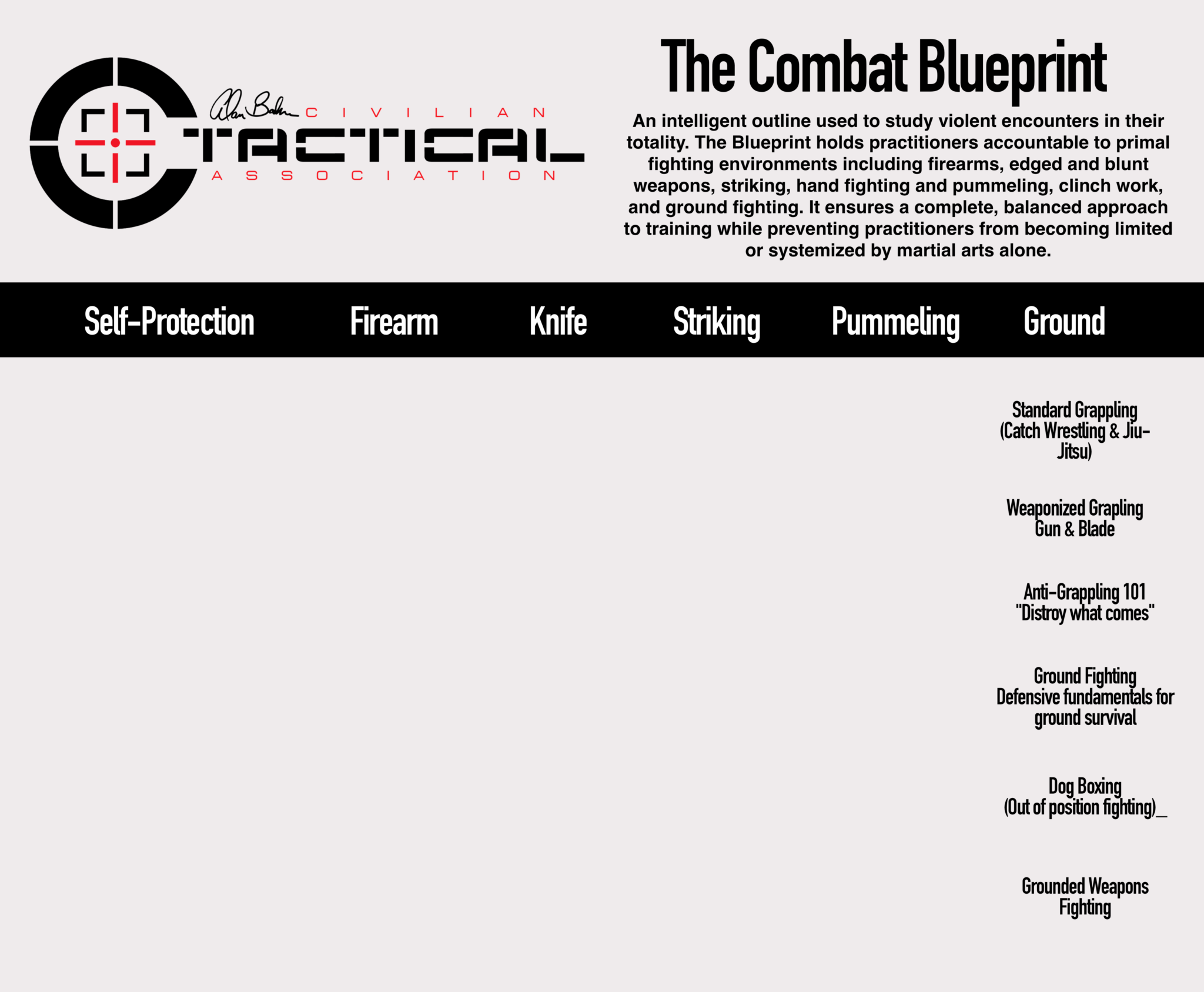
The C-Tac Combat Blueprint gives students a big-picture map of conflict so they can identify gaps, avoid blind spots, and build a more complete training plan.
In the often overwhelming world of martial arts and self-defense, finding the most effective and applicable training methods can be difficult. The field is filled with techniques, systems, theories, and specialized training paths. Each one may have value, but without a roadmap, students can lose sight of the larger problem.
The Combat Blueprint was created to help solve that problem.
It provides a structured way to look at violent encounters through major environments of conflict. Instead of becoming trapped inside one style, one range, one method, or one belief system, the student can step back and ask better questions.
What am I training? What am I not training? Where do I have experience? Where do I only have assumptions? Where am I overcomplicated? Where have I become systemized?
Those questions matter because self-defense training is not just about adding more techniques. It is about building a more honest picture of capability.
The Five Primal Environments
Projectiles
Firearms, marksmanship, close-quarter firearm manipulation, retention, disarms, and projectile-based problems.
Weapons
Edged weapons, impact tools, improvised weapons, and weapon-based realities that change the fight.
Striking
Punching, elbows, knees, kicking, shielding, and managing the striking environment.
Clinch
Hand fighting, pummeling, control, positioning, off-balancing, and close-quarter dominance.
Ground
Grappling, anti-grappling, ground fighting, dog boxing, and grounded weapon fighting.
Why We Call Them Primal Environments
In the C-Tac program, these areas are often described as Primal Environments because they reflect natural human responses that tend to appear under the pressure of real violence.
A person does not need years of training to swing a fist, grab a stick, pick up a sharp object, rush into a clinch, tackle, fall, or reach for a tool. Training makes those actions more intelligent, more efficient, and more controlled, but the raw behavior is already present in the human machine.
That is why the Blueprint begins with these environments. They show up in real encounters whether people are trained or untrained.
If your training ignores one of these areas, you may have a gap. If your system gives you only one answer for every problem, you may have a blind spot. If your preferred method causes you to believe that all conflicts must look a certain way, you may be systemized.
Avoiding Systemization
One of the first reasons I created the Combat Blueprint was to avoid systemization.
Every martial art and methodology carries a way of seeing the world. That can be good. A strong system gives students language, structure, repetition, culture, and a pathway. But if the student is not careful, the system can also install assumptions.
For example, a grappling-centered student may begin to believe that all fights go to the ground. A striking-centered student may assume that distance can always be maintained. A weapons student may overvalue the tool. A firearms student may underestimate the close-range chaos that happens before access is possible.
The Blueprint gives the student a way to step outside the system and look at the full landscape. This does not mean abandoning your primary art. It means understanding where it is strong, where it is incomplete, and where you need additional education.
A system can make you better, but it can also teach you to see only the problems it was built to solve.
Training PrincipleFinding Gaps In Knowledge
The second major value of the Combat Blueprint is that it exposes gaps in knowledge.
When I started mapping out the Blueprint, I realized there were areas where I did not have enough information. That forced me to look for teachers, mentors, training environments, and pressure-testing opportunities.
That is a healthy process. A serious student should be willing to discover what they do not know.
For me, firearms became one of those areas years ago. As I began working more around law enforcement, military, security, and protection environments, I recognized that formal firearms training was a gap. I had to fix it. That meant finding instructors, getting range time, doing the reps, investing money, testing under pressure, and realizing there was more to learn than I originally understood.
That is what the Blueprint should do. It should make you honest.
Simplification And Training Depth
The third major value of the Combat Blueprint is simplification.
If you look at firearms, weapons, striking, clinch, and ground as separate areas of study, the amount of information can become overwhelming very quickly. Each area can become a lifetime pursuit by itself.
That means you cannot afford to waste time on low-yield material. You have to identify the usable fundamentals, simplify them, and then develop depth through training.
Simplification does not mean shallow training. It means removing unnecessary complication so you can spend more time developing what matters.
Inside the podcast, we also discuss three layers of development: technical knowledge, attribute development, and body state training. A technique is not enough by itself. The student also needs timing, vision, awareness, pressure tolerance, relaxation, control of tension, and the ability to apply skills in a stressful body state.
Three Layers Of Training
Technical Knowledge
The movements, tools, methods, and strategies that give the student a working vocabulary.
Attribute Development
Timing, vision, sensitivity, positioning, endurance, coordination, pressure recognition, and adaptability.
Body State Training
The ability to control tension, breathing, posture, composure, and action under stress.
Resistance Environments And The Volume Knob
A blueprint is not enough if it remains theoretical.
Each pillar needs a resistance environment. Grappling has rolling. Striking has sparring or pad work with pressure. Clinch has pummeling and hand fighting. Weapons training needs live movement and resistance. Firearms training needs dry fire, range work, and when appropriate, properly managed force-on-force training.
The key is that resistance must be adjustable.
Inside the Academy, we often describe this as having a volume knob. Some days you can train hard. Some days you need to be an extra in the background. Injuries, age, recovery, stress, and life all affect what level of intensity is appropriate.
Good training is not always maximum intensity. Good training is the right intensity for the lesson, the student, and the moment.
Ground Is Not One Thing
One of the questions discussed in the podcast is how the ground pillar breaks down.
In C-Tac, ground-based combat is not treated as one single category. Grappling is important, but grappling alone is not enough when weapons, multiple people, hard surfaces, boots, walls, vehicles, and everyday carry tools are involved.
For that reason, the ground category can be broken into several subsystems of study.
Grappling
Brazilian Jiu-Jitsu, Combat Submission Wrestling, catch wrestling, and related ground control methods.
Anti-Grappling
Countering, neutralizing, and cheating the grappling game when the other person is better or bigger.
Ground Fighting
Fighting from the ground when the other person is not trying to grapple, but is trying to strike or damage.
Dog Boxing
Out-of-position fighting from compromised surfaces, walls, vehicles, corners, and awkward body positions.
Grounded Weapon Fighting
Weapon access, weapon retention, angles, distance creation, and survival when the fight is on the ground.
EDC Grappling
Adjusting grappling basics when holsters, blades, tools, and everyday carry equipment are present.
The Problem With Training Stories Instead Of Training Today
Bob brings up an important point in this episode: it is easy for experienced martial artists to start telling stories instead of continuing to train.
Stories have value. They preserve lessons, history, humor, and perspective. But if the stories replace current training, the student begins to drift into the past.
The question is simple: did you train today?
You do not have to train like you did twenty years ago. You do not have to destroy your body. You do not have to prove yourself every session. But if you still care about capability, you need to keep engaging the work in some form.
That may mean grappling. It may mean running. It may mean dry fire. It may mean mobility work. It may mean light pummeling, blade flow, strength work, walking, or careful recovery training. The point is to stay in the process.
Right now should be the good old days. If it is not, we need to fix it.
Warrior’s Path PrincipleEasy, Consistent, And Sustainable
Bob also brings up the value of making hard things easy enough to repeat.
This is an important idea for long-term training. If every session crushes you, you will eventually stop showing up. If the work becomes too dark, too punishing, or too emotionally heavy, it becomes harder to return to it consistently.
The goal is not to avoid difficulty. The goal is to manage difficulty intelligently.
Training should challenge you, but it should also be sustainable. If you can make the work meaningful, manageable, and repeatable, you will accumulate far more practice over the long run.
This is one of the quiet secrets of long-term capability. Consistency beats occasional intensity.
Timeless Tools
As the conversation develops, we discuss another important idea: Timeless Tools.
Certain attributes fade as we age. Raw speed changes. Strength changes. Recovery changes. The body changes every decade.
That does not mean training ends. It means intelligent students begin to invest in tools that last longer.
Alignment, structure, positioning, timing, relaxation, breath control, judgment, awareness, composure, and tactical patience become increasingly important over time.
The long path requires students to ask: what skills will still serve me twenty years from now?
Capability Principle
Capability grows when training becomes honest, organized, and tested.
The Combat Blueprint helps students avoid blind spots, but it also demands responsibility. Once you see a gap, you have to decide whether you are going to ignore it or train it.
The purpose is not fear. The purpose is better preparation, clearer thinking, and more intelligent self-protection.
The Civilian Tactical Training Association
The Combat Blueprint is one of the thought tools used inside the C-Tac program and the Civilian Tactical Training Association.
C-Tac is built for responsible people who want practical training in awareness, preparedness, defensive tactics, everyday carry integration, and real-world self-defense decision-making.
The goal is not to create fear. The goal is to build responsible capability: the ability to think clearly, act decisively, protect yourself and others, and make better decisions under pressure.
If you want to learn more about the C-Tac program or the Civilian Tactical Training Association, visit: https://civtaccoach.com/
FAQ
What is the C-Tac Combat Blueprint?
The Combat Blueprint is a C-Tac thought tool that helps students understand the major environments of violence, identify gaps in their training, and build a more complete self-protection plan.
What are the five Primal Environments?
The five primary environments are Projectiles, Weapons, Striking, Clinch, and Ground. Each one represents an area where conflict may occur and where students need some level of training.
Why does the Blueprint help avoid systemization?
It gives students a way to look beyond one system, style, or range of fighting so they can recognize assumptions and avoid developing blind spots.
Who is Bob Burgee?
Bob Burgee is Alan Baker’s co-host in this episode and serves as the Technical Director for the Capability Academy and the video academy platforms across the extended campus.
Where can I learn more about C-Tac?
You can learn more about C-Tac and the Civilian Tactical Training Association at civtaccoach.com.
Sifu Alan Baker
Founder of the Capability Academy
Shift Your Perspective, Take Action, And Forge Your Path To Greatness