
Capability Academy • Brazilian Jiu-Jitsu • Master Pedro Sauer
Bridging The Gap Without Eating A Punch: Old School Gracie Jiu-Jitsu With Master Pedro Sauer
In this private lesson at Savannah Gracie Jiu-Jitsu, Master Pedro Sauer teaches Sifu Alan Baker how to bridge the gap safely, connect to the opponent, off-balance the body, and control once inside.
Video Guide
In This Video
- 00:00 Arriving at Savannah Gracie Jiu-Jitsu
- 00:40 Private lesson with Master Pedro Sauer
- 01:17 The problem of bridging the gap
- 01:42 Why moving forward can expose you to strikes
- 02:30 Drawing the opponent forward
- 03:05 Intercepting the forearms and shoulders
- 05:47 Connecting once inside
- 06:28 Making the opponent carry your weight
- 07:19 Toes, balance, and discomfort
- 08:30 Off-balancing from side control positions
- 09:41 Listening to the opponent’s reaction
- 10:23 Collecting the legs and controlling movement
- 12:24 Self-defense mindset and thinking one step ahead
- 13:01 Closing with Master Sauer
Media Description
A Private Lesson In Savannah, Georgia
We are in Savannah, Georgia at Savannah Gracie Jiu-Jitsu training with Master Pedro Sauer.
This was one of my mini trips down to Savannah to do a private lesson with Master Sauer. I generally try to take this trip at least four times a year so I can get one-on-one time with him, revisit the fundamentals, and continue polishing the details of Gracie Jiu-Jitsu directly with my primary Brazilian Jiu-Jitsu instructor.
In this lesson, Master Sauer walks me through a classic, pressure-tested way to bridge the gap without eating a punch. From there, he shows how to connect, off-balance, and control once you are inside.
This is the kind of material that reminds you why old school Gracie Jiu-Jitsu is not just ground fighting. It is self-defense, distance management, timing, connection, balance, leverage, and control.
The safest way to close distance is not always to chase the opponent. Sometimes the better answer is to make the opponent give you the entry.
Gracie Jiu-Jitsu PrincipleTraining With Master Pedro Sauer
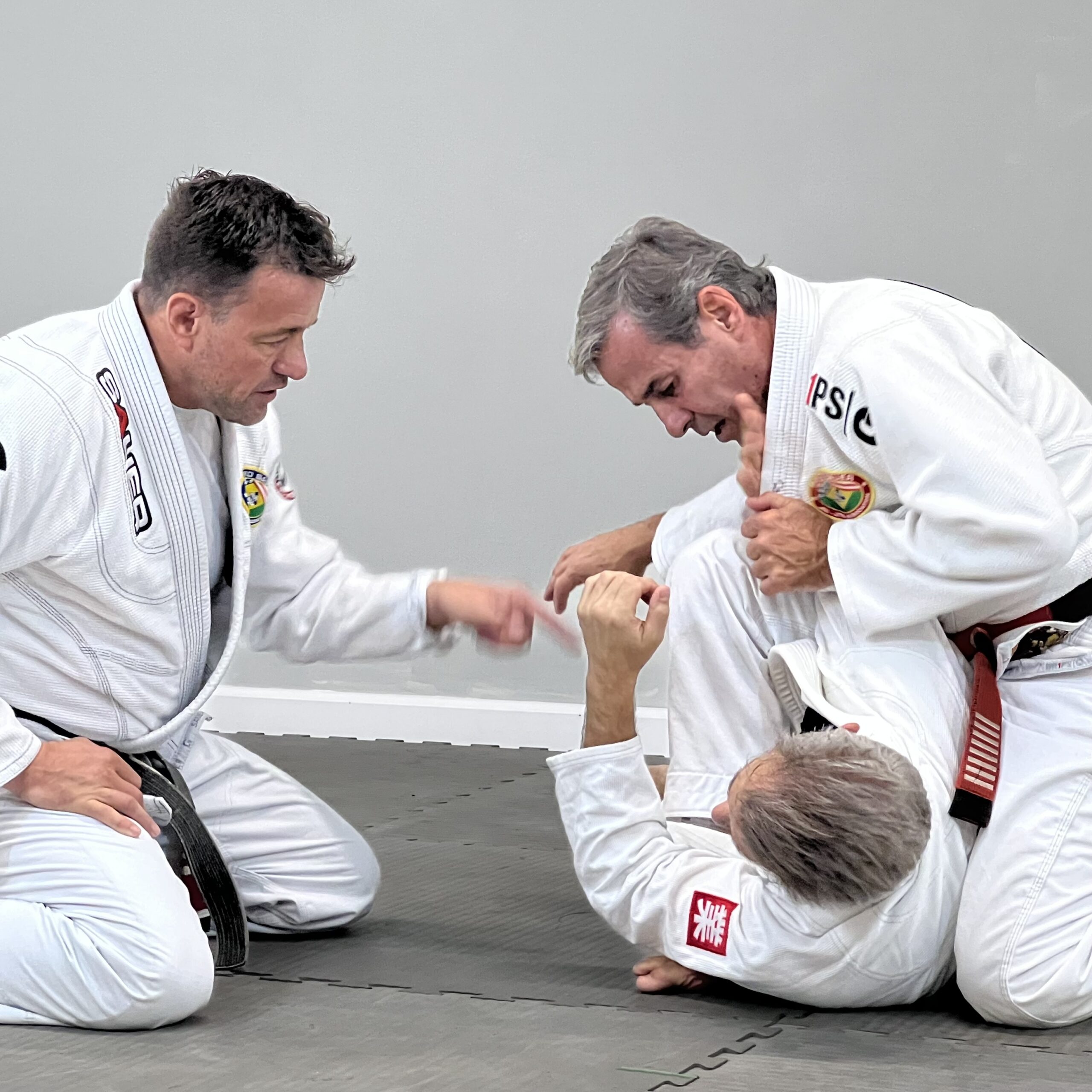
Master Pedro Sauer teaching Sifu Alan Baker. Alan has trained with Master Sauer for more than 30 years and received all of his Brazilian Jiu-Jitsu belts from white belt through fourth-degree black belt from him.
Master Pedro Sauer is one of the respected senior figures in Brazilian Jiu-Jitsu and Gracie Jiu-Jitsu. He is publicly listed as a Hélio and Rickson Gracie black belt and is known for his technical precision, self-defense orientation, and ability to explain small details that make techniques work.
For me, this is also personal. Master Sauer is my primary Brazilian Jiu-Jitsu instructor. I have been training with him for more than 30 years, and he has shaped the way I understand leverage, pressure, mechanics, self-defense, and the deeper purpose of Jiu-Jitsu.
These private lessons are part of my own continuing education. Even after decades of training, I still make the trip because the details continue to matter. Every time I go back to the fundamentals with Master Sauer, I see something with more clarity.
Key Lessons From The Private Lesson
Do Not Chase The Entry
Moving straight forward can expose you to punches. The entry should be timed, protected, and intelligent.
Make Them Step
Master Sauer shows how to draw the opponent forward so the entry happens as they give you the timing.
Control Balance First
Once inside, the goal is not just to hug. The goal is to make the opponent uncomfortable and off-balanced.
The Problem With Closing Distance
The first question in this lesson is simple: how do you get close enough to control someone without getting hit on the way in?
Master Sauer immediately points out one of the common mistakes. If your goal is to close the gap and you simply step forward toward the person, you may walk directly into the strike.
That is an important self-defense lesson. Distance is not neutral. Every step changes what weapons are available, who can hit, who can grab, who can move, and who is exposed.
A poor entry gives the opponent the strike. A better entry changes the timing.
Make The Opponent Give You The Entry
Instead of chasing forward, Master Sauer shows the idea of moving slightly back in a way that invites or draws the opponent forward.
The goal is not to retreat passively. The goal is to create a spring. You move back enough to make the opponent step, and when they step, you move with them.
That timing matters. If the opponent is still planted, they can strike, step back, or adjust. But if they are already coming forward, their ability to immediately go backward is compromised.
This is why Master Sauer says you need the cooperation of the opponent’s body coming toward you. You are not asking them to help you. You are using their movement to solve the distance problem.
The entry is not only about your movement. It is about making their movement give you the timing.
Training PrincipleIntercepting The Forearms
Once the opponent begins to come forward, Master Sauer shows how the hands move toward the shoulders and forearms.
The goal is not to reach and catch a small moving target with the hands. The goal is to intercept with the forearms and palms in a way that covers the line and prevents the strike from connecting cleanly.
This is an old school self-defense principle. The entry has to protect you while it connects you. You are not just diving into the person. You are entering with structure.
If the arms stretch toward the face, the structure is already there to intercept. If the person moves forward, the timing allows you to close the gap as their own momentum helps create the connection.
Connecting Is Not Just Hugging
After the entry, Master Sauer makes another important point: the goal is not simply to hold the person.
The goal is to connect.
That means the opponent must carry your weight. Your body must create pressure. Your legs must move with them. Your position has to make them uncomfortable.
If you only hug the person while they stay balanced, they can move their legs, regain position, strike, or counter. If you connect correctly and make them carry your weight, their options begin to disappear.
This is the difference between grabbing and controlling.
Off-Balancing The Body
Master Sauer repeatedly draws attention to the opponent’s toes, feet, and balance.
If the toes come off the ground, if the weight shifts, or if the person is forced onto their heels, they cannot move with the same confidence. Their base is compromised.
This is a major principle in Jiu-Jitsu. Control begins before the takedown. Control begins when the other person no longer feels comfortable standing.
Once the opponent is uncomfortable, they have to regain balance before they can create a meaningful counterattack. That recovery gives information. It telegraphs intention. It gives the Jiu-Jitsu practitioner something to listen to.
Capability Principle
Capability is the ability to see the problem before the technique begins.
In this lesson, the technique is not just the entry. It is the timing before the entry, the forearm interception during the entry, the connection after the entry, and the off-balancing that determines what comes next.
Master Sauer is teaching more than a movement. He is teaching how to read the body, create discomfort, listen to the reaction, and stay one step ahead.
Listening To The Reaction
One of the deeper lessons in this video is the idea that the opponent’s reaction determines the next step.
Once you connect and place the opponent in a position of disadvantage, you listen. If they move one way, that gives one answer. If their leg becomes light, that gives another. If they try to walk away, the leg is already there to collect.
This is not mechanical memorization. It is responsive Jiu-Jitsu.
Master Sauer shows how a small weight transfer can make a leg light enough to collect. From there, the takedown becomes available because the body has already given the answer.
Thinking One Step Ahead
Near the end of the lesson, Master Sauer sums it up simply: self-defense, anticipate moves, think one step ahead.
That line captures the larger value of the lesson.
This is not only about one old school entry. It is about how Jiu-Jitsu teaches a person to think. You draw the movement. You intercept. You connect. You compromise the base. You listen to the reaction. You make the next move safer before you take it.
That is the kind of thinking that separates technique collection from real understanding.
Training Relationships Matter
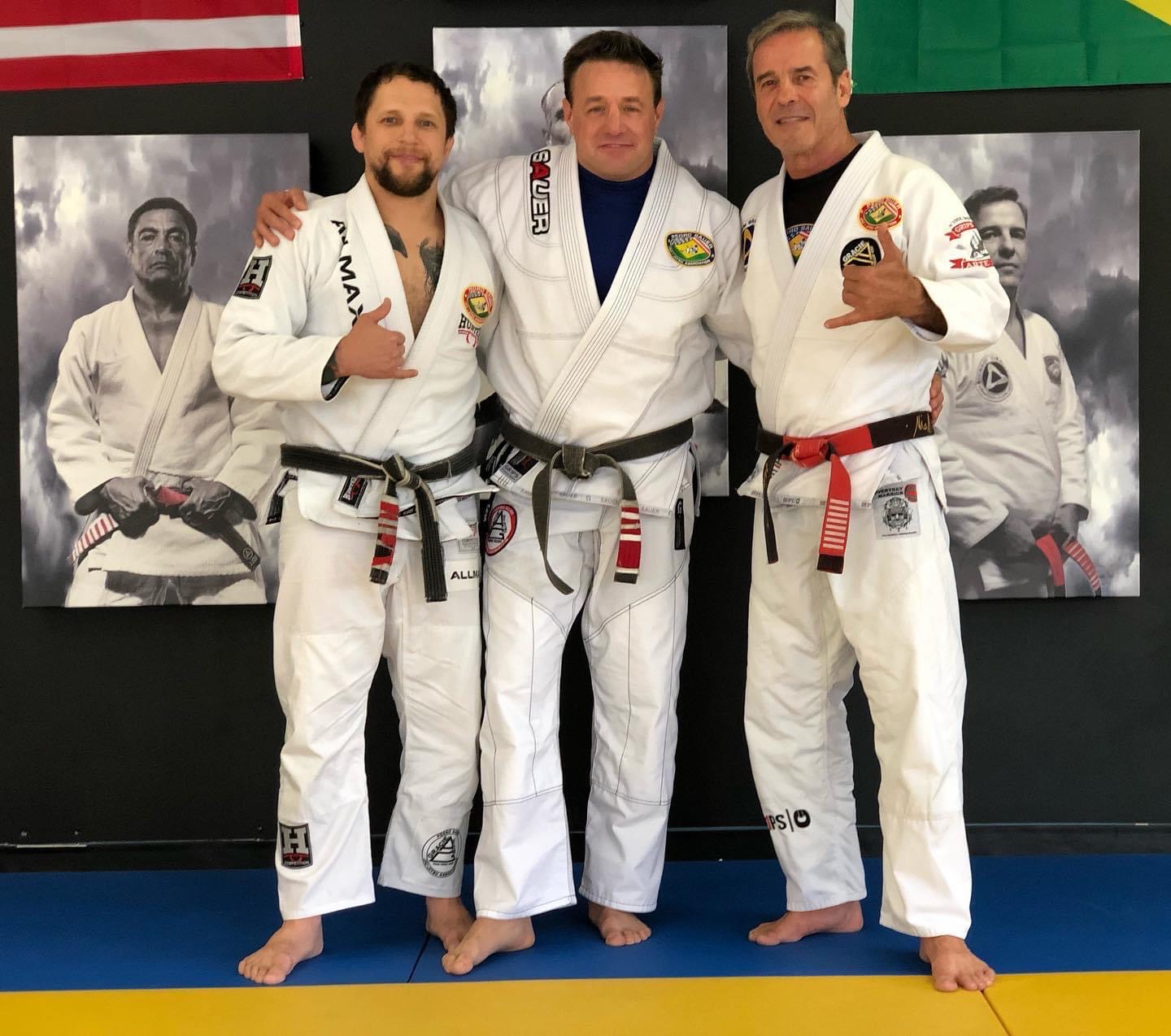
Sifu Alan Baker with Master Pedro Sauer and Jeff Curran. Long-term training relationships help preserve lineage, standards, and the deeper lessons behind the art.
One of the reasons I keep making these trips is because direct training relationships matter.
Online information is useful, but it cannot replace the moment when your teacher adjusts your body, changes the angle, corrects the pressure, and gives you the missing detail.
Master Sauer has a gift for making old material feel new again because he continues to reveal the mechanics under the movement. That is why going back to the fundamentals with him is never basic in the shallow sense.
The fundamentals are where the art keeps getting deeper.
Why This Matters Beyond The Technique
This lesson is about bridging the gap, but it is also about how to approach learning.
The serious student does not abandon fundamentals because they have seen them before. The serious student returns to them with better eyes.
Each time you revisit a principle, you may see a new layer: timing, angle, weight, base, posture, connection, reaction, or control. That is what keeps Jiu-Jitsu alive after decades of study.
The goal is not to collect more moves. The goal is to understand the art more deeply.
FAQ
Where was this lesson filmed?
This lesson was filmed in Savannah, Georgia at Savannah Gracie Jiu-Jitsu during a private lesson with Master Pedro Sauer.
What is the main lesson of this video?
The main lesson is how to bridge the gap safely without walking into a punch, then connect, off-balance, and control once inside.
Why does Master Sauer avoid chasing forward?
Chasing forward can expose you to strikes. Master Sauer shows how to draw the opponent forward and enter as their movement gives the timing.
Why is off-balancing important?
Off-balancing makes the opponent uncomfortable, limits their ability to counter, and creates opportunities for control, takedowns, and follow-up movement.
How is Master Pedro Sauer connected to Alan Baker?
Master Sauer is Alan Baker’s primary Brazilian Jiu-Jitsu instructor. Alan has trained with him for more than 30 years and received his Brazilian Jiu-Jitsu belts from white belt through fourth-degree black belt from Master Sauer.
Sifu Alan Baker
Founder of the Capability Academy
Shift Your Perspective, Take Action, And Forge Your Path To Greatness