
Legacy Academy • Brazilian Jiu-Jitsu • Master Pedro Sauer
Master Pedro Sauer On Gracie Jiu-Jitsu, Technique, Leverage, And Becoming A Better Human Being
In this lesson and interview, Master Pedro Sauer shares how he discovered Gracie Jiu-Jitsu, his early connection with Rickson Gracie, and the deeper lessons of humility, technique, leverage, respect, and character.
Video Guide
In This Video
- 00:00 Master Pedro Sauer discovers Gracie Jiu-Jitsu
- 00:52 Walking into the Gracie academy for the first time
- 02:20 Training with a young Royler Gracie
- 04:36 The gi that started the journey
- 04:42 Self-defense detail and arm control
- 05:58 The early Gracie training environment
- 07:38 Hélio Gracie and the demand for perfect technique
- 10:42 Guard passing details and avoiding half guard
- 11:59 Strength versus technical development
- 14:28 Jiu-Jitsu, character, respect, and self-control
- 17:15 Mount control and preventing the guard recovery
- 18:16 Injury prevention and trust in the academy
- 20:50 The UFC and the martial arts turning point
- 25:51 Defending punches from the bottom
- 27:55 Gratitude for the Gracie family legacy
- 31:05 Association, loyalty, and the value of lineage
Media Description
A Story About How Jiu-Jitsu Changes A Life
In this lesson and interview, Master Pedro Sauer shares the story of how he first discovered Gracie Jiu-Jitsu, his early connection with Rickson Gracie, and the unforgettable experience of walking into the Gracie academy for the first time.
What begins as a personal story quickly becomes a deeper lesson on humility, technique, leverage, respect, and the true purpose of Jiu-Jitsu.
Master Sauer talks about his first exposure to the Gracie family, the shock of experiencing Jiu-Jitsu for the first time, the early training environment, the influence of Hélio Gracie, the difference between using strength and using leverage, and why Jiu-Jitsu should help build better human beings, not just better fighters.
This video also includes technical instruction and training details that highlight the difference between simply doing Jiu-Jitsu and understanding Jiu-Jitsu.
The difference between doing Jiu-Jitsu and understanding Jiu-Jitsu is often found in the details.
Legacy Academy PrincipleMy Relationship With Master Pedro Sauer
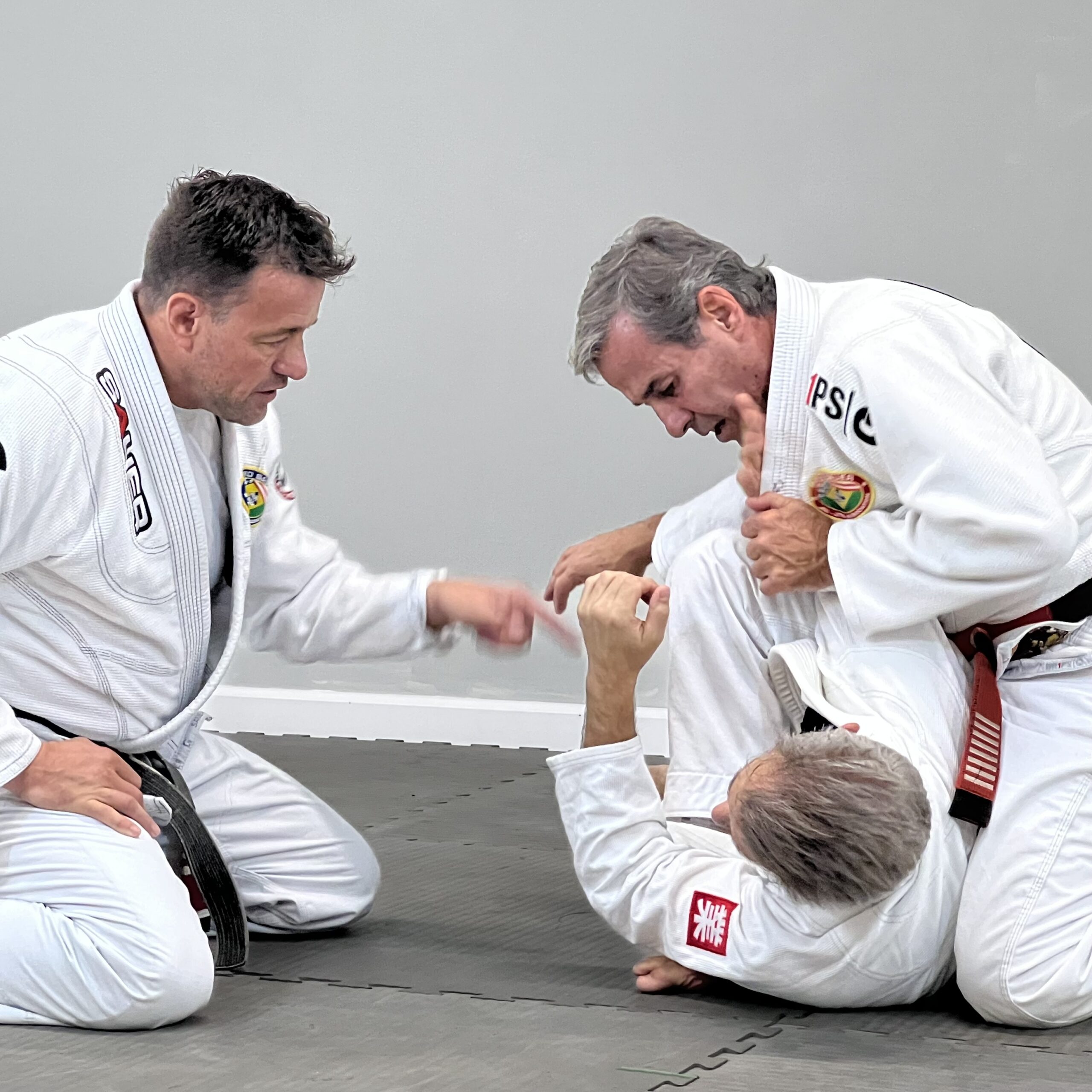
Master Pedro Sauer teaching Sifu Alan Baker. Master Sauer has been Alan’s primary Brazilian Jiu-Jitsu instructor for more than 30 years.
Master Pedro Sauer is my primary Brazilian Jiu-Jitsu instructor. I have been training with him for more than 30 years, and at the time of this article, I received all of my belts from white belt through fourth-degree black belt from Master Sauer.
That kind of relationship matters.
In martial arts, lineage is not just a name on a certificate. It is a path of transmission. It is the accumulation of lessons, corrections, private conversations, training experiences, shared history, and the gradual shaping of how a student sees the art.
This is one of the reasons I value conversations like this. They preserve more than technique. They preserve the thinking, the stories, the humor, the standards, and the human connection behind the art.
Who Is Master Pedro Sauer?
Master Pedro Sauer is one of the respected senior figures in Brazilian Jiu-Jitsu and Gracie Jiu-Jitsu. He is publicly listed among high-graded Brazilian Jiu-Jitsu practitioners and is widely known as a black belt under Hélio and Rickson Gracie.
His teaching has influenced students, instructors, academies, law enforcement personnel, martial artists, and self-defense practitioners around the world. He is known not only for technical precision, but for the way he communicates the deeper purpose of the art.
In this interview, that purpose comes through clearly. Master Sauer does not present Jiu-Jitsu as a way to dominate people. He presents it as a method for developing confidence, character, respect, discipline, self-control, and technical understanding.
That is why his voice belongs inside the Legacy Academy. His stories and lessons help preserve the older spirit of Jiu-Jitsu as an art of self-defense, leverage, refinement, and human development.
Key Lessons From The Interview
Technique Must Be Understood
Master Sauer shows how small details change whether a movement is merely performed or truly understood.
Leverage Beats Panic
Strength has value, but Jiu-Jitsu teaches how to apply strength through mechanics, timing, and leverage.
Respect Builds The Academy
The training room should develop trust, character, discipline, and better human beings.
The First Lesson: Humility
Master Sauer begins by describing how he first came into contact with Rickson Gracie and the Gracie academy. At the time, he had martial arts experience, boxing experience, and confidence in his ability to handle himself.
Then he experienced Jiu-Jitsu.
His story of being handled by a much younger Royler Gracie is funny, memorable, and deeply important. It shows one of the first gifts Jiu-Jitsu gives to the serious student: humility.
Many people enter martial arts with ideas about strength, toughness, athleticism, or fighting ability. Jiu-Jitsu has a way of revealing the truth very quickly. It shows what works, what does not work, and how little the body understands when leverage, position, and timing are missing.
That kind of humility is not meant to break the student. It is meant to open the door to learning.
The Details Make The Technique
One of the technical lessons in the video shows the difference between lifting an arm and truly understanding how to control the elbow, build base, step, use the body, and create leverage.
Master Sauer makes the point clearly: there is a difference between doing Jiu-Jitsu with technique and just doing Jiu-Jitsu.
That is a major lesson for every student.
It is possible to imitate the outside shape of a movement without understanding the mechanics that make it work. The student may move the arm, step to the side, or go to the back, but if the elbow, hip, base, posture, and timing are wrong, the technique is missing its engine.
The older I get in martial arts, the more I value these kinds of details. They are not decorations. They are the art.
Details are not small when they are the thing that makes the technique work.
Training PrincipleHélio Gracie And The Demand For Precision
Master Sauer also shares stories about training around Hélio Gracie.
The picture that comes through is one of precision, intensity, and uncompromising attention to detail. If the movement was correct, Hélio could acknowledge it. If the movement was slightly wrong, he corrected it immediately.
That standard matters because technical Jiu-Jitsu depends on precision. The art was designed to allow a smaller or weaker person to survive, control, escape, and submit through mechanics and leverage. If the mechanics are sloppy, the art becomes dependent on strength.
This is why Master Sauer emphasizes the technical aspect so strongly. If the student only learns to fight harder, they may improve quickly for a short time, but they also risk injury, exhaustion, and decline. If the student learns the mechanics, the art becomes something they can carry longer.
Strength, Leverage, And The Price Of Poor Training
One of the most important sections of the interview is Master Sauer’s discussion of strength versus technical development.
Strength is not bad. Athleticism is not bad. Conditioning is not bad. But if the student relies only on strength, they are bringing to the academy what they already had before they walked in.
The academy should send the student home with something more.
Master Sauer explains that the student should leave with muscle plus technique, not just the same muscle they arrived with. That is a powerful way to describe the purpose of training.
If two people train with intensity but without education, eventually someone gets hurt. If students are taught mechanics, leverage, patience, and control, they can train longer, explore more, and develop trust in the academy.
That is one of the reasons the teaching environment matters as much as the curriculum.
Trust Is A Training Tool
Master Sauer discusses the importance of dealing with students who go too hard and injure training partners.
This is more than a discipline issue. It is an educational issue.
If students cannot trust each other, they cannot explore the art properly. They will not test escapes honestly. They will not allow themselves to enter difficult positions. They will become defensive, tense, and fearful of injury.
Trust allows learning.
When a partner applies an armbar with control, the other student can study the escape. When a partner trains with responsibility, the academy becomes a place where people can grow rather than simply survive each round.
This is one of the hidden foundations of a good martial arts school: the teacher must build a culture where intensity and care can coexist.
Legacy Academy Principle
A true martial arts academy does not only produce better fighters. It should produce better human beings.
Master Sauer returns to this idea throughout the conversation. Jiu-Jitsu should develop confidence, character, integrity, respect, discipline, self-control, and the ability to treat others well.
The real test of respect is not whether you respect the person who can beat you. The deeper test is whether you respect the person who cannot.
That lesson belongs at the center of martial arts education.
Jiu-Jitsu And The Larger Martial Arts World
Master Sauer also talks about the UFC and the way Jiu-Jitsu changed the martial arts landscape.
The early UFC events forced martial artists to confront questions that had been debated for years. What happens when styles meet? What happens when the fight goes to the ground? What happens when theory meets resistance?
But Master Sauer does not use that history to disrespect other arts. In fact, he speaks with respect for karate, taekwondo, kung fu, aikido, and other martial arts.
That is an important point. Jiu-Jitsu does not have to be used as a weapon against other arts. It can be an addition. It can help complete a martial artist’s education. It can give stand-up systems a ground, clinch, and control component without taking away their identity.
The key is humility on both sides. The Jiu-Jitsu instructor must respect the existing art, and the academy must be willing to learn what Jiu-Jitsu can add.
Understanding Jiu-Jitsu From The Bottom
Later in the video, Master Sauer teaches a bottom-position lesson for dealing with punches from the mount.
His instruction is simple but important: do not reach up and try to stop the punches with your arms in a way that allows the opponent to climb higher and take away your bridge.
Instead, the student has to understand position, control, elbow placement, trapping, bridging, and timing. The goal is not to panic. The goal is to survive intelligently and use the body mechanics that Jiu-Jitsu gives you.
This is one of the reasons Jiu-Jitsu is so valuable as a self-defense art. It teaches the student what to do when things are already bad. It gives them a way to think, protect, survive, and improve position.
Preserving Stories, Lineage, And Lessons
At the Legacy Academy, we preserve important lessons, stories, and training material from instructors who helped shape the martial arts landscape.
These conversations and lessons are not just about technique. They are about lineage, perspective, teaching, character, and the continued study of martial arts as a path of development.
Master Pedro Sauer’s voice is important because he carries a living connection to the Gracie academy, Hélio Gracie, Rickson Gracie, the early days of Jiu-Jitsu in America, and the long-term evolution of the art.
For me personally, this is more than historical material. It is part of my own path. Master Sauer has shaped my Jiu-Jitsu from the beginning, and his teaching continues to influence the way I think about martial arts, instruction, humility, and capability.
FAQ
Who is Master Pedro Sauer?
Master Pedro Sauer is a respected senior Brazilian Jiu-Jitsu instructor and Gracie Jiu-Jitsu black belt under Hélio and Rickson Gracie.
What is this video about?
This video combines interview, history, and technical instruction. Master Sauer shares how he discovered Gracie Jiu-Jitsu, discusses the early training environment, and teaches details about leverage, guard passing, mount control, and self-defense.
Why does Master Sauer emphasize technique over strength?
He explains that strength without education can lead to injury, panic, and short-term progress. Technical Jiu-Jitsu teaches the student how to use leverage, mechanics, and timing intelligently.
How is Master Sauer connected to Alan Baker?
Master Sauer is Alan Baker’s primary Brazilian Jiu-Jitsu instructor. Alan has trained with him for more than 30 years and received all of his belts from white belt through fourth-degree black belt from Master Sauer.
How does this connect to the Legacy Academy?
The Legacy Academy preserves important martial arts stories, lessons, and teaching material from instructors who helped shape the martial arts world. This video preserves both technical knowledge and the deeper philosophy behind Jiu-Jitsu.
Sifu Alan Baker
Founder of the Capability Academy
Shift Your Perspective, Take Action, And Forge Your Path To Greatness